
Calibration Method of Gas Sensor: Practical Guide
Gas sensors are widely used in industrial safety systems to monitor the concentrations of combustible gas, toxic gas and oxygen. With the increase of service time, the sensor may be affected by factors such as aging, pollution, humidity, temperature change or high concentration gas exposure, resulting in the measurement reading drifting. Regular calibration helps to maintain the measurement accuracy and ensure the reliable operation of gas detection equipment.
Understanding the common calibration methods of gas sensors is helpful for industrial enterprises to establish effective equipment maintenance plans.
Why Is Gas Sensor Calibration Important?
Even if the sensor performance has changed, the gas detector may still display the reading normally. Without proper calibration, the gas concentration displayed by the equipment may deviate from the actual concentration.
Regular calibration helps to verify the measurement accuracy of the sensor, find performance problems in time, and reduce the risk caused by unreliable measurement results. This is especially important for chemical plants, oil and gas facilities, sewage treatment plants and confined space working environments.
Zero Calibration: Establishing Measurement Datum
Zero calibration is used to establish the reference standard of the sensor under known conditions. Depending on the type of sensor, it may be necessary to use clean air or designated zero gas for calibration.
Before calibration, it should be confirmed that the site environment meets the requirements and there is no target gas interference. The ambient air of industrial site cannot be directly regarded as clean air without target gas.
Follow the manufacturer’s instructions, wait for the reading of the detector to be stable, and complete the zero adjustment through the calibration menu of the equipment.
If the reading is still unstable, check whether the sensor is polluted, whether environmental factors interfere, or whether the sensor is aging.
For specific operation methods, please refer to HIREP’s article: Zero Calibration Guide for Portable Four-in-One Gas Detector.
Range Calibration: Using Standard Gas
Range calibration is to verify and adjust the response of the sensor by using standard gas with known concentration. By this method, it can be checked whether the measurement of the target gas by the detector meets the requirements.
The general operation process includes connecting the appropriate calibration adapter, introducing standard gas according to the specified flow rate, and inputting the gas concentration marked on the gas bottle label when the equipment is required. After the reading is stable, complete the calibration operation.
Make sure that the standard gas matches the type of sensor. Incorrect gas concentration, inappropriate flow rate or wrong parameter setting may affect the calibration results.
For more operating instructions, please refer to HIREP’s article: Guide to Gas Calibration Setting of Portable Four-in-One Gas Detector.
Functional Test: Check Sensor Response
Bump Test is a kind of equipment function check, which is not equivalent to complete calibration. During the test, the test gas is introduced to confirm whether the detector can respond normally and whether the functions such as acousto-optic alarm and vibration alarm are normal.
If the detector fails to pass the function test, its use in safety-critical scenarios should be suspended until the problem is identified and solved.
It should be noted that the function test cannot prove the accuracy of measuring concentration, so it cannot directly replace calibration.
Calibration of Portable and Fixed Gas Detectors
Different types of gas detectors have different calibration methods due to equipment structure and sensor technology.
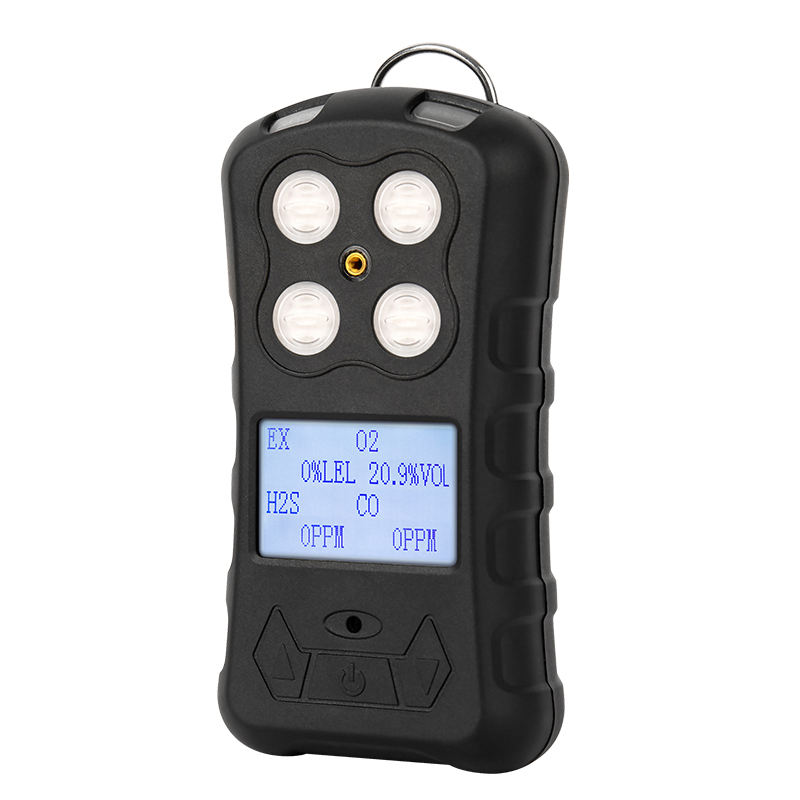
Portable gas detectors are usually used for personal protection, routine inspection and confined space operations. The four-in-one gas detector can be used to monitor combustible gas, oxygen, carbon monoxide and hydrogen sulfide. Each sensor channel should be maintained and calibrated according to its specific requirements.
For more product information, please visit HIREP HRP-B1000-C Portable Four-in-One Gas Detector.
Stationary gas detectors are usually installed near pipelines, valves, storage tanks and production equipment for continuous monitoring of gas concentration. Daily maintenance may include sensor calibration, functional testing, sensor air inlet inspection, and signal transmission status verification.
For more maintenance information, please read HIREP’s article: Operation and Maintenance Guide of Fixed Digital Gas Detector.
Common Calibration Problems
Calibration failure may be related to incorrect standard gas, unstable gas flow, leakage at the joint, sensor pollution or aging. Environmental conditions may also affect the measurement results.
If the calibration still fails for many times, the reason should be found out first, instead of repeatedly adjusting the equipment. Damaged sensors may need to be replaced or professionally repaired.
How Often Is the Gas Sensor Calibrated?
The calibration period of gas sensor depends on the sensor type, use environment, frequency of equipment use, manufacturer’s suggestion and site safety management requirements. Testers used in harsh environments may need to be checked more frequently.
It is recommended to record the date of each calibration, standard gas concentration, test results and sensor replacement. Through regular calibration, functional testing and standard maintenance, it can help the gas detection equipment to maintain a reliable working state.


 WhatsApp: 8619339980364
 E-mail: contact@hirepsafety.com
