
Fixed Digital Gas Detector Operation and Maintenance Guide
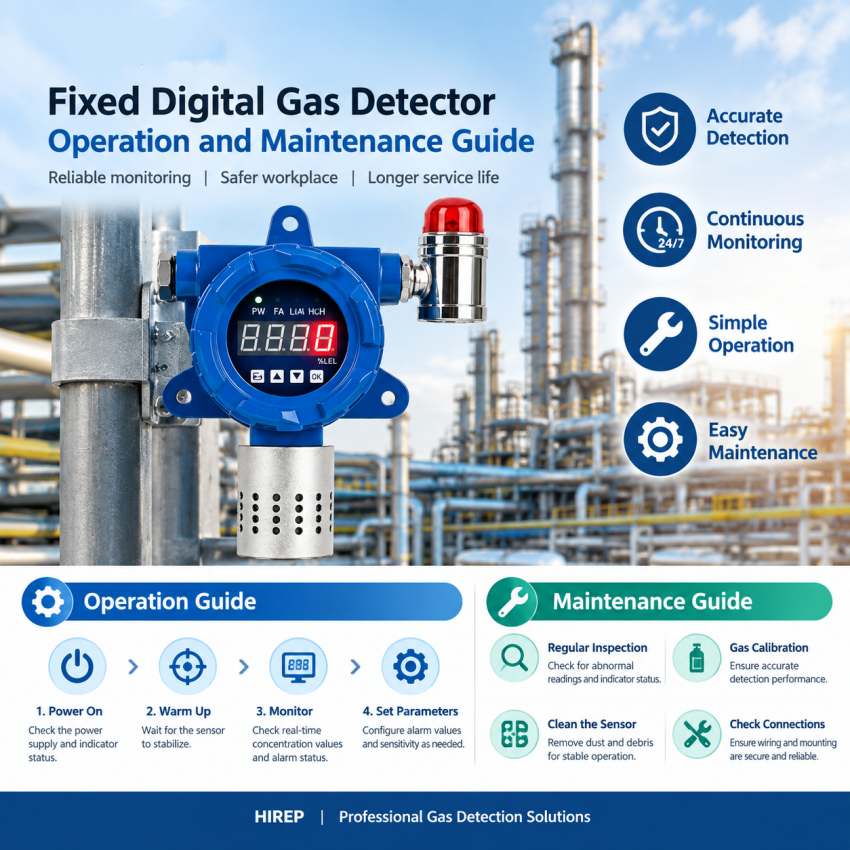
The fixed digital gas detector is mainly used to continuously monitor the gas concentration in industrial and commercial environments, especially in places where there is a risk of gas leakage. Through the clear digital display screen, the staff can directly check the current gas concentration at the site and take timely measures when abnormal readings appear.
Stationary gas detectors are widely used in chemical plants, oil and gas facilities, industrial workshops, storage areas, sewage treatment plants and other places where gas safety needs to be monitored, and can be used to detect combustible gases, oxygen and toxic gases.
How does the fixed digital gas detector work?
The fixed gas detector detects the change of target gas concentration through the gas sensor. The sensor converts the gas concentration into an electrical signal, which is processed internally by the detector and displayed on the digital display screen.
Under normal working conditions, the display screen will display the currently detected gas concentration in real time. According to different models, the detector can also provide 4–20ma, RS485, relay and other output signals, which are used to connect with gas alarm controller or industrial monitoring system.
When the detected gas concentration reaches the preset alarm value, the detector can start the alarm function to remind the staff to pay attention to the potential gas danger.
How to view the digital display?
Digital display screen is an important part of fixed gas detector. Workers can directly view the current test data without connecting other equipment.
Depending on the type of gas to be detected, the display may show:
- %LEL: used to display the concentration of combustible gas.
- %VOL: used to show oxygen concentration.
- Ppm: used to show the concentration of toxic gas.
- Current gas concentration and detection status
- Alarm or fault prompt
The specific display mode and measurement unit depend on the sensor type and the configuration of the detector.
High and low alarm value setting
Most fixed digital gas detectors support multiple alarm levels. Users can set low alarm value and high alarm value according to target gas, actual application environment and site safety requirements.
For example, when the gas concentration reaches the low alarm value, the detector can start the first alarm; If the concentration continues to increase and reaches the high alarm value, a higher alarm level can be started.
When setting the alarm value, the characteristics of the target gas and the actual working environment should be fully considered. Without fully understanding the equipment and application requirements, it is not recommended to modify the alarm threshold at will.
Zero calibration
Zero calibration is used to adjust the reference reading of the detector under the appropriate zero condition.
Before zero calibration, ensure that the detector is in a satisfactory environment and wait for the sensor reading to be stable. The specific calibration method should be carried out according to the operating instructions provided by the equipment manufacturer, and it is not recommended to adjust the zero parameter at will.
Regular zero-point inspection can help users find changes in sensor performance in time and maintain a stable detection effect.
Gas calibration
Gas calibration, also known as range calibration or Span Calibration, usually uses standard gas with known concentration to check and adjust the response of detector.
A typical gas calibration process includes:
- Prepare standard gas that meets the requirements.
- Connect the standard gas to the calibration interface of the detector.
- Introduce standard gas according to equipment requirements.
- Enter the gas calibration menu.
- Set the calibration concentration according to the actual concentration on the standard gas cylinder.
- Wait for the reading to stabilize.
- Complete the calibration according to the operating instructions of the detector.
- Stop ventilation, and make the detector return to normal monitoring state.
The specific calibration period depends on the sensor type, use environment, manufacturer’s suggestion and site safety management requirements.
RS485 communication address setting
In applications that need to use multiple fixed gas detectors, multiple detection devices can be connected to the same monitoring system through RS485 communication.
Usually, each detector needs to set an independent communication address. Before connecting multiple devices to the same RS485 communication network, ensure that different devices do not use duplicate communication addresses.
After installation, it is recommended to record the communication address of each detector to facilitate subsequent equipment management and maintenance.
Daily inspection and maintenance
Regular inspection is very important to keep the stationary gas detector running stably.
Staff can regularly check:
- Does the digital display screen work normally?
- Is the gas concentration reading stable?
- Is the alarm indicator normal?
- Is the sensor air inlet blocked?
- Is there any damage to the equipment shell?
- Are cables and terminals secure?
- Does the tester need to be calibrated?
- Has the site environment changed?
Dust, water vapor, corrosive substances and mechanical damage may affect the performance of the detector. Therefore, sensors and equipment housings should be properly cleaned and protected according to the actual installation environment.
What should I do when the detector gives an alarm?
When the fixed gas detector gives an alarm, the alarm information should be taken seriously and handled according to the safety emergency procedures formulated on site.
First, check the gas concentration on the digital display screen, and confirm the currently detected gas type. If it is suspected that there is real gas leakage at the site, safety measures should be taken according to the actual situation, such as evacuating to a safe area in time, strengthening ventilation when safety conditions permit, and taking measures to isolate the gas source.
Don’t simply turn off or ignore the alarm just because it affects normal work. If the on-site danger has been eliminated, but the detector continues to alarm, the equipment, sensors and the on-site environment should be further inspected.


 WhatsApp: 8619339980364
 E-mail: contact@hirepsafety.com