
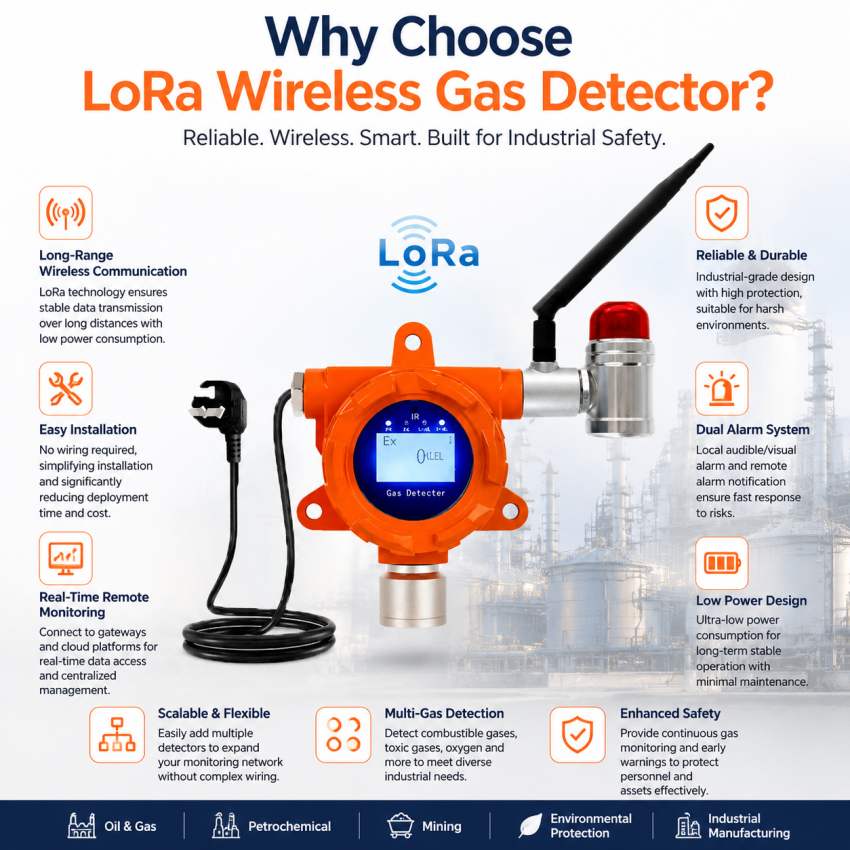
Why Choose LoRa Wireless Gas Detector?
Based on the experience of gas monitoring projects in oil and gas, petrochemical industry, mines, large industrial plants and other scenes
This paper deeply analyzes the core value and application advantages of LoRa wireless gas detection technology in view of the practical application pain points of industrial distributed gas monitoring system. With the development of large-scale modern industrial devices, complicated layout and diversified operation scenarios, the limitations of traditional wired gas monitoring schemes are increasingly prominent, and LoRa wireless gas detection technology has become the mainstream preferred scheme for industrial safety gas monitoring with its core characteristics of flexible deployment, strong expansibility and low comprehensive cost.
First, the core reason why industrial scenes need wireless gas monitoring scheme urgently
In the large-scale industrial production scene, the traditional wired gas detection system has been applied for a long time, and its inherent shortcomings can no longer meet the needs of modern safety production management. The main pain points are concentrated in four aspects:
- First, the construction is difficult and the construction cost is high
- Second, the scene adaptability is poor
- Third, the system is not extensible enough
- Fourth, the cost of renovation downtime is high
The above problems will directly lead to the hidden dangers of industrial gas monitoring, such as blind spots, lagging response, complicated operation and maintenance, etc. LoRa wireless gas detection technology completely gets rid of the constraints of wired wiring, accurately solves the industrial pain points of traditional solutions, and provides a lightweight and efficient landing path for industrial gas safety monitoring.
Second, the operating principle of LoRa technology in industrial gas monitoring
LoRa is a mature low-power WAN communication technology. Its core features are long transmission distance, low power consumption and strong anti-interference ability. It is perfectly suitable for industrial outdoor, large-scale and long-term online monitoring scenarios.
In the industrial gas monitoring system, LoRa technology is mainly responsible for the core data transmission:
- Real-time gas concentration data collected by each on-site gas detection node
- Transmitted to the on-site gateway equipment through LoRa wireless signals
- Data collected and analyzed by the gateway
- Uploaded to PLC / SCADA / IoT cloud platform
The wireless networking architecture completely replaces the traditional wired transmission mode, simplifies the system architecture and greatly improves the flexibility and adaptability of the gas monitoring system.
Third, the core industrial application advantages of LoRa wireless gas detector
3.1 Streamline the construction process and greatly reduce the comprehensive construction cost
Traditional wired systems require cable laying, explosion-proof construction and debugging.
LoRa wireless gas detector does not need wiring, digging or pipeline construction, enabling:
- Fast installation
- Short construction period
- Lower labor cost
- Reduced safety risks
3.2 Adapting to large-scale and distributed industrial monitoring scenarios
LoRa supports wide-area networking:
- One gateway supports dozens or hundreds of nodes
- Suitable for oil & gas pipelines, chemical parks, mines
- Achieves full coverage monitoring
3.3 Support remote real-time monitoring to improve safety management efficiency
The system supports integration with SCADA, PLC and IoT platforms:
- 24-hour real-time data upload
- Visual monitoring dashboard
- Alarm notification (sound/light, pop-up, message push)
- Historical data storage and analysis
3.4 Break through the scene restrictions and adapt to special areas where wiring is difficult
Suitable for:
- Overhead pipelines
- Confined spaces
- Remote tank areas
- Temporary construction zones
No wiring required, fast deployment.
3.5 Simple operation and maintenance, and lower long-term use cost
Compared with wired systems:
- No cable aging or breakage issues
- Reduced inspection workload
- Lower maintenance cost
- Longer battery life design
3.6 Strong anti-interference, suitable for complex industrial conditions
LoRa technology provides:
- Stable transmission in harsh environments
- Low packet loss rate
- Reliable data continuity
3.7 Flexible networking, which can be expanded and upgraded as needed
System advantages:
- No rewiring required for expansion
- Easy addition of new nodes
- Supports phased deployment upgrades
Fourth, the core industrial application scenarios
LoRa wireless gas detector is widely used in:
- Oil and gas industry
- Petrochemical industry
- Mining industry
- Environmental protection solid waste field
- Industrial manufacturing industry
- Smart park field
Five, the project landing actual combat summary
Traditional wired systems often face:
- Frequent signal interruption
- Monitoring blind spots
- Delayed alarm response
- High maintenance cost
LoRa wireless system solves these problems by:
- Eliminating wiring dependency
- Achieving full-area coverage
- Simplifying system architecture
- Reducing maintenance pressure
VI. Key Points for Attention in System Design Landing
Key design considerations:
- Rational planning of gateway installation points
- Use of IP65 or higher protection equipment
- Proper sensor selection based on gas type
- Regular calibration and maintenance
VII. Summary
LoRa wireless gas detector combines wireless communication and gas sensing technology, providing a solution that is:
- Low cost
- High efficiency
- High flexibility
- High reliability
It supports both new industrial projects and upgrades of existing wired systems, making it a highly practical solution in industrial gas safety monitoring.


 WhatsApp: 8619339980364
 E-mail: contact@hirepsafety.com