
What is a 4G wireless fixed gas detector?
introduction
With the continuous expansion of industrial facilities, continuous improvement of automation and increasingly dispersed working areas, the traditional wired gas detection system is facing more and more challenges in remote monitoring, complex wiring and installation cost. In order to solve these problems, more and more enterprises begin to adopt 4G wireless fixed gas detector to realize more flexible and intelligent real-time gas monitoring.
4G wireless fixed gas detector combines traditional gas sensing technology with cellular communication technology, and can transmit gas concentration data and alarm information to cloud platform, control center or mobile terminal in real time without complicated wiring, so as to realize remote centralized management.
This paper will introduce in detail what a 4G wireless fixed gas detector is, its working principle, core advantages and typical application scenarios.
What is a 4G wireless fixed gas detector?
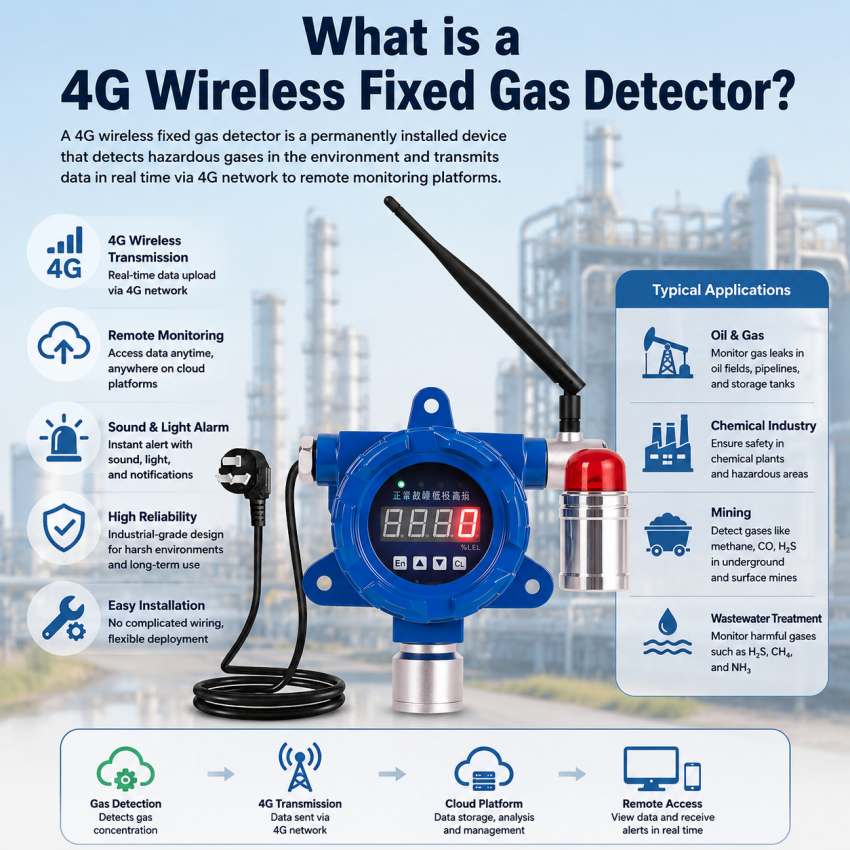
The 4G wireless fixed gas detector is an industrial gas monitoring device installed in a fixed position with a built-in 4G communication module. It can continuously detect the concentration of specific gases in industrial environment and transmit real-time data to remote monitoring system through 4G mobile network.
Different from the traditional fixed detector that needs to lay communication cables, 4G wireless devices can run independently and communicate directly with cloud servers or industrial management platforms.
Its monitorable gases include:
- Combustible gas (methane, propane, hydrogen, liquefied petroleum gas, etc.)
- Toxic and harmful gases (carbon monoxide, hydrogen sulfide, ammonia gas, chlorine gas, etc.)
- Oxygen concentration
- Volatile organic compounds (VOC)
With the help of 4G communication technology, managers can grasp the gas safety situation in real time no matter where they are, as long as there is network coverage.
Working principle of 4G wireless fixed gas detector
The 4G wireless fixed gas detector mainly consists of the following core parts:
Gas sensor module
The sensor continuously detects the gas concentration in the environment, and different gases adopt different detection technologies, such as:
- Electrochemical sensor: used to detect toxic gases.
- Catalytic combustion sensor: used to detect combustible gas.
- Infrared (NDIR) sensor: used to detect hydrocarbon gas and carbon dioxide.
- PID photoionization sensor: used to detect VOC gas
Signal processing unit
The internal control system of the equipment converts the output signal of the sensor into digital data and compares it with the preset alarm value.
When the concentration is abnormal, the system immediately starts the alarm mechanism.
4G communication module
The built-in 4G module sends data to:
- Cloud monitoring platform
- central control room
- supervisory control and data acquisition
- Mobile app
- Remote operation and maintenance center
Realize real-time remote monitoring.
Alarm system
When the concentration of dangerous gas exceeds the standard, the equipment can automatically trigger:
- Acousto-optic alarm
- Mobile phone SMS notification
- APP push reminder
- Remote linkage control
- Emergency stop system
Help enterprises to respond quickly to leakage accidents and reduce security risks.
Main advantages of 4G wireless fixed gas detector
1. Reduce the installation cost
Traditional wired systems usually require:
- telecommunication cable
- Signal line
- cable bridge
- piping installation
- Mass manual installation
The wireless scheme can greatly reduce the wiring work and reduce the overall project cost.
Especially suitable for:
- Large industrial park
- Temporary construction project
- Remote area facilities
- Later expansion project
2. Realize remote real-time monitoring.
One of the biggest advantages of 4G technology is the ability of remote data access.
Security managers can view in real time through mobile phones, tablets or computers:
- Gas concentration data
- Alarm record
- Equipment operation state
- Historical trend analysis
- Maintenance information
So as to improve management efficiency and accident response speed.
3. More flexible installation and deployment
For some areas with difficult wiring or high cost, 4G wireless fixed gas detector has obvious advantages, such as:
- Oil fields and natural gas pipelines
- Mining area
- Chemical storage tank area
- Sewage treatment plant
- Temporary construction site
System deployment and expansion can be completed quickly without complicated communication lines.
4. Support centralized management of cloud platform
Modern 4G wireless gas detection systems usually support cloud platform management functions, including:
- Centralized monitoring of multiple sites
- Data visualization display
- Automatically generate safety reports
- Long-term storage of historical data
- Predictive maintenance analysis
- Unified management of multiple factories
These functions are helpful for enterprises to promote industrial digitalization and intelligent safety management.
Typical application fields of 4G wireless fixed gas detector
Oil and gas industry
Oil fields and natural gas pipelines are usually widely distributed, and the construction cost of traditional wired monitoring system is high.
4G wireless detector can be used to monitor:
- Methane leakage
- Hydrogen sulfide concentration
- Storage tank safety
- Remote wellhead equipment
Help enterprises reduce environmental and safety risks.
Chemical manufacturing industry
Chemical enterprises need to continuously monitor all kinds of toxic and combustible gases.
Wireless gas detection system can improve:
- Safety level of production area
- Emergency response efficiency
- Regulatory compliance ability
- Centralized safety management capability
At the same time, it is convenient for subsequent factory expansion and system upgrade.
Mining industry
The mine environment is complex, and there is a high demand for flexible gas monitoring equipment.
4G wireless fixed detector can be used to detect:
- methane
- carbon monoxide
- Oxygen content
- hydrogen sulfide
Realize remote management, reduce the workload of manual inspection and improve the safety guarantee level of miners.
Sewage treatment industry
Hazardous gases are often produced during sewage treatment, such as:
- Hydrogen sulfide (hs)
- Methane (ch)
- Ammonia gas (NH)
The wireless monitoring system can cover a large factory area and reduce the difficulty of installation and maintenance.
How to choose 4G wireless fixed gas detector?
When purchasing, enterprises should focus on the following aspects:
sensor technology
Different gases need to match different detection principles, and only by selecting appropriate sensors can the detection accuracy and long-term stability be guaranteed.
Network compatibility
It is necessary to confirm that the equipment supports the local operator’s 4G frequency band to ensure stable and reliable communication.
Environmental protection ability
Industrial environment usually requires equipment to have:
- IP66 or IP67 protection level
- explosion proof certification
- resistant material
- Wide temperature working ability
Cloud platform compatibility
Modern enterprises prefer products that support the following functions:
- SCADA system access
- Modbus communication protocol
- Cloud monitoring platform
- Mobile APP management
- Remote diagnosis and maintenance
Maintenance convenience
Equipment with automatic diagnosis and remote calibration reminder function can reduce maintenance cost and improve system reliability.
Development trend of wireless gas detection technology
With the development of Industry 4.0 and intelligent manufacturing, wireless gas detection system is evolving towards more intelligent direction.
Possible future development trends include:
- AI predictive maintenance
- Edge computing technology
- 5G communication application
- Digital twin system integration
- Big data security analysis
However, from the current industrial application, 4G technology is still one of the most mature, stable, extensive and reasonable wireless communication solutions.
conclusion
4G wireless fixed gas detector combines mature gas detection technology with modern mobile communication technology, providing more flexible, efficient and economical safety monitoring solutions for industrial enterprises.
By real-time remote monitoring, reducing wiring costs and supporting centralized management in the cloud, such devices can help enterprises improve production safety, reduce operational risks and promote industrial digital transformation.
For large industrial parks, remote working areas and projects that need rapid deployment, 4G wireless gas detection technology has become an indispensable part of modern industrial safety system.


 WhatsApp: 8619339980364
 E-mail: contact@hirepsafety.com