
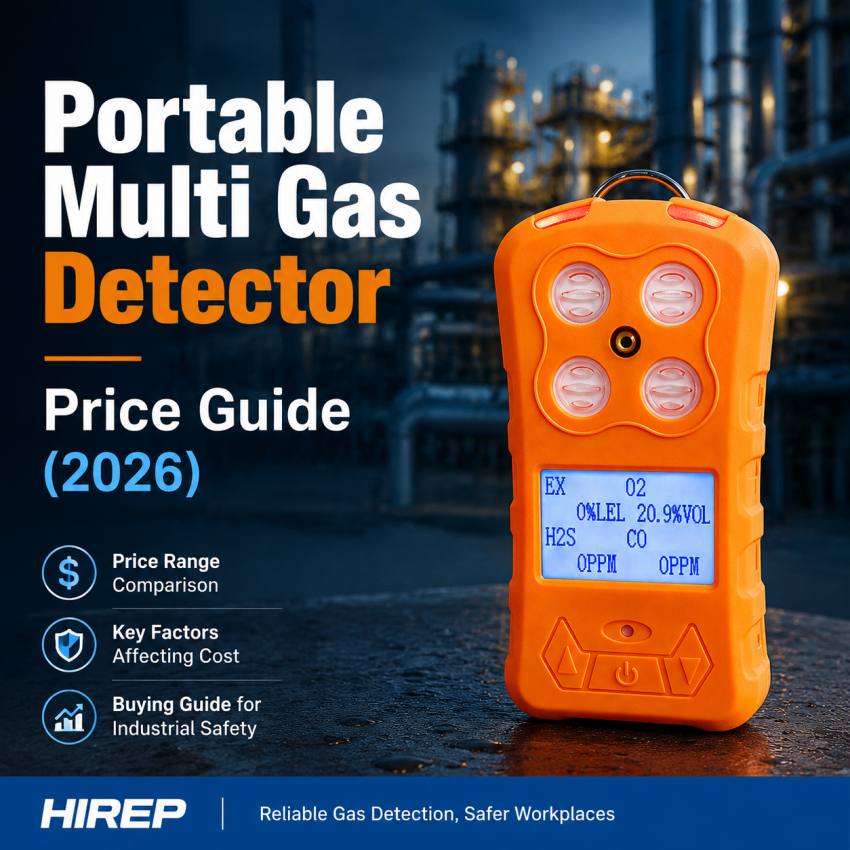
Portable Multi Gas Detector Price Guide (2026)
In the field of industrial safety management, portable multi-gas detector has become the standard equipment before people enter the high-risk working environment.
Whether it is petrochemical maintenance, confined space operation, mining, sewage treatment or emergency rescue scenes, the core role of such instruments is always the same: identify the hidden dangers of dangerous gases in advance and prevent safety accidents.
When enterprises actually purchase, they often encounter a very realistic problem: the appearance and function of detectors seem to be almost the same, but the price is very different. What is the reason behind it?
Combined with years of application experience of industrial gas detection by Hirep, the price difference of market products is mainly determined by three core dimensions: detection performance, sensor specifications and industrial compliance certification qualification.
First, the mainstream price range of portable multi-gas detector
1. Basic entry fund ($120–300): basic protection type.
This kind of products are mostly used in low-risk working environment or auxiliary detection scenarios.
General configuration:
- Oxygen/carbon monoxide/hydrogen sulfide basic three-gas detection
- Acousto-optic alarm prompt
- Simple operation interface
- Basic sensor module
Applicable scenarios:
- Daily routine inspection
- Auxiliary gas detection in non-high risk areas
- Temporary site safety monitoring
This kind of instrument can only meet the basic use requirements and is not suitable for long-term use as the main safety equipment in high-risk industrial scenes.
2. Industrial mainstream model ($300–800): the main model used on site.
At present, this is the largest gear purchased by industrial customers, and it is also the most widely used equipment specification for Haipu cooperative customers.
Typical configuration:
- Support synchronous detection of 3 to 5 gases
- Electrochemical sensor group with stable performance
- Multiple alarm mechanism (acousto-optic+vibration)
- Long battery life lithium battery
- Optional data storage and recording function
The comprehensive performance of the gear equipment is balanced under real industrial working conditions, which can meet the requirements of most general safety production specifications.
Comprehensive procurement cost and equipment reliability are the mainstream procurement choices of major factories and enterprises.
3. High-end professional models ($800–2000 and above): special models for high-risk industries.
Mainly for high-risk operation scenarios such as oil and gas exploitation, chemical plant area and confined space.
Core features:
- 6 or more gas detection channels
- Infrared+Electrochemical Composite Sensing Technology
- Explosion-proof structure design of the whole machine
- Bluetooth/USB data export function
- Have international explosion-proof certifications such as ATEX and IECEx
According to the landing experience of Haipu project, the customers of this kind of equipment are mostly industrial and mining enterprises with strict compliance control standards.
Its core advantages are not more functions, but long-term operation stability, safety redundancy and reliability of the whole machine.
Second, the core key factors affecting product pricing
1. Sensing technology determines the core cost of the whole machine.
Different types of gases need to match the corresponding detection principles:
- Electrochemical sensor: detect toxic and harmful gases such as carbon monoxide and hydrogen sulfide.
- Catalytic combustion sensor: detects combustible gas (lower explosion limit LEL)
- Infrared sensor: detect carbon dioxide and hydrocarbon combustible gas.
Among them, the purchase cost of infrared sensor is higher, but it has stronger stability and longer service life.
2. The more kinds of detection gases, the higher the complexity of the whole system.
The number of synchronous detection gases increases, and the equipment cost rises synchronously. The reasons include:
- Equipped with more independent sensor modules
- The calibration process is more complicated.
- The hardware standard of data operation processing is higher.
Generally speaking, the four-in-one gas detector is a standard configuration with balanced cost performance in industrial scenes.
3. Explosion-proof grade and compliance certification have a significant impact on the selling price.
A large part of the price difference of industrial equipment comes from all kinds of compulsory certification, and the mainstream certification standards include:
- ATEX: EU explosion-proof standard
- IECEx: international explosion-proof system certification
- UL/CSA: North American market safety standard
In formal industrial operation scenarios, the priority of compliance certification qualification is often higher than the additional functions of equipment.
4. The structural design of industrial fuselage raises the manufacturing cost.
Examples are as follows:
- IP65-IP67 dustproof and waterproof protection level
- Anti-fall and anti-impact shell structure
- Adaptability of high and low temperature in wide temperature range
- Dust-proof and waterproof sealing technology of the whole fuselage
This kind of design will not increase the surface function of the equipment, but will directly and greatly extend the service life of the whole instrument.
5. Brand strength and long-term supporting services (taking Hirep as an example)
In industrial procurement, brand differences are mainly reflected in the hidden use cost of equipment in the whole life cycle:
- Sensor batch performance consistency is better.
- Mature standardized calibration system for whole machine
- Guarantee of stable and continuous supply of spare parts
- After-sales technical response is faster.
For the purchasers of industrial enterprises, this kind of long-term supporting value is often more important than the unit price of equipment procurement.
Third, the long-term hidden use cost that is easily ignored by the purchaser
Many purchasers only pay attention to the single purchase unit price of instruments, but after the equipment is put into use, the real comprehensive cost will continue to be generated:
- Regular annual calibration service fee
- Cost of sensor replacement consumables (replacement cycle is usually 1-3 years)
- Battery aging replacement and maintenance expenditure
- Production shutdown loss caused by equipment failure shutdown
- Compliance and safety inspection supporting operation and maintenance consumables and labor costs


 WhatsApp: 8619339980364
 E-mail: contact@hirepsafety.com