
What Is Lower Explosive Limit (LEL) and Why Is It Important?
Introduction
In industrial safety management, the monitoring of combustible gas is a key link to prevent fire and explosion accidents. Among them, * * Lower Explosive Limit (LEL)** is one of the most basic and important safety indicators. Correctly understanding the meaning and application of LEL is of great significance for ensuring the safety of personnel and the stable operation of production.
What is LEL (LEL Meaning)
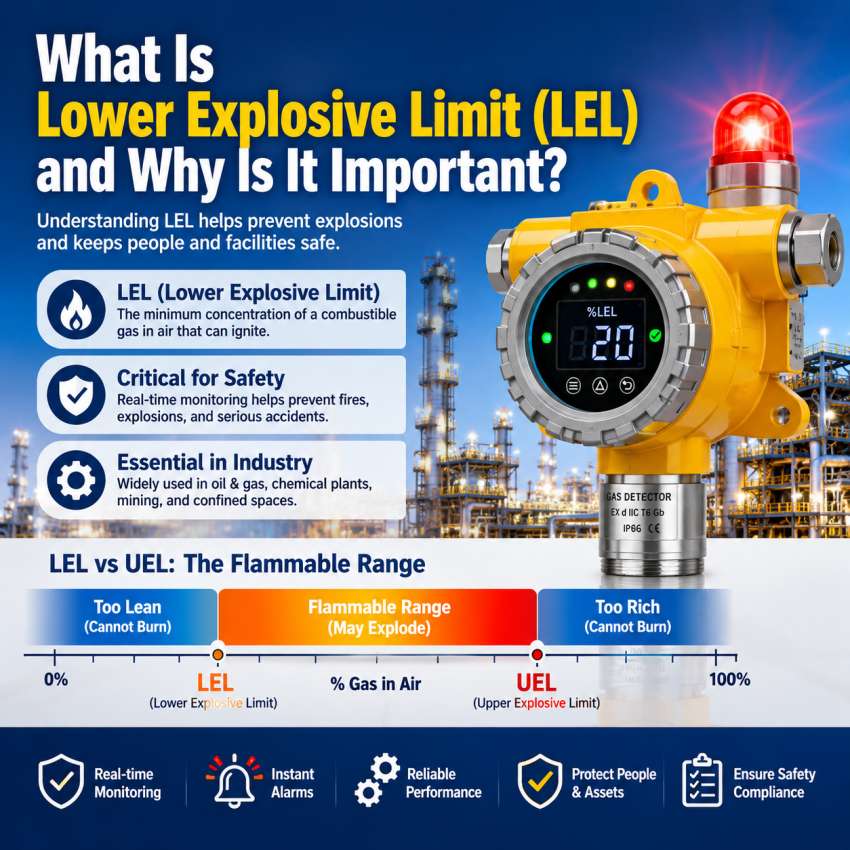
LEL refers to the lowest concentration of combustible gas that can be ignited in air.
When the gas concentration is lower than this value, the proportion of fuel in the air is insufficient and combustion conditions cannot be formed; Once it reaches or exceeds this concentration, it may burn or even explode in the presence of a fire source.
Take common gases as an example:
The LEL of methane (ch) is about 5%.
The LEL of hydrogen (h) is about 4%.
When the gas concentration reaches 100% LEL, it means that it has entered the critical state of explosion risk.
The role of LEL in industrial safety
In the actual industrial scene, LEL is often used to measure whether there is the risk of flammable gas leakage in the environment, and it is the core parameter in the safety monitoring system.
Widely used in the following industries:
Oil and gas industry
Chemical production plant
Sewage treatment and biogas system
Mine and tunnel engineering
Closed space working environment
By monitoring LEL value in real time, enterprises can find gas leakage in time and take measures to avoid accidents.
What is LEL gas detector?
LEL gas detector is a professional equipment for detecting the concentration of combustible gas in the air, and it is also one of the important tools for industrial safety protection.
Through the built-in sensor, it converts the gas concentration into %LEL value for display and alarm.
Common sensor types include:
Catalytic combustion sensor
Infrared gas sensor
According to different usage scenarios, the equipment is mainly divided into:
Stationary gas detection system (for continuous online monitoring)
Portable gas detector (for on-site inspection and personal protection)
LEL alarm level setting
In practical application, LEL alarm is usually divided into several levels, which are used for early warning in stages:
Low alarm (10%–20% LEL): It indicates that there may be a leak.
High alarm (40%–60% LEL): It is in a dangerous state and needs immediate treatment.
100% LEL: reaching the lower explosion limit, with extremely high risk.
When the alarm is triggered, the system usually performs the following actions:
Start the ventilation equipment
Cut off relevant power supply or equipment.
Sound and light alarm and organize evacuation.
The difference between LEL vs UEL
In the characteristics of combustible gas, there is also an important concept: UEL (upper explosion limit).
The differences between the two are as follows:
LEL (lower explosive limit): the lowest concentration boundary where the gas is too thin to burn.
UEL (upper explosion limit): the highest concentration boundary where the gas is too rich to burn.
Only in the range between LEL and UEL, the gas can be burned or exploded, and this range is called “combustible interval”.
Importance of combustible gas monitoring
Combustible gas monitoring system is mainly used for real-time detection of gas leakage in industrial environment, which is an important guarantee means for safe production.
Typical applications include:
Gas leakage monitoring in storage tank area
Inspection of pipeline system
Safety control of boiler and combustion equipment
Pre-entry inspection of confined space
In these scenarios, LEL is the most commonly used and intuitive safety judgment index.
Importance of calibration of gas detector
In order to ensure the accuracy of the test results, the gas detector needs to be calibrated regularly.
If it is not calibrated in time, it may lead to:
Data deviation or drift
Incorrect alarm (false alarm or omission)
Security risks cannot be identified in time.
Usually, the calibration gas with standard concentration is used for debugging, and the maintenance period (such as monthly or quarterly) is set according to the use environment.
Why is LEL so important?
The significance of LEL is that it directly reflects the critical state of explosion risk and is one of the core parameters in the industrial safety early warning system.
Through continuous monitoring of LEL, we can realize:
Discover combustible gas leakage in advance
Prevent fire and explosion accidents.
Improve the safety level of industrial site
Meet the requirements of safety production regulations
tag
LEL is not only a technical parameter, but also an important defense line in the industrial safety system. Understanding its principle, combined with reliable gas detection and standardized calibration and maintenance, can significantly reduce industrial risks and ensure the safe operation of personnel and equipment.


 WhatsApp: 8619339980364
 E-mail: contact@hirepsafety.com