
What Is a Fixed Gas Detection System? A Complete Guide to Industrial Safety
What Is a Fixed Gas Detection System?
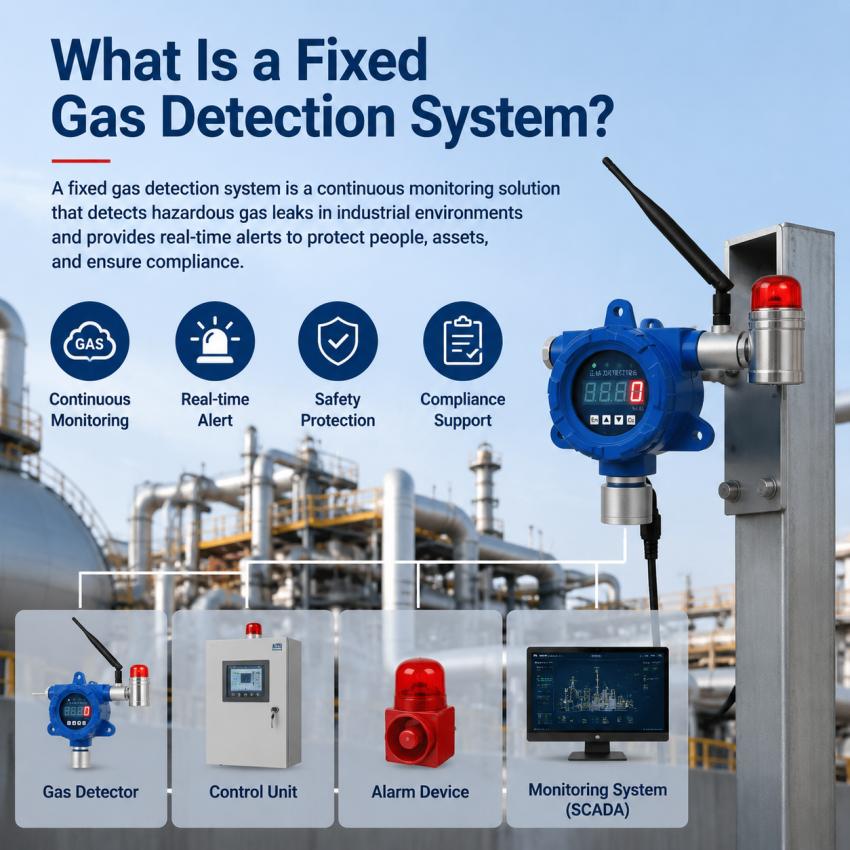
Fixed Gas Detection System is a kind of safety monitoring system permanently installed in industrial sites, which is used to continuously detect and measure the concentration of dangerous gases in the environment.
Different from portable gas detectors that workers need to carry with them, the fixed gas detection system is usually installed in fixed areas where gas leakage may occur, and it is used for long-term and continuous monitoring of dangerous gases.
The system can realize 24-hour real-time gas monitoring, over-limit alarm, and data transmission management, and help enterprises prevent safety accidents such as explosion, fire, poisoning, and oxygen deficiency.
Fixed gas detection systems are widely used in:
- Oil and gas industry
- Petrochemical works
- Chemical manufacturing industry
- Mining industry
- Electric energy industry
- Sewage treatment plants
- Laboratories
- Industrial storage areas
With the continuous improvement of industrial safety requirements, fixed gas detection systems have become an important part of modern industrial safety management systems.
How Does the Fixed Gas Detection System Work?
A complete fixed gas detection system usually consists of several core parts:
1. Fixed Gas Detector
The gas detector is the front-end detection equipment in the system, which is usually installed in positions where gas leakage may occur.
It can continuously monitor the gas concentration in the environment, convert the detected gas signals into electrical signals, and transmit them to the control system.
According to different application requirements, the fixed gas detector can detect:
- Combustible gases (such as methane, propane, hydrogen)
- Toxic gases (such as carbon monoxide, hydrogen sulfide, ammonia, chlorine)
- Oxygen concentration
Common Sensor Technologies Include:
Electrochemical Sensor
Mainly used for detection:
- Toxic gases
- Oxygen
For example:
- CO
- H₂S
- NH₃
- O₂
Infrared Sensor (IR)
Mainly used for detection:
- Flammable gases
- Hydrocarbon gases
It has the characteristics of anti-poisoning and long service life.
Catalytic Combustion Sensor
Mainly used for detection:
- Combustible gas concentration
PID Photoionization Sensor
Mainly used for detection:
- VOC volatile organic compounds
2. Gas Detection Controller
The controller is the core management equipment of the fixed gas detection system.
It is responsible for receiving the data uploaded by multiple gas detectors and analyzing them.
The main functions include:
- Real-time display of gas concentration
- Setting alarm parameters
- Data recording
- Linkage with other safety equipment
- Connecting the remote monitoring system
In large-scale industrial projects, one controller can connect dozens or even hundreds of gas detection points at the same time to realize centralized management.
3. Alarm and Communication System
When the gas concentration exceeds the preset alarm value, the system will give an alarm immediately.
Common alarm methods include:
- Acousto-optic alarm
- On-site display alarm
- Remote alarm notification
- Control system alarm
Modern fixed gas detection systems also support a variety of communication methods, such as:
- RS485
- Modbus protocol
- 4G wireless communication
- LoRa wireless communication
- Industrial Internet of Things platform
Through these communication technologies, safety managers can remotely check changes in gas concentration in the field and improve accident response speed.
Why Is the Fixed Gas Detection System So Important?
There are many dangerous gases in industrial environments that cannot be detected by human eyes.
Many toxic and combustible gases have the following characteristics:
- Colorless
- No obvious smell
- Harm does not occur until it reaches a dangerous concentration
The fixed gas detection system can find danger in advance and provide time for personnel evacuation and safe treatment.
1. Find Gas Leakage in Advance
The most important function of a fixed gas detection system is:
Finding gas abnormalities before danger occurs.
For example:
- Methane leakage in oil and gas areas may lead to explosion risks.
- Hydrogen sulfide leakage may cause serious personal injury.
- Lack of oxygen in confined spaces may lead to suffocation.
By giving an alarm in advance, staff can take timely measures to avoid accidents from expanding.
2. Realize All-Weather Continuous Monitoring
Manual inspection cannot achieve real-time monitoring, while fixed gas detection systems can:
- Run all day
- Continuously collect data
- Automatically alarm
Applicable to:
- Tank areas
- Pipeline areas
- Pump rooms
- Compressor rooms
- Chemical production areas
- Confined spaces
They are especially suitable for industrial sites that require continuous operation.
3. Improve Staff Safety
The fixed gas detection system can provide additional security for employees.
When dangerous gas appears, the system can help staff:
- Evacuate dangerous areas quickly
- Stop dangerous operations
- Initiate emergency measures
- Reduce the risk of gas exposure
4. Meet the Requirements of Industrial Safety Standards
Many industries require the installation of gas detection systems to meet safety regulations and industry standards.
Common standards include:
- OSHA occupational safety requirements
- ATEX explosion-proof standards
- IEC international standards
- NFPA fire safety codes
Correct installation of fixed gas detection systems helps enterprises improve safety levels and reduce accident risks.
Main Components of Fixed Gas Detection System
A complete fixed gas detection solution usually includes:
| Component | Function |
|---|---|
| Gas detector | Detects target gas concentration |
| Gas sensor | Senses and converts gas signals |
| Controller | Data processing and alarm management |
| Audible and visual alarm | Provides on-site warning |
| Communication module | Uploads detection data |
| Power supply system | Ensures stable operation of equipment |
At present, more and more new fixed gas detectors adopt integrated designs, integrating the following functions into a single device:
- Gas detection
- LCD display
- Acousto-optic alarm
- Wireless data transmission
This design can reduce installation difficulty and improve system deployment efficiency.
Matters Needing Attention in Installation of Fixed Gas Detector
Correct installation is the key to ensuring detection accuracy.
1. Analyze Potential Leak Locations
Before installation, it is necessary to conduct risk assessments to determine locations where leakage may occur, such as:
- Valves
- Pipeline interfaces
- Storage tanks
- Pumps
- Compressors
- Chemical equipment
The detector should be installed near locations where gas is most likely to accumulate.
2. Select Installation Height According to Gas Characteristics
Different gases have different densities, and installation positions are also different.
Gases Lighter Than Air:
Examples:
- Hydrogen
- Methane
They usually diffuse upward, so detectors are generally installed at higher positions.
Gases Heavier Than Air:
Examples:
- Propane
- Chlorine
They are easy to accumulate at low positions, so detectors are usually installed at lower positions.
3. Consider Site Environmental Factors
Industrial sites may have:
- High temperature
- High humidity
- Dust
- Corrosive gases
- Vibration
Therefore, when selecting gas detection equipment, attention should be paid to:
- Ingress protection
- Explosion-proof grade
- Operating temperature range
- Corrosion resistance
Difference Between Fixed Gas Detection System and Portable Gas Detector
Although both are used to detect dangerous gases, their application scenarios are different.
| Comparison Item | Fixed Gas Detection System | Portable Gas Detector |
|---|---|---|
| Installation method | Fixed installation | Carried by personnel |
| Monitoring mode | Continuous monitoring | Temporary detection |
| Protection scope | Regional security | Personal security |
| Alarm mode | Local + Remote alarm | Personal alarm |
| Application scenario | Factory safety monitoring | Inspection and maintenance |
In many industrial environments, the best safety solution is:
Fixed gas detection system + portable gas detector used together.
Fixed equipment is responsible for regional monitoring, and portable equipment protects field staff.
Fixed Gas Detection System Application Industries
Oil and Gas Industry
Used for:
- Refineries
- Natural gas stations
- Tank areas
- Pipelines
Detection:
- Methane
- Flammable gases
Chemical Industry
Used for monitoring:
- Ammonia
- Chlorine
- Hydrogen sulfide
- VOC gases
Prevent toxic gas leakage.
Sewage Treatment Industry
Sewage treatment processes may produce:
- Hydrogen sulfide
- Methane
- Oxygen-deficient environments
The fixed gas detection system can ensure worker safety.
Mining Industry
Main detection:
- Methane
- Carbon monoxide
- Oxygen
Prevent mine accidents.
Electric Energy Industry
Applied to:
- Battery rooms
- Hydrogen areas
- Fuel systems
How to Choose a Suitable Fixed Gas Detection System?
When selecting a fixed gas detection system, the following factors need to be considered:
1. Detection Gas Type
First, determine the gas to be detected.
Different gases require different types of sensors.
2. Detection Range
Select the appropriate range according to the site environment and safety requirements.
For example:
- LEL combustible gas detection
- PPM toxic gas detection
- Oxygen concentration detection
3. Communication Mode
According to project requirements, select:
- Wired communication
- RS485 communication
- Wireless communication
- Cloud platform monitoring
4. Environmental Adaptability
Need to consider:
- Temperature
- Humidity
- Explosion-proof requirements
- Protection grades
5. Post Maintenance
A quality system should support:
- Simple calibration
- Sensor replacement
- Fault diagnosis
- Long-term stable operation
Future Development Trend of Fixed Gas Detection Technology
With the development of the Industrial Internet of Things, fixed gas detection systems are developing toward intelligence.
Wireless Gas Monitoring
Wireless technologies such as 4G and LoRa can reduce wiring costs and are suitable for complex industrial environments.
Cloud Remote Management
Enterprises can use cloud platforms to:
- View real-time data
- Receive alarm information
- Analyze historical trends
Intelligent Data Analysis
Using data analysis technology, companies can:
- Predict abnormal situations
- Optimize safety management
- Reduce accident risks
Multi-System Linkage
In the future, fixed gas detection systems will be more connected with:
- Fire protection systems
- Emergency shutdown devices
- Building management systems
Forming a more complete industrial safety system.
Conclusion
A fixed gas detection system is an important device for continuously monitoring dangerous gas concentrations and providing safety warnings in industrial environments.
By combining gas sensors, control systems, alarm equipment, and communication technologies, fixed gas detection systems can help enterprises identify gas leakage risks in time, protect employee safety, and reduce the probability of industrial accidents.
For industries involving combustible gases, toxic gases, and oxygen deficiency risks, choosing a reliable fixed gas detection system is not only a safety management requirement but also an important guarantee for enterprises to achieve long-term stable operation.
With the development of intelligent manufacturing and the Industrial Internet of Things, fixed gas detection systems will play an increasingly important role in the future industrial safety field.


 WhatsApp: 8619339980364
 E-mail: contact@hirepsafety.com