
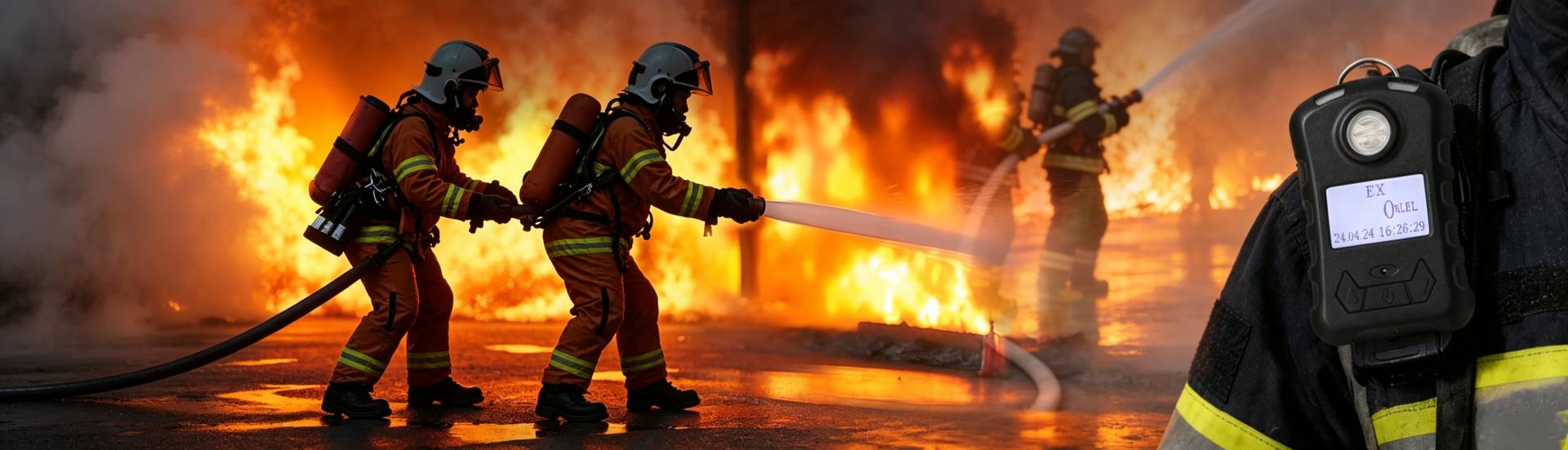
4-20mA fixed gas detector
What is a 4-20mA Fixed Gas Detector?
The 4-20mA fixed gas detector is a special detection equipment for industrial safety, which is fixedly installed on the site, and can continuously monitor the concentration of specific gases in the environment in real time, and output the detection data through the standard 4-20mA current loop signal.
The equipment is mainly deployed in high-risk areas prone to gas leakage, including:
- Chemical production workshop
- Oil and gas production and processing facilities
- Tank area
- Pipeline Gallery and Compressor Station
- Boiler room
- Battery storage power station
- Sewage treatment plant
The standard 4-20mA fixed gas detector consists of six core components to ensure the stable and accurate operation of the equipment:
- High-precision gas sensor (core detection unit)
- Signal processing and conversion module
- On-site LCD screen (optional, for local real-time data viewing)
- Acousto-optic alarm module
- 4-20mA standard signal output interface
- Explosion-proof enclosure (suitable for installation and use in hazardous areas)
When the concentration of harmful gases in the environment is higher than the reference value, the detector collects concentration data in real time, completes signal processing, and transmits standardized current signals to the back-end industrial control system.
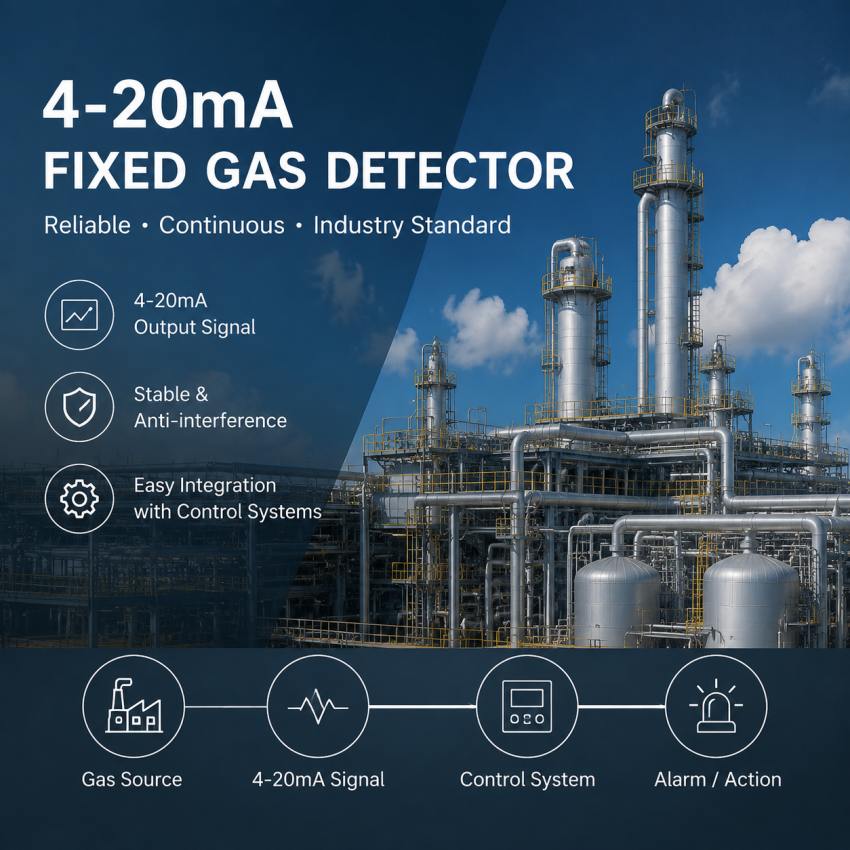
Working Principle of 4-20mA Fixed Gas Detector
4-20mA current signal is a general analog standard in the field of industrial automation and process control, which is widely used because of its stable performance and strong compatibility.
The signal has a linear and stable correspondence with the gas concentration, which can be used for the control system to accurately analyze the detection data.
The standard correspondence between signal current and gas concentration is as follows:
- 4mA: zero gas concentration/clean air (reference state)
- 8–12mA: low and medium concentration gas range
- 16mA: high gas concentration level
- 20mA: upper limit of full-scale detection
Taking the methane detector with the range of 0–100% LEL as an example, the actual correspondence is as follows:
- 4mA corresponds to 0%LEL (no combustible gas)
- 12mA corresponds to 50%LEL (half range concentration)
- 20mA corresponds to 100%LEL (full-scale concentration)
The back-end PLC, DCS or safety system can convert the accurate gas concentration value by identifying the change of current signal.
When the gas concentration exceeds the preset alarm threshold, the system will automatically trigger a series of safety linkage actions:
- On-site acousto-optic alarm
- Warning indicator lights up
- Automatic start-up of ventilation equipment
- Emergency shutdown interlock of production equipment
- Push remote alarm notification to management
Core Advantages of 4-20mA Fixed Gas Detector
1. Strong industrial adaptability, stable signal and anti-interference
The core advantage of 4-20mA current loop signal is its excellent operation stability, which is superior to most communication protocols.
It can effectively resist the influence of electromagnetic interference, long-distance signal attenuation and environmental noise in industrial field, and ensure continuous and accurate data transmission even in complex and harsh factory environment, fully meeting the long-term operation requirements of equipment for 24 hours.
2. Compatible with existing control systems and convenient access
At present, most industrial enterprises have deployed mature automation systems, including PLC control system, DCS distributed control system, SCADA monitoring platform and SIS safety instrument system.
As a global industrial standard signal, 4-20mA detector can be directly adapted and connected to existing equipment, without large-scale system modification and complicated debugging configuration, and plug and play.
3. All-weather uninterrupted real-time monitoring
The fixed detector can run continuously for 24 hours, and it is not necessary for workers to frequently enter the high-risk gas area for inspection.
Through active real-time monitoring, enterprises can find the hidden danger of trace gas leakage in advance, reduce the risk of safety accidents, improve the efficiency of emergency treatment and comprehensively upgrade the level of industrial safety management.
4. Adapt to harsh and high-risk industrial environment
Industrial-grade 4-20mA fixed gas detector is specially designed for extreme working conditions, equipped with explosion-proof certification structure, waterproof and dustproof shell, supporting wide-temperature environment operation, and can be used indoors and outdoors, which is completely suitable for harsh use scenarios of high-risk industries such as petroleum, chemical industry and new energy.
Main Industrial Application Scenarios
Oil and Gas Industry
In the process of oil and gas exploitation, refining and storage, a large number of combustible gases such as methane, propane and hydrogen will be produced.
4-20mA fixed gas detectors are widely installed in storage tank areas, pipeline corridors, oil refineries, compressor stations and other points to capture the gas leakage risk in advance and prevent fire and explosion accidents.
Chemical Manufacturing Industry
Chemical production processes will produce toxic, harmful and combustible gases such as ammonia, chlorine, hydrogen sulfide and volatile organic compounds (VOCs).
Continuous real-time gas monitoring can effectively protect the personal safety of field workers and reduce the probability of safety accidents such as poisoning and explosion.
Sewage Treatment Industry
High-risk gases, such as hydrogen sulfide and methane, will be produced in the process of sewage degradation treatment, which are easy to accumulate in closed spaces.
Stationary gas detection system is deployed in closed areas such as pump house, underground pipe gallery and sludge storage area to realize continuous safety monitoring.
New Energy Storage Industry
Lithium battery energy storage system will release flammable and toxic gases under abnormal working conditions such as overheating, short circuit and thermal runaway.
4-20mA fixed gas detector can capture abnormal gas signals in real time, give early warning, and link with fire safety system to ensure the safe operation of energy storage power station.
Comparison Between 4-20mA and Other Mainstream Communication Protocols
4-20mA VS RS485 Gas Detector
There are significant differences between the two mainstream industrial detection protocols in practical application:
- Signal type: 4-20mA is analog current signal; RS485 is a digital signal.
- Installation configuration: 4-20mA wiring is simple without complicated debugging; RS485 requires professional configuration of communication parameters.
- Industrial compatibility: 4-20mA fully adapts to the traditional PLC/DCS system; RS485 only adapts to special digital communication system.
- Anti-interference ability: 4-20mA is more stable in the industrial environment with strong electromagnetic interference.
For the traditional industrial control system that pays attention to stability and simplicity, 4-20mA is still a more mature and reliable preferred scheme.
4-20mA VS Wireless Gas Detector
- Wiring requirements: 4-20mA requires wired wiring installation; Wireless devices do not need wiring.
- Operation stability: 4-20mA wired transmission is stable and free from environmental interference; Wireless signals are easily affected by shielding and network fluctuation.
- Maintenance cost: 4-20mA daily maintenance is extremely low; Wireless devices need to change batteries and detect signals regularly.
- Application scenario: 4-20mA is suitable for core fixed safety monitoring points; Wireless equipment adapts to flexible deployment, temporary monitoring and difficult wiring areas.
For the core safety monitoring scenarios with extremely high reliability requirements, industrial enterprises generally give priority to the wired 4-20mA scheme.
Guide for Selection of 4-20mA Stationary Gas Detector
1. Determine the type of gas to be measured
The gas sensor has strong pertinence, and different harmful gases need to be matched with dedicated sensors.
Common detection types include combustible gas (lower explosive limit LEL), oxygen, toxic gas and volatile organic compounds (VOCs).
Matching the corresponding sensor model is the first prerequisite to ensure the detection accuracy.
2. Select the Adaptive Detection Range
It is necessary to determine the detection range according to the field gas characteristics and industry safety standards.
Industry standard range:
- 0-100%LEL for combustible gas
- 0-30%VOL for oxygen
- ppm for toxic gas
3. Evaluate the Site Installation Environment
On-site environmental parameters directly determine the equipment selection.
Environmental temperature and humidity, dust concentration, explosion-proof grade requirements and indoor and outdoor installation conditions need to be comprehensively considered.
Explosion-proof gas detectors must be used in high-risk areas of Class A explosion.
4. Confirm System Compatibility
It should be confirmed that the equipment supports standard 4-20mA signal output and alarm relay output, and can seamlessly connect with the field PLC/DCS system and remote monitoring platform to ensure normal and stable signal transmission and system linkage.
Specification for Daily Maintenance of 4-20mA Fixed Gas Detector
Scientific and regular maintenance is the key to ensure the long-term stable operation of equipment and prolong its service life.
1. Regular Calibration
After long-term continuous operation of the equipment, the sensor is prone to zero drift and the detection accuracy is attenuated.
It is necessary to use standard gas for professional calibration regularly to eliminate the measurement error and restore the detection accuracy.
2. Routine Inspection of Equipment and Sensors
Regularly check the response sensitivity of the sensor and the integrity of the equipment shell, and troubleshoot problems such as dust blockage and equipment corrosion to ensure the normal working conditions of the detection unit.
3. Alarm Function Test
Regularly check the acousto-optic alarm and relay output functions, confirm that the back-end control system can receive signals normally, and ensure that the safety linkage function can be effectively triggered under sudden working conditions.
4. Installation Environment Review
In combination with the change of field working conditions, the applicability of the installation points of the detector shall be checked regularly to avoid problems such as detection blind spots and signal interference caused by equipment layout adjustment.
Professional Suggestions on Industrial Gas Safety Management
Combined with many years of industrial gas detection engineering application experience, fixed gas monitoring system is not a simple detection equipment, but a core component of industrial safety protection system.
A complete and reliable gas safety solution, including:
- Standardized installation layout
- Accurate sensor selection
- Scientific alarm threshold setting
- Regular calibration and maintenance
- Effective linkage with emergency system
The overall efficiency of gas detection system depends not only on the quality of the equipment itself, but also on standardized installation, scientific maintenance and refined daily management.


 WhatsApp: 8619339980364
 E-mail: contact@hirepsafety.com