
LEL Detector vs Combustible Gas Detector
What is a LEL detector?
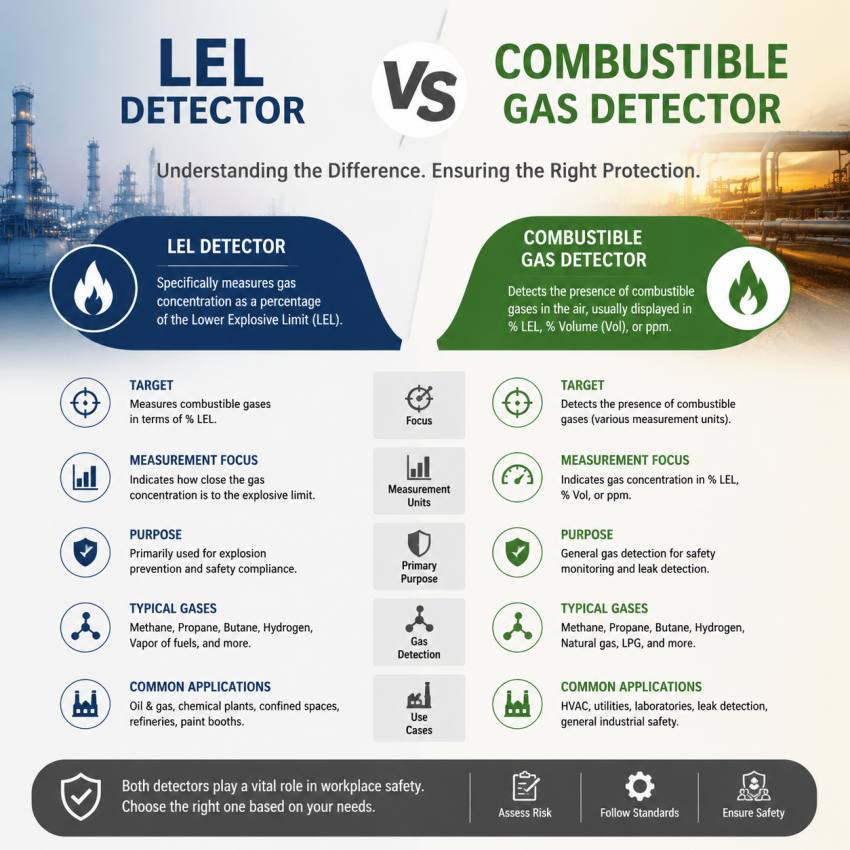
LEL detector is a kind of gas detection equipment used to detect the concentration of combustible gas, and the percentage of Lower Explosive Limit (LEL) is used as the display unit.
The lower explosive limit refers to:
The lowest concentration of combustible gas that can be ignited or exploded after being mixed with air.
For example:
- The LEL of Methane is about 5% by volume.
- The LEL of Hydrogen is about 4% by volume.
- The LEL of Propane is about 2.1% by volume.
When the gas detector shows:
10% LEL
It means that the concentration of combustible gas in the air has reached 10% of the lower explosion limit of the gas.
Industrial sites usually set different levels of alarm values, such as:
- Low alarm: 10% LEL
- High alarm: 20% LEL
This can remind the staff to take measures before the gas concentration reaches the dangerous range.
What is a combustible gas detector?
Combustible Gas Detector is a broader concept, which is used to detect all kinds of flammable and combustible gas leakage equipment.
Detectable gases include:
- Methane
- Natural Gas
- Hydrogen
- Propane
- Butane
- Ethylene
- Other hydrocarbon combustible gases
The combustible gas detector can use different concentration display methods, such as:
- %LEL (percentage of lower explosive limit)
- %VOL (volume percentage)
- PPM (parts per million)
In most industrial safety applications, %LEL is used as the measurement unit, because it can directly reflect the proximity of gas to the dangerous state of explosion.
Therefore:
LEL detector belongs to a kind of combustible gas detector.
LEL detector vs combustible gas detector: main differences
| Comparison project | LEL detector | Combustible gas detector |
|---|---|---|
| Define | Combustible gas detection equipment using LEL as the measurement standard | Common equipment name to detect combustible gas |
| Measurement unit | Usually %LEL | %LEL, %VOL, PPM |
| Main purpose | Prevent gas from reaching explosive dangerous concentration | Detect all kinds of combustible gases |
| Scope of application | Industrial safety monitoring | Industrial, commercial and even some civilian scenes |
| Detection gas | Different according to sensor | Detection of combustible gas according to sensor type |
| Scope | More specific | Broader |
Simply put:
LEL detector is a combustible gas detector with the lower explosion limit (LEL) as the detection standard.
Working principle of LEL detector
Industrial LEL detectors usually adopt the following two sensor technologies:
1. Catalytic combustion sensor (Catalytic Sensor)
The catalytic combustion sensor detects the gas concentration through the oxidation reaction of combustible gas on the surface of the sensing element.
Advantages:
- Fast response speed
- Suitable for a variety of hydrocarbon combustible gases
- Lower cost
Disadvantages:
- Vulnerable to environmental pollutants
- Need oxygen to work
- Silicon, sulfide and other substances may cause sensor poisoning
2. Infrared Sensor
Infrared combustible gas detector can judge the concentration by detecting the absorption change of infrared light by gas.
Advantages:
- Long service life
- Strong anti-sensor poisoning ability
- Suitable for harsh industrial environment
Common applications:
- Oil and gas industry
- Offshore platform
- Chemical production plant
Where is the main application of LEL detector?
LEL detector is widely used in industrial environments with explosion risk.
Oil and gas industry
Application scenario:
- Refinery
- Tank area
- Oil and gas pipeline
- Natural gas treatment station
Continuous monitoring of combustible gas concentration can help enterprises find the leakage risk in time.
Chemical industry
Chemical production process often involves:
- Organic solvent
- Hydrocarbon gas
- Flammable chemicals
The fixed LEL detector is usually installed in:
- Near the production equipment
- Storage area
- Reaction kettle area
- Loading and unloading area
Mining industry
Methane accumulation in underground mines is an important safety hazard.
LEL detection system can:
- Real-time monitoring methane concentration
- Provide early warning
- Reduce the risk of explosion accidents
Sewage treatment industry
Biogas produced during sewage treatment may contain:
- Methane
- Hydrogen sulfide
Combustible gas detector is usually used for:
- Digestion tank
- Gas storage area
- Pumping station
Fixed LEL detector vs portable combustible gas detector
The choice of equipment mainly depends on the application requirements.
Fixed LEL detector
The fixed detector is installed in the designated area for long-term continuous monitoring.
Advantages:
- 24-hour continuous monitoring
- Can be connected to the alarm control host
- Suitable for large industrial facilities
- Support automatic alarm
Typical application:
- Factory
- Petroleum storage and transportation station
- Chemical plant
- Energy facilities
Portable combustible gas detector
Portable detector is carried by staff for personal safety protection.
Advantages:
- Motion detection
- Suitable for entering a limited space
- Real-time protection of staff
- Convenient to use
Typical application:
- Plant maintenance
- Tank inspection
- Emergency rescue
- Limited space operation
How to choose LEL detector or combustible gas detector?
When selecting equipment, you need to consider the following factors:
1. Confirm the target detection gas
Different gases need to match different sensors.
For example:
- Methane detection → catalytic combustion or infrared sensor
- Hydrogen detection → dedicated combustible gas sensor
- A variety of hydrocarbon gas detection → infrared technology may be more suitable
2. Consider the installation environment
Needs assessment:
- Temperature range
- Humidity
- Dust
- Corrosive environment
- Explosion-proof grade requirements
For dangerous areas, it is usually necessary to choose an explosion-proof fixed gas detector.
3. Determine monitoring needs
According to the security objectives, select:
Continuous regional monitoring:
→ Fixed LEL detector
Personnel safety protection:
→ Portable combustible gas detector
Remote monitoring:
→ Wireless LEL gas detection system
Common mistakes in selecting combustible gas detection equipment
Mistake 1: Focus only on the price
The equipment with the lowest price may not meet the requirements of industrial safety.
Need attention:
- Sensor quality
- Certification standard
- Calibration requirements
- Manufacturer’s experience
Mistake 2: Ignore sensor matching
Different detectors can’t detect all combustible gases.
Before choosing, you need to confirm:
- Target gas type
- Sensor technology
- Detection range
Mistake 3: Ignore maintenance
Even high-quality gas detectors need regular maintenance.
Suggestion:
- Periodic calibration
- Replace the sensor periodically
- Test the alarm function regularly
Frequently asked questions FAQ
Is the LEL detector the same as the combustible gas detector?
Not exactly the same.
LEL detector is a kind of combustible gas detector, which uses LEL as the concentration display standard.
What gases can LEL detector detect?
Depending on the type of sensor, it can detect:
- Methane
- Propane
- Hydrogen
- Natural gas
- Other combustible gases
Which is more suitable for industrial safety, %LEL or %VOL?
For industrial safety applications, %LEL is more intuitive, because it can directly indicate how far the current environment is from the explosive dangerous state.
Should I choose a fixed or portable combustible gas detector?
Fixed type is suitable for long-term regional monitoring;
Portable is suitable for personal protection when people enter dangerous areas.


 WhatsApp: 8619339980364
 E-mail: contact@hirepsafety.com