
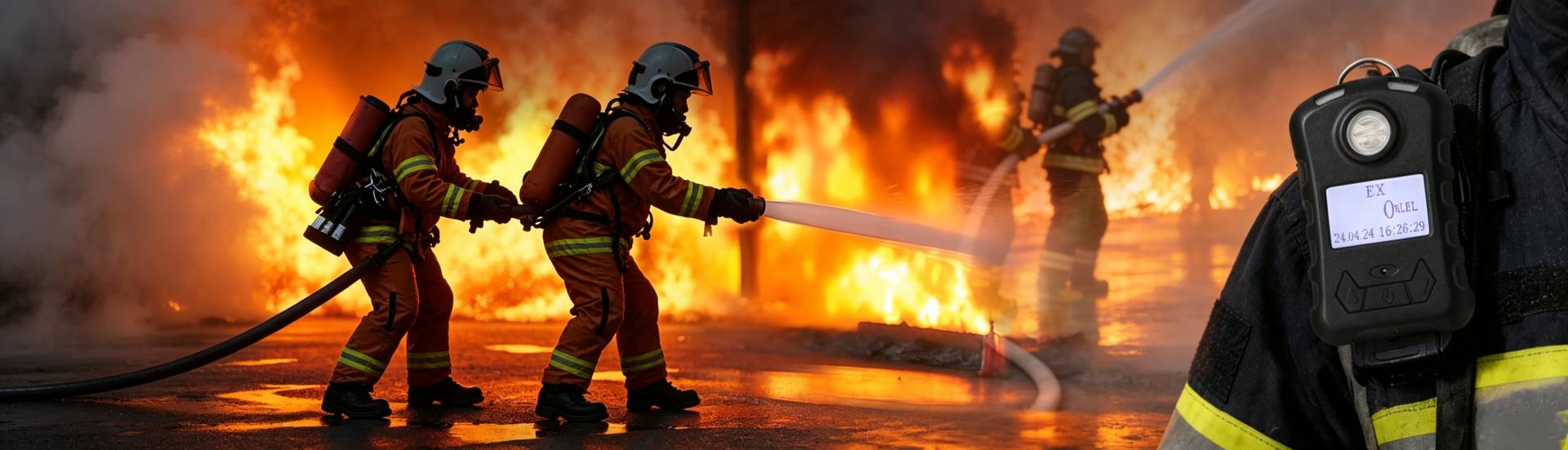
What is a fixed combustible gas detector? Why is it essential for industrial safety?
introduction
Combustible gas leakage is always one of the most serious safety risks in industrial production. Oil and gas, chemical manufacturing, sewage treatment, electric power production and food processing industries all need perfect gas monitoring systems to prevent fires, explosions and the resulting high economic losses.
Fixed combustible gas detector is one of the most important devices in industrial safety system. Different from the portable gas detector, the fixed equipment can continuously monitor the specific area 24 hours a day, find the accumulation of combustible gas in time, and realize early warning and rapid response.
This paper will introduce the working principle, core technology, installation points and its important role in industrial safety management of fixed combustible gas detector in detail.
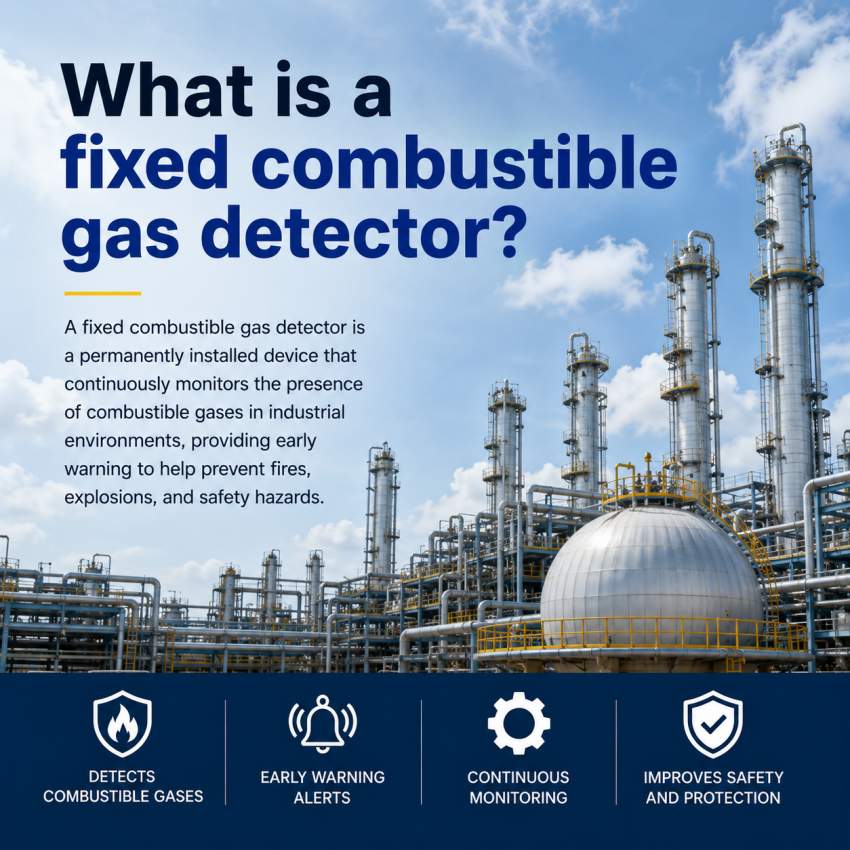
What is a fixed combustible gas detector?
The fixed combustible gas detector is a kind of safety equipment permanently installed in industrial site for continuously monitoring the concentration of combustible gas.
This kind of equipment usually measures the gas concentration as a percentage of the lower explosive limit (LEL). When the gas concentration exceeds the preset alarm value, the system will automatically start the acousto-optic alarm, ventilation equipment or emergency stop program.
Common monitoring gases include:
- Methane (ch)
- Propane (C₃H₈)
- Hydrogen (h)
- Butane (ch)
- natural gas
- Liquefied petroleum gas (LPG)
- Various hydrocarbon vapors
Continuous monitoring can help enterprises find leakage in time before the formation of dangerous concentration and avoid explosion accidents.
Working principle of fixed combustible gas detector
Modern fixed gas detectors usually adopt different types of sensor technologies according to the application requirements.
Catalytic combustion sensor
Catalytic combustion sensor is one of the most widely used combustible gas detection technologies at present.
Its advantages include:
- Fast response speed
- Lower cost
- Can detect a variety of hydrocarbon gases
- LEL measurement is stable and reliable.
However, the catalytic sensor needs oxygen to participate in the reaction, and it is easily affected by chemical substances such as silicide and sulfide.
Infrared (NDIR) sensor
In recent years, infrared technology has been more and more widely used in industrial fields.
The main advantages include:
- Can be detected without oxygen.
- Longer service life
- Low maintenance cost
- Sensor poisoning is not easy to occur.
- Suitable for harsh industrial environment
Therefore, infrared sensors are especially suitable for petrochemical industry, offshore platforms and closed process areas.
Why is the fixed combustible gas detector so important?
1. Prevention of fire and explosion accidents
The core function of fixed combustible gas detector is to prevent the concentration of combustible gas from reaching the explosion limit.
Through early warning, enterprises can take timely measures, such as:
- Isolation leakage equipment
- Start the ventilation system
- Evacuate site personnel
- Emergency shutdown
These measures can significantly reduce the risk of major accidents.
2. Meet the requirements of regulations and standards
Industrial enterprises usually need to comply with various safety regulations and international standards, such as:
- European ATEX explosion-proof standard
- IECEx international explosion-proof certification
- OSHA occupational safety specification
- Local fire regulations require
Reasonable deployment of fixed gas detection system is helpful for enterprises to successfully pass the safety review and regulatory requirements.
3. Ensure the safety of employees’ lives
Employee safety is always an important responsibility of enterprise management.
Continuous gas monitoring can achieve:
- Real-time hazard identification
- Immediate alarm reminder
- Safer working environment
- Lower accident rate
So as to establish a more perfect enterprise safety culture system.
4. Reduce economic losses
Gas accidents may lead to:
- Production line shutdown
- Equipment damage
- Legal liability and compensation
- Environmental punishment
- Insurance claims increase
Compared with the huge losses caused by accidents, it is undoubtedly more economical to invest in high-quality fixed combustible gas detection system.
What scenarios is the fixed combustible gas detector suitable for?
The reasonable installation position determines the reliability of the detection effect.
chemical plant
Flammable solvents and hydrocarbon raw materials are widely used in chemical production, so it is necessary to continuously monitor the gas leakage risk.
Oil and gas industry
Storage tank area, compressor station, oil pipeline and processing device are all important application areas of fixed detector.
power plant
Natural gas power stations usually install combustible gas detection equipment in gas turbines, fuel supply systems and pipeline areas.
Sewage treatment plant
Methane gas produced in sewage treatment process may pose explosion risk in confined space, so it needs continuous monitoring.
Warehouse logistics center
Liquefied petroleum gas warehouse and dangerous chemicals storage area also need fixed gas monitoring system to ensure safety.
How to choose a fixed combustible gas detector?
Enterprises should focus on the following aspects when selecting models.
examination area
Most industrial products support:
0~100%LEL
And can meet the monitoring requirements of most combustible gases.
explosion proof certification
Preference is given to products that have passed the following certifications:
- ATEX
- IECEx
- UL
- CSA
Ensure that the equipment can run safely in dangerous areas.
communication method
Modern industrial systems usually support:
- 4-20mA analog output
- RS485 Modbus communication
- HART protocol
- 4G wireless communication
- LoRa wireless network
It is convenient to integrate with existing DCS, PLC and SCADA systems.
the protection grades
The industrial site environment is complex, so we should choose:
- IP65
- IP66
- IP67
High-grade products to improve equipment stability and service life.
Maintenance suggestion of fixed combustible gas detector
Regular maintenance is very important to ensure the detection accuracy.
Periodic calibration
According to industry requirements and site environment, it is generally suggested that:
Calibrate every 3 ~ 6 months.
Function test (Bump Test)
Functional testing can verify:
- Does the sensor respond normally?
- Is the acousto-optic alarm effective?
- Is the control system linked normally?
daily inspection
Regular inspection contents include:
- Sensor pollution
- Shell damage
- Is the wiring loose?
- Influence of environmental factors
Good preventive maintenance can effectively reduce the failure rate of equipment.
Development trend of fixed combustible gas detection technology
With the upgrading of industrial digitalization, gas detection technology is also improving.
Wireless gas monitoring system
4G and LoRa wireless technologies are reducing the wiring cost, especially suitable for large factories and distributed monitoring scenarios.
Intelligent Management of Internet of Things (IoT)
The management system based on cloud platform can realize:
- Remote real-time viewing data
- Mobile phone alarm notification
- Predictive maintenance
- Historical data analysis
Improve the overall safety management efficiency.
New sensor technology
Future infrared and laser detection technologies will have:
- Higher precision
- Longer life
- Lower maintenance cost
- Strong environmental adaptability
Help enterprises to establish a more intelligent and efficient safety monitoring system.
conclusion
The fixed combustible gas detector is not only a safety equipment that meets the requirements of laws and regulations, but also an important part of modern industrial safety management.
Through all-weather continuous monitoring, rapid leakage warning and intelligent alarm linkage, it can effectively prevent explosion accidents, ensure employee safety, reduce business risks and improve enterprise operation efficiency.
Whether in chemical plants, oil and gas facilities, power plants or sewage treatment plants, investing in high-quality fixed combustible gas detection systems is an important guarantee for building a safe, stable and sustainable industrial environment.


 WhatsApp: 8619339980364
 E-mail: contact@hirepsafety.com