
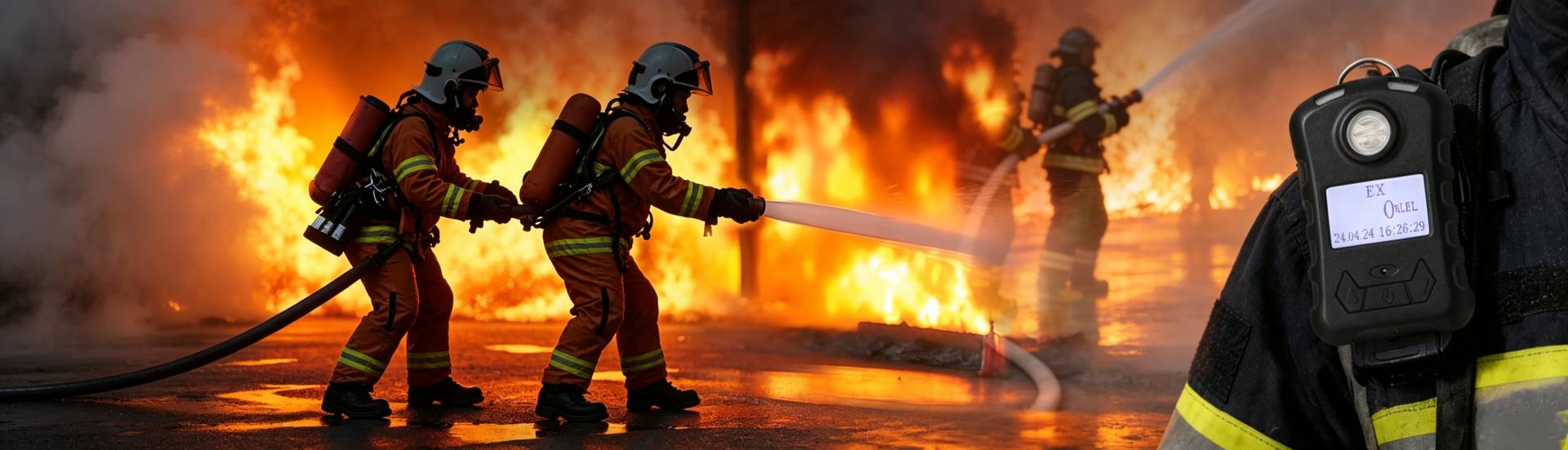
multi gas detector working principle
Introduction
In high-risk industries such as petroleum, chemical industry, mining, metallurgy and confined space operation, gas leakage and hypoxia have always been important factors threatening personnel safety.
In order to find dangerous gas in time and avoid fire, explosion and poisoning accidents, multi-gas detector has become an indispensable equipment in industrial safety protection system.
Multi-gas detector is a portable gas detection device that can detect the concentration of multiple gases at the same time.
Compared with the detector that can only detect a single gas, the multi-gas detector can integrate multiple sensors in the same equipment to continuously monitor the concentrations of combustible gas, toxic gas and oxygen in the environment.
Common detection gases include:
- Oxygen (O₂)
- Combustible gas (LEL)
- Carbon monoxide (CO)
- Hydrogen sulfide (H₂S)
- Ammonia gas (NH₃)
- Chlorine gas (Cl₂), etc.
When the detected gas concentration exceeds the preset alarm value, the equipment will remind the staff by means of sound, light and vibration to help them take safety measures in time.
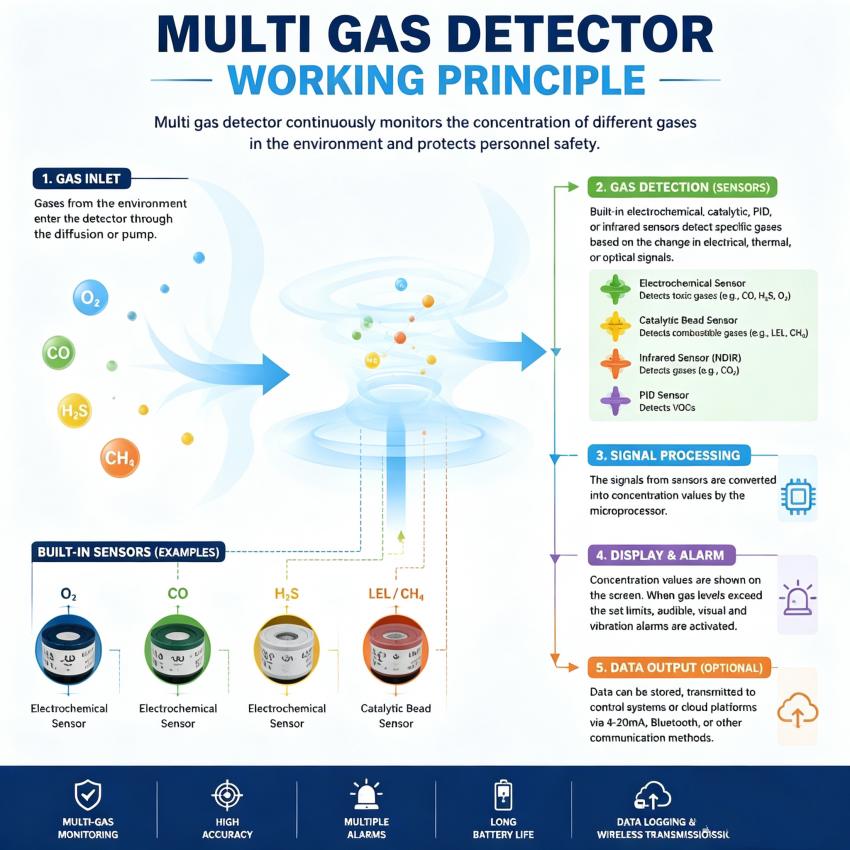
Work Flow of Multi-Gas Detector
The working process of multi-gas detector mainly includes:
Gas collection → Sensor detection → Signal processing → Concentration display → Overrun alarm
The equipment continuously analyzes the air entering the detection chamber through the internal sensor, and feeds back the detection results to the users in real time.
1. Gas Sampling and Sensor Detection
After the multi-gas detector is started, the ambient air will enter the detection area in two ways:
Diffusion detection:
Air naturally enters the sensor area.
Pumping detection:
Take the initiative to extract gas samples in a long distance or confined space by using the built-in air pump.
The gas entering the equipment will react with the corresponding sensor, and different gases need different detection technologies.
2. Detection Principle of Different Types of Sensors
Catalytic Combustion Sensor (LEL)
The catalytic combustion sensor is mainly used to detect the concentration of combustible gas, such as:
- Methane (CH₄)
- Propane (C₃H₈)
- Hydrogen (H₂)
Its working principle is:
When the combustible gas enters the sensor, it will undergo an oxidation reaction on the surface of the catalytic element, generating a certain amount of heat, which will change the resistance of the internal elements of the sensor.
The detector calculates the concentration of combustible gas in the air by measuring the change of resistance, and displays it with LEL (percentage of lower explosive limit).
For example:
- 0% LEL: Environmentally safe, with no obvious combustible gas.
- Close to 100% LEL: Reaching the explosion danger range.
Electrochemical Sensor (Toxic Gas and Oxygen)
Electrochemical sensors are mainly used to detect:
- Carbon monoxide (CO)
- Hydrogen sulfide (H₂S)
- Oxygen (O₂)
- Ammonia gas (NH₃)
In the working process, after the target gas enters the sensor, it reacts chemically with the internal electrode and generates a current signal.
The higher the gas concentration, the stronger the generated current signal, and the detector displays the corresponding concentration value after algorithm conversion.
Common units:
- Ppm (parts per million)
- %VOL (volume percentage)
Infrared Sensor (IR)
Some high-end multi-gas detectors adopt infrared detection technology, which is mainly used to detect:
- Methane (CH₄)
- Carbon dioxide (CO₂)
The infrared sensor uses the principle that different gases have absorption characteristics for specific infrared wavelengths, and calculates the gas concentration by analyzing the changes of optical signals.
Compared with traditional sensors, infrared sensors have:
- Long service life
- Good stability
- Strong anti-interference ability
- Not susceptible to sensor poisoning
And other characteristics.
3. Data Processing and Concentration Display
After the sensor collects the gas signal, it will be transmitted to the microprocessor inside the equipment.
The system will perform:
- Signal conversion
- Temperature compensation
- Zero calibration
- Concentration calculation
Finally, the detection results are displayed on the LCD screen in real time.
Typical Display Mode:
| Detection Gas | Display Unit |
|---|---|
| Oxygen (O₂) | %VOL |
| Carbon monoxide (CO) | ppm |
| Hydrogen sulfide (H₂S) | ppm |
| Combustible gas | %LEL |
4. Gas Overrun Alarm
In order to ensure that personnel can quickly find dangerous situations, multi-gas detectors are usually equipped with multiple alarm functions.
Acousto-Optic Alarm
When the gas concentration reaches the alarm value:
- Buzzer gives out high decibel sound;
- The LED warning light flashes quickly.
Vibration Alarm
In noisy environments such as mines and factories, vibration alarm can help workers receive danger warnings in time.
Some industrial-grade multi-gas detectors also support:
- 4G wireless data transmission
- Bluetooth communication
- Data record
- Remote monitoring of cloud platform
Realize real-time management of field data.
Main Application Scenarios of Multi-Gas Detector
Oil and Gas Industry
During the maintenance of drilling platforms, refineries and natural gas pipelines, it is used to detect:
- Combustible gas leakage
- Hydrogen sulfide risk
- Lack of oxygen
Chemical Production
There may be many kinds of dangerous gases in the chemical field, and the multi-gas detector can help the staff find them in time:
- Toxic gas leakage
- Chemical volatilization
- Explosion risk
Mine Operation
Underground mine environment is complex, easy to appear:
- Methane accumulation
- Excessive carbon monoxide
- Lack of oxygen
Multi-gas detector can provide real-time safety guarantee for miners’ operation.
Confined Space Operation
Gas detection is usually required before entering the following areas:
- Storage tank
- Pipeline
- Sewage reservoir
- Underground space
- Cabin
Detect the concentration of oxygen and dangerous gas to ensure the safe entry of operators.
Conclusion
Multi-gas detector can monitor oxygen, combustible gas and toxic gas in the environment in real time by integrating a variety of high-precision sensors, and analyze the data through intelligent processing system to provide timely warning before the danger occurs.
For high-risk industries such as petroleum, chemical industry, mining and confined space, multi-gas detector is not only a detection device, but also an important protective tool to ensure the safety of personnel.
Choosing a multi-gas detector with stable sensor performance, fast response speed, accurate detection ability and reliable alarm function can effectively reduce the risk of industrial accidents and improve the level of on-site safety management.


 WhatsApp: 8619339980364
 E-mail: contact@hirepsafety.com