
4 Gas Detector vs Single Gas Detector: How to Choose the Appropriate Gas Detection Scheme?
Gas detection is an indispensable and important link in industrial safety management. In the working environment where dangerous gas exists, choosing a suitable gas detector can effectively prevent gas leakage, poisoning, fire, explosion and other safety accidents.
At present, the most common portable gas detection equipment in industrial fields mainly includes 4 Gas Detector and Single Gas Detector.
Although both of them are used to detect the concentration of dangerous gases, there are obvious differences in their application scenarios, safety requirements, and detection capabilities.
Understanding the difference between 4 gas detectors and single gas detectors can help enterprises choose gas monitoring solutions that are more suitable for their own working environment.
What Is a Single Gas Detector?
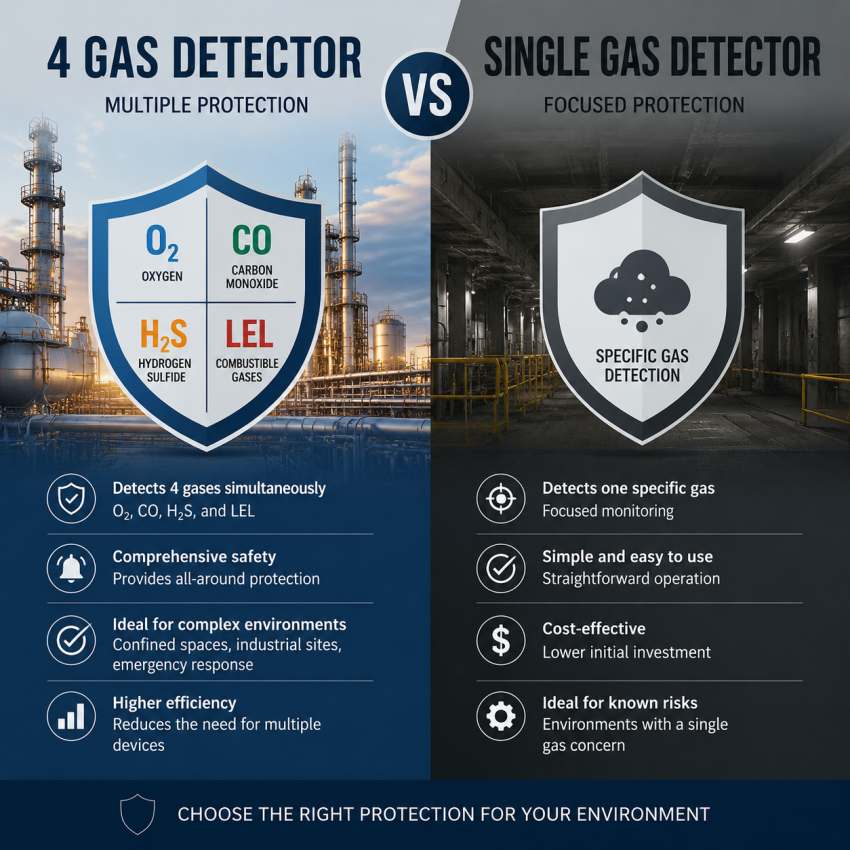
A single gas detector is a portable gas detection device that is specially used to detect the concentration of a specific gas.
The single gas detector is a simple and efficient personal protective equipment when workers clearly know the main types of dangerous gases in the working environment.
For example, in the oil and gas industry, if there is a high risk of hydrogen sulfide (H₂S) leakage in the work area, staff usually choose to carry a hydrogen sulfide single gas detector for real-time monitoring.
Common types of single gas detection include:
- Carbon monoxide (CO) detector
- Hydrogen sulfide (H₂S) detector
- Oxygen (O₂) detector
- Chlorine (Cl₂) detector
- Ammonia gas (NH₃) detector
- Flammable gas (LEL) detector
Single gas detectors usually have the characteristics of small size, light weight, simple operation, and long battery life, which are very suitable for daily inspection and personal safety protection.
Advantages of Single Gas Detector
1. Simple Operation
The single gas detector only monitors one gas, so the operation is simpler.
Workers do not need to pay attention to multiple gas parameters and can quickly check the current gas concentration and alarm status, thus improving on-site work efficiency.
2. Longer Battery Life
Because only one sensor works, the power consumption of a single gas detector is usually low.
Compared with multi-gas detectors, single gas detectors can provide longer continuous operation and are more suitable for long-term wearing.
3. Lower Cost
If there is only one main hazardous gas in the working environment, choosing a single gas detector can reduce procurement costs and meet safety detection requirements.
4. Lightweight and Easy to Carry
The single gas detector adopts a compact design, which can be easily worn by staff.
Applicable to:
- Daily equipment inspection
- Personal safety protection
- Gas monitoring in specific areas
What Is a 4 Gas Detector?
A 4 gas detector is a portable multi-gas detection device that can detect the concentrations of four gases at the same time.
The most common 4-in-1 gas detection combinations in the industrial field include:
- LEL (Combustible gas)
- Oxygen (O₂)
- Carbon monoxide (CO)
- Hydrogen sulfide (H₂S)
These four gases are the most common risk factors in industrial environments, especially in confined space operations.
A 4 gas detector can monitor the risks of multiple gases at the same time, give an alarm in time before dangerous situations occur, and improve staff safety.
Advantages of 4 Gas Detector
1. Simultaneous Detection of Multiple Gases
The biggest advantage of a 4 gas detector is that it can simultaneously monitor multiple risk factors.
For example, when entering a confined space, staff may face:
- Risk of insufficient oxygen
- Toxic gas leakage
- Combustible gas accumulation
A single gas detector can only find one risk, while a 4 gas detector can provide more comprehensive safety monitoring.
2. Suitable for Complex Industrial Environments
There are unknown or changing gas risks in many industrial sites.
4 gas detectors are widely used in:
- Oil and gas industry
- Chemical plants
- Sewage treatment plants
- Mines
- Tank maintenance
- Confined space operations
It can provide more comprehensive protection for staff.
3. Improve Emergency Rescue Capability
During gas leakage accidents or emergency rescue operations, multi-gas detection data is very important.
A 4 gas detector can help safety personnel quickly judge:
- Is the environment suitable for entry?
- Is the oxygen concentration normal?
- Does the toxic gas exceed the standard?
- Is there a risk of explosion?
4 Gas Detector vs Single Gas Detector: Main Differences
| Comparison Item | Single Gas Detector | 4 Gas Detector |
|---|---|---|
| Number of detected gases | One gas | Four gases simultaneously |
| Main uses | Specific gas monitoring | Comprehensive safety monitoring |
| Volume and weight | Smaller and lighter | Slightly larger |
| Battery consumption | Lower | Relatively higher |
| Operation | Simple operation | Need to pay attention to multiple data |
| Procurement cost | Lower | Higher |
| Usage environment | Known gas risk | Multiple or unknown gas risks |
| Typical users | Individual workers | Industrial safety teams |
How to Choose a Suitable Gas Detector?
Choosing a 4 gas detector or single gas detector mainly depends on the working environment and safety requirements.
Suitable for Selecting a Single Gas Detector
A single gas detector may be more suitable if the following conditions are met:
- There is only one main hazardous gas in the working area
- The type of gas risk is clear
- Personal protection is required
- Longer battery life is preferred
- Portable equipment is needed
Application Cases:
Petroleum Industry
Used to detect hydrogen sulfide (H₂S) leakage.
Boiler Room
Used to detect carbon monoxide (CO).
Specific Industrial Areas
Used for oxygen concentration monitoring.
Suitable for Selecting a 4 Gas Detector
A 4 gas detector is more recommended in the following environments:
- Confined space entry operations
- Industrial equipment maintenance
- Chemical production areas
- Oil and gas facilities
- Areas with unknown gas risks
Typical Applications:
- Internal inspection of storage tanks
- Underground pipeline maintenance
- Sewage well operations
- Industrial emergency rescue
Sensor Technology in Gas Detectors
Whether it is a single gas detector or a four-gas detector, it depends on different types of sensors to achieve accurate detection.
Electrochemical Sensor
Mainly used to detect toxic gases:
- CO
- H₂S
- NH₃
- Cl₂
Features:
- High sensitivity
- Suitable for low concentration gas detection
Catalytic Combustion Sensor
Mainly used for detecting combustible gases.
The working principle is to measure gas concentration through the oxidation reaction of combustible gas on the sensor surface.
Commonly used for:
- Methane (CH₄)
- Hydrogen (H₂)
- LPG, etc.
Infrared Sensor
Mainly used for detecting hydrocarbon combustible gases.
Advantages:
- High stability
- Long service life
- Strong anti-interference ability
Why Is It Important to Choose a Gas Detector Correctly?
Choosing the wrong gas detection equipment may bring safety risks.
For example:
- Using a single gas detector in an environment where there are many kinds of dangerous gases may cause other dangerous gases to be missed.
- Using a 4 gas detector in a simple single gas environment may increase unnecessary procurement costs.
When choosing a gas detection scheme, enterprises should consider:
- Dangerous gas type
- Working environment conditions
- Detection range requirements
- Alarm type
- Industry safety standards
- Staff protection requirements
Conclusion
The main difference between a 4 gas detector and a single gas detector lies in the quantity of gas detected and the application scenarios.
The single gas detector is suitable for a clear single gas risk environment and has the advantages of simple operation, small size, and low cost.
The 4 gas detector can detect combustible gas, oxygen, carbon monoxide, and hydrogen sulfide at the same time, making it more suitable for complex industrial environments and confined space operations.
For industries such as oil and gas, chemical manufacturing, mining, and sewage treatment, a 4 gas detector is usually a more comprehensive safety choice.
For workplaces where the gas risk type has been defined, a single gas detector can also provide reliable and economical safety protection.
Choosing the right gas detection equipment can not only improve work efficiency but also help enterprises establish a safer industrial environment.


 WhatsApp: 8619339980364
 E-mail: contact@hirepsafety.com