
LEL Combustible Gas Detector for Industrial Gas Leakage Monitoring: Installation and Selection Guide
Combustible gas leakage is one of the main safety risks faced by industrial facilities. In oil and gas, chemical production, manufacturing and fuel storage industries, flammable gases may leak from pipelines, valves, compressors and storage equipment. If these gases accumulate in the surrounding environment, it may form a fire or explosion hazard.
LEL combustible gas detector is mainly used to monitor the concentration of combustible gas in the environment and provide early warning when the gas concentration rises. By installing appropriate gas detection equipment in high-risk areas, industrial enterprises can improve their gas leakage monitoring capabilities and reduce potential safety risks.
Understanding the working principle, installation requirements and selection criteria of LEL combustible gas detector is very important for establishing an effective industrial gas monitoring system.
What Is the Function of LEL Combustible Gas Detector?
LEL combustible gas detector is an industrial safety instrument, which is mainly used to measure the concentration of combustible gas in the air. LEL is the abbreviation of Lower Explosive Limit, which is called the lower explosive limit in Chinese, and refers to the lowest concentration of combustible gas that can be ignited in air under appropriate conditions.
Industrial LEL combustible gas detector usually displays the measurement results by using the lower explosive limit percentage (%LEL). This method can help operators to evaluate the concentration of combustible gas and identify potential explosion hazards.
For example, when the detector displays 20%LEL, it means that the currently measured combustible gas concentration has reached 20% of the lower explosion limit of the gas. The actual gas concentration depends on the specific gas type detected.
LEL combustible gas detector is usually used to detect methane, propane and other combustible gases compatible with sensors. The specific sensor technology needs to be selected according to the target gas and the actual working environment.
What Is the Working Principle of Industrial LEL Combustible Gas Detector?
Industrial LEL combustible gas detector usually uses catalytic combustion or infrared sensor technology to measure combustible gas concentration.
Catalytic Combustion Detection
Catalytic combustion sensor detects combustible gas by heating the oxidation reaction on the surface of sensitive element. When the gas enters the sensor, the oxidation reaction will generate heat and cause the resistance of the sensitive element to change.
The detector processes the generated signals and converts them into corresponding gas concentration readings.
Catalytic combustion sensor is widely used in industrial combustible gas monitoring because it can detect a variety of combustible gases. However, the sensor needs enough oxygen to work normally, and may be affected by catalyst poisoning or pollution.
Infrared Gas Detection
The infrared sensor measures the concentration of combustible gas by detecting the absorption degree of infrared radiation with a specific wavelength.
This technology is usually used to detect methane and some hydrocarbon gases. The measuring principle of infrared sensor does not depend on oxygen, and it is usually not easily affected by the problem of catalyst poisoning.
However, infrared detection technology is not suitable for all combustible gases. For example, hydrogen monitoring requires the use of sensor technology that matches its detection characteristics.
Main Installation Position of LEL Combustible Gas Detector
The installation position of LEL combustible gas detector will directly affect the gas leakage monitoring effect. During installation, reasonable planning should be made according to gas properties, potential leakage sources, ventilation conditions and site layout.
Near Gas Pipelines and Valves
Gas pipelines, connectors, valves and flanges are common potential leakage locations. Installing fixed gas detectors near these areas can help to find abnormal combustible gas concentrations in time.
Around the Compressor and Process Equipment
Industrial compressors, pumps and gas treatment equipment may leak during operation or maintenance. LEL detector can continuously monitor these high-risk areas.
Near the Gas Storage Tank
Appropriate gas monitoring measures should be taken for storage tanks storing flammable gases or volatile substances. Fixed detectors can be arranged around the storage tank according to the potential leakage position, so as to find the potential safety hazard as soon as possible.
A Poorly Ventilated Area
In areas with limited ventilation conditions, combustible gas may accumulate continuously. When installing the gas detector, it is necessary to consider the air flow direction, spatial structure and physical properties of the target gas.
For example, under common conditions, the density of methane is lower than that of air, while the density of propane is higher than that of air. Therefore, the installation position of the detector should be determined according to the actual gas characteristics and site environment.
Confined Space Environment
There may be flammable gas hazards in storage tanks, underground equipment rooms, pipelines and other confined spaces. On the premise of following the applicable safe operation procedures in confined space, a portable multi-gas detector can be used to detect the ambient gas condition before the workers enter the confined space and during the operation.
What Is the Difference Between Fixed LEL Combustible Gas Detector and Portable LEL Combustible Gas Detector?
Industrial gas monitoring system usually uses both fixed and portable LEL combustible gas detectors to meet different safety monitoring requirements.
Fixed LEL Combustible Gas Detector
HIREP Fixed Gas Detector is usually installed at designated monitoring positions to continuously measure the concentration of combustible gas in the environment.
The fixed detector is suitable for pipelines, production facilities, storage areas and other places that need long-term monitoring.
According to the specific product configuration, the industrial gas detector can support 4-20mA, RS485 or relay output, which is used to connect the gas alarm controller and the industrial automation system.
Portable LEL Combustible Gas Detector
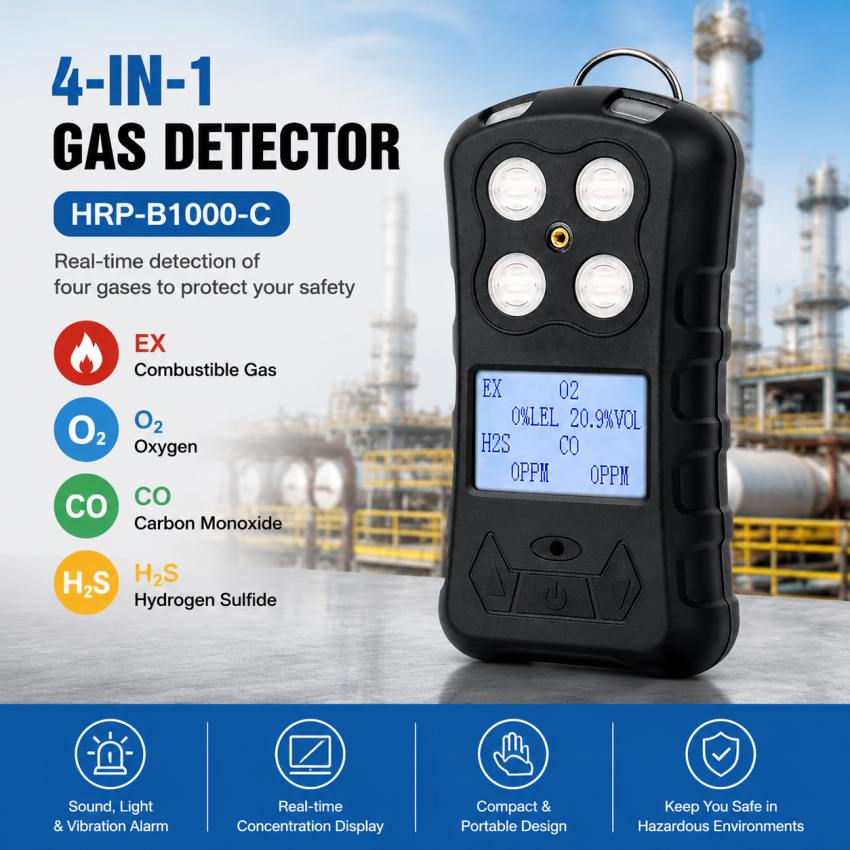
HIREP Portable Gas Detector adopts handheld design, which is mainly used for mobile inspection and personal safety monitoring.
Portable detector is suitable for equipment maintenance personnel, on-site inspection personnel and staff who need to carry out gas detection in different places.
Fixed and portable detection equipment can be used together to realize the gas safety management mode combining continuous regional monitoring with flexible mobile inspection.
How to Choose a Suitable LEL Combustible Gas Detector for Industrial Application?
To select a suitable LEL combustible gas detector, the following factors need to be considered comprehensively.
Target Gas Compatibility
Firstly, determine the type of combustible gas to be monitored. Different gases have different detection characteristics, so it is very important to ensure that the sensor is compatible with the target gas.
Sensor Technology
Catalytic combustion sensor and infrared sensor have different advantages and limitations. Gas composition, oxygen conditions and potential sensor pollution should be considered when selecting.
Measuring Range
According to the possible gas concentration in the field and the actual monitoring application requirements, select the appropriate detection range.
Environmental Protection Performance
There may be high humidity, dust, vibration or outdoor exposure in the industrial environment. The detector with appropriate protection level and environmental adaptability parameters should be selected according to the actual use environment.
Explosion-Proof Requirements
For dangerous areas, the detector must meet the explosion-proof requirements and relevant certification standards applicable to the installation location.
Signal Output
Check whether the detector supports the communication interfaces required by the existing gas monitoring system, such as 4-20mA, RS485 or relay output.
Calibration and Maintenance
Regular calibration, function test and sensor inspection are important measures to keep the gas detection equipment running reliably.
Solution for Detecting Combustible Gas in HIREP Industrial LEL
HIREP Safety focuses on the development and manufacture of industrial gas detection equipment, and its products are mainly used for combustible gas monitoring, toxic gas detection and industrial safety applications.
HIREP fixed gas detector can be used for continuous gas monitoring in industrial facilities. According to different product configurations, the equipment can be connected to the gas alarm system and industrial control equipment through compatible signal output and communication interfaces.
For the requirements of mobile inspection and personal safety protection, HIREP portable gas detector can provide flexible gas monitoring solutions for industrial workers.
HIREP gas detection products are suitable for oil and gas facilities, chemical plants, manufacturing workshops, storage areas and confined space operations.
Choosing the appropriate LEL combustible gas detector according to the target gas type, installation environment and monitoring requirements is helpful for enterprises to improve the gas leakage detection ability and strengthen the safety management of industrial production.


 WhatsApp: 8619339980364
 E-mail: contact@hirepsafety.com
