
Industrial Gas Monitoring System: Composition, Application Scenarios and Equipment Selection Guide
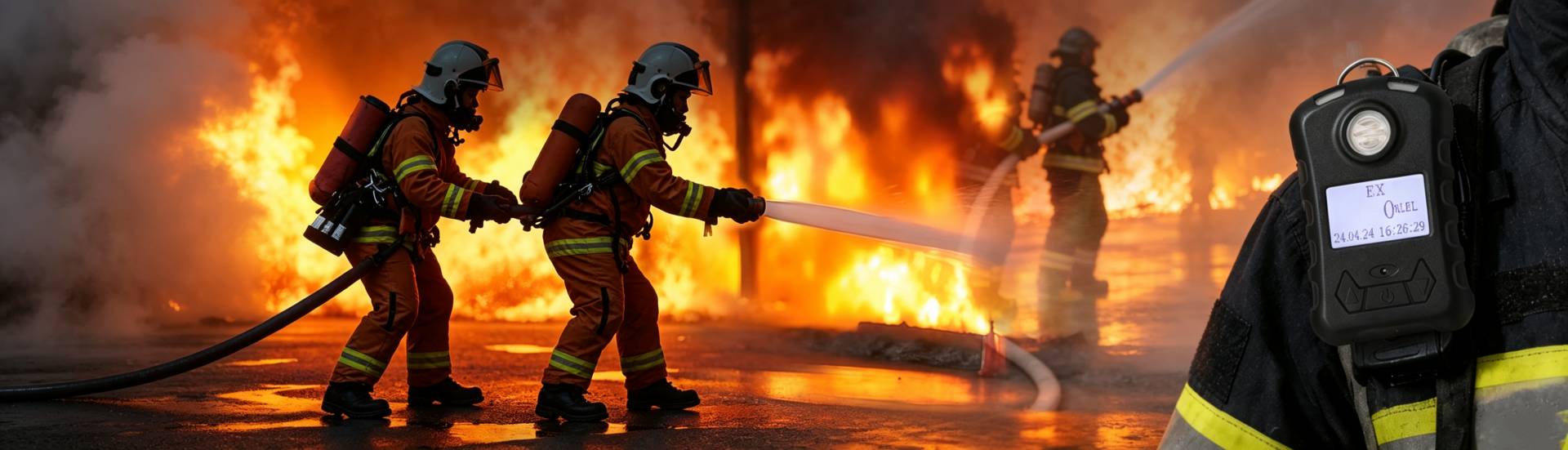
In petrochemical, natural gas, manufacturing and sewage treatment industries, methane, hydrogen sulfide, carbon monoxide, ammonia and other dangerous gases are often exposed in the production process. These gases may leak from pipeline joints, valves, storage tanks, compressors and production equipment. Some gases are colorless and odorless, so it is difficult to find them in time only by manual inspection. Once the concentration reaches a dangerous level, it may cause poisoning, suffocation, fire and even explosion accidents.
Therefore, more and more industrial enterprises begin to configure industrial gas monitoring systems to continuously monitor key areas. Through the cooperation of fixed detection equipment, portable detector and alarm control equipment, the change of gas concentration in the field can be grasped more timely and the safety risk in the production process can be reduced.
What Equipment Does the Industrial Gas Monitoring System Consist Of?
A complete industrial gas monitoring system usually includes fixed gas detector, portable gas detector, alarm controller and signal transmission equipment. Different equipment undertakes different monitoring tasks and needs to be reasonably configured according to the site environment and production process.
Fixed Gas Detector
Stationary gas detectors are mainly installed in places where gas leakage is easy to occur, such as pipeline joints, valves, compressors, reaction equipment and storage tanks. The equipment can continuously collect the gas concentration in the environment and transmit the detection data to the alarm controller or the central control system.
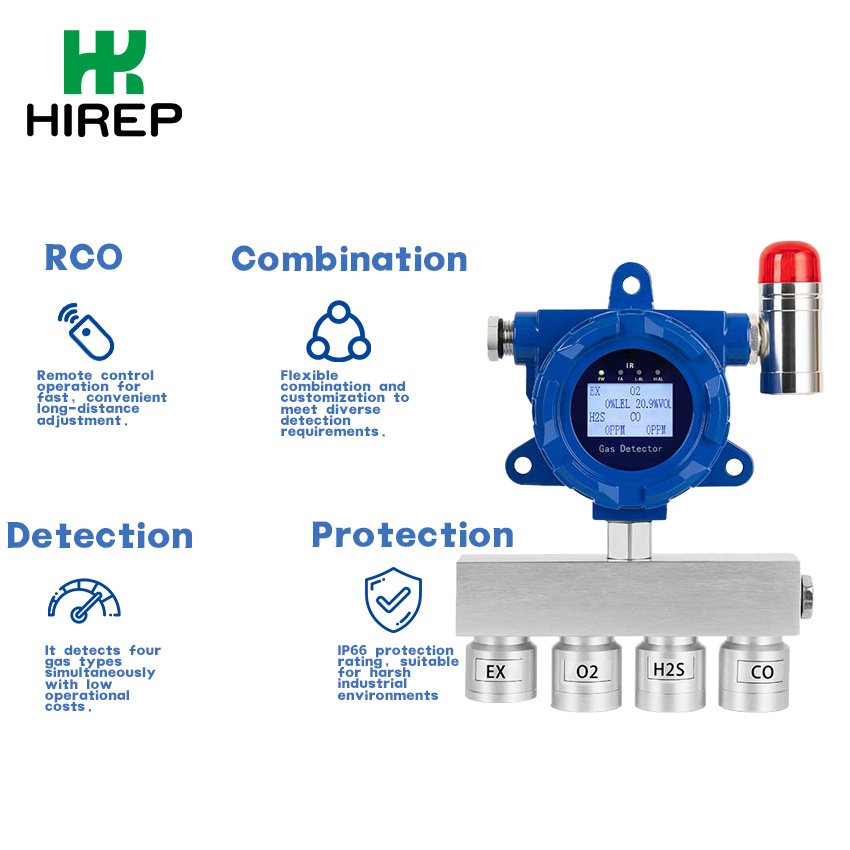
For industrial sites that need to monitor many kinds of dangerous gases for a long time, HRP-T2000 Fixed Multi-Gas Detector can be selected according to the detection requirements. This series of equipment can be applied to different industrial gas monitoring scenarios according to specific configurations, and support 4-20mA, RS485 and other signal output modes.
Portable Gas Detector
Stationary equipment is mainly responsible for continuous monitoring in key areas, while portable gas detectors are more used for personnel inspection, equipment maintenance and limited space operations.
For example, before workers enter underground pipelines, sewage pools, storage tanks or other confined spaces, they need to detect the gas environment in the working area first. During the operation, it is also necessary to continuously monitor personal gas according to the site requirements.
HRP-B1000-C Portable Four-in-One Gas Detector can detect LEL, oxygen, carbon monoxide and hydrogen sulfide at the same time, which is suitable for a variety of industrial inspection and limited space safety inspection tasks.
Gas Alarm Controller and Signal Transmission Equipment
The alarm controller is responsible for receiving the data sent by the gas detector, and performing centralized display and alarm management on the field gas concentration. When the detection value reaches the set alarm threshold, the system can trigger the acousto-optic alarm device to remind the field personnel to take timely measures.
In a factory with a high degree of automation, the gas monitoring system can also be connected with PLC, DCS or other control systems through interfaces such as 4-20mA and RS485, which is convenient for managers to check the gas concentration and alarm status in different areas in the control room.
What Industries Are Industrial Gas Monitoring Systems Mainly Used In?
Oil and Gas Industry
In natural gas treatment stations, transmission pipelines, compressor rooms and gas storage facilities, the leakage of combustible gases such as methane is a safety issue that needs to be paid attention to. By installing fixed gas detectors near key equipment and potential leakage points, abnormal concentration changes can be found in time. Workers can also use portable detectors for on-site inspection when they are carrying out equipment maintenance or pipeline inspection.
Chemical Production Industry
Chemical plants involve a variety of raw materials, reaction media and production processes, and different gas risks may exist in different regions. For example, some production areas need to monitor toxic gases such as ammonia, chlorine and hydrogen sulfide, while solvent storage and transportation areas need to pay attention to VOC and combustible gas concentration. Equipment selection should be determined in combination with the actual chemicals used and the site environment.
Sewage Treatment Industry
Hydrogen sulfide and methane are easily produced in sewage treatment tanks, underground pipelines, pumping stations and sludge treatment areas. Especially in the space with poor ventilation conditions, gas may gradually accumulate. Therefore, it is an important link of on-site safety management to detect gas before working in limited space and to configure continuous monitoring equipment when necessary.
Industrial Manufacturing Workshop
In mechanical processing, metal processing, food production and other manufacturing places, the production process may involve natural gas, liquefied petroleum gas, ammonia, solvent vapor and other dangerous substances. Setting corresponding gas monitoring points according to production process is helpful to find leakage problems in time and avoid affecting production and personnel safety.
How to Select Industrial Gas Monitoring Equipment?
When choosing industrial gas monitoring equipment, we must first make clear the types of gases to be detected. Different gases correspond to different sensor types, and it is not possible to judge whether it is applicable only by the appearance of the equipment or the number of detection channels.
Secondly, the installation environment needs to be considered. Outdoor, underground space, humid areas and places with explosion danger have different requirements on the protection level, explosion-proof performance and working temperature of equipment. The installation location also needs to be determined in combination with gas density, leakage source location and site ventilation.
In addition, attention should also be paid to the detection range, response time, alarm setting and signal output mode of the equipment. If it is necessary to access the existing automation system, it should be confirmed in advance whether the communication interface and protocol match.
For monitoring equipment that needs long-term operation, daily inspection, periodic calibration and sensor maintenance can not be ignored. Only when the equipment selection is reasonable, the installation position is correct and it is maintained in a good state, can the gas monitoring system continue to play its role.
HIREP Industrial Gas Detection Equipment
HIREP focuses on the research and development and production of fixed and portable gas detection equipment, and its products are suitable for oil and gas, chemical industry, manufacturing industry, sewage treatment and other industrial safety fields.
From the continuous monitoring of the fixed gas detector to the on-site inspection of the portable four-in-one detector, different types of equipment can be used in combination according to actual needs. When planning the gas monitoring system, enterprises should choose the appropriate detection scheme according to the types of dangerous gases, site layout and control requirements.
For more information about fixed and portable gas detection products, please visit the official website of HIREP: www.hirepsafety.com.


 WhatsApp: 8619339980364
 E-mail: contact@hirepsafety.com
