
Hydrogen Sulfide Gas Fixed Detection System: Complete Guide for Industrial Safety
What Is a Fixed Detection System for Hydrogen Sulfide Gas?
Introduction
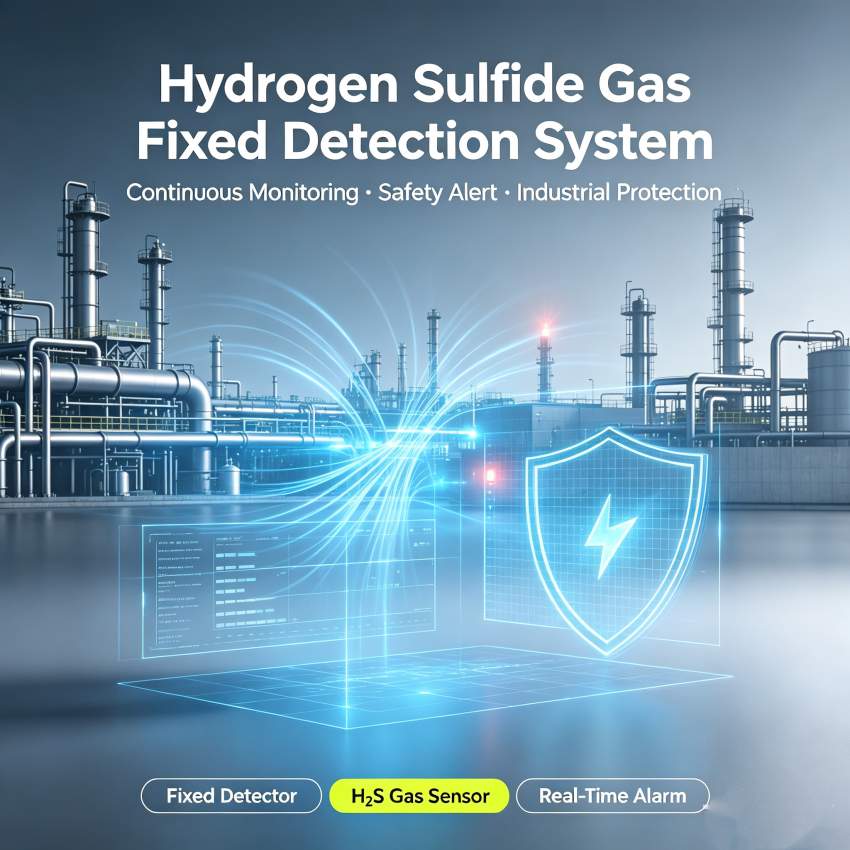
The fixed detection system of hydrogen sulfide gas is an industrial gas monitoring equipment installed in a fixed position, which is used to detect the change of H₂S concentration in the environment for a long time.
Different from the portable gas detector that workers need to carry with them, the fixed system is usually installed in the area where there is a risk of gas leakage, and continuously collects air data through sensors, and gives an alarm in time when abnormal concentration is detected.
A complete fixed hydrogen sulfide detection system usually consists of the following parts:
- H₂S gas detection sensor
- Control host
- Acousto-optic alarm device
- Data communication module
- Power supply system
According to the requirements of the project, the system can also be connected with the factory control system, ventilation equipment and emergency linkage device to achieve faster safety response.
Why Is It Necessary to Install a Fixed Detection System for Hydrogen Sulfide?
One of the biggest dangers of hydrogen sulfide is that it is difficult to be reliably identified.
At low concentration, H₂S may smell like rotten eggs, but with the increase of concentration, human sense of smell will quickly lose its ability to judge, so it is impossible to judge whether it is safe by smell.
Exposure to high concentrations of hydrogen sulfide may lead to:
- Respiratory system injury
- Dizziness, loss of consciousness
- Severe poisoning
- Life danger
Therefore, in industrial areas where H₂S gas may be produced, installing a fixed detection system can help enterprises find risks in advance and reduce the probability of accidents.
Working Principle of Hydrogen Sulfide Fixed Detection System
The fixed H₂S detection system mainly completes gas monitoring through the following processes:
1. Real-Time Sensor Detection
The H₂S sensors in the system are installed in key monitoring areas, such as the vicinity of production equipment, storage areas and pipeline areas.
The sensor continuously detects the concentration of hydrogen sulfide in the air and converts the detection result into an electrical signal.
At present, electrochemical sensors are common in industrial applications.
Characteristics of Electrochemical Sensor:
- Has high sensitivity to toxic gas
- Detection stability
- Suitable for continuous on-line monitoring
2. Data Processing and Concentration Analysis
The data collected by the sensor will be transmitted to the control host.
The system analyzes and processes the signal and displays it in real time:
- Current H₂S concentration
- Alarm status
- Equipment operation state
- Sensor status
Workers can quickly know the gas situation on site through the control platform.
3. Over-Standard Alarm
When the concentration of hydrogen sulfide reaches the set alarm value, the system will immediately start the alarm.
Common alarm methods include:
- Audible alarm
- LED warning lamp
- Remote signal transmission
- Control system linkage
Through a variety of alarm methods, it can help field personnel to take evacuation or protective measures in time.
4. System Linkage Control
In large-scale industrial projects, the fixed gas detection system usually does not operate alone, but is combined with other safety equipment.
For example:
- Automatic ventilation system
- Emergency stop system
- Central monitoring platform
- Fire safety system
When dangerous gas is detected, corresponding safety measures can be quickly started.
Main Application Fields of Hydrogen Sulfide Fixed Detection System
Oil and Gas Industry
There may be H₂S associated with natural gas in the process of oil and gas production.
Fixed detection systems are widely used in:
- Refinery
- Natural gas treatment station
- Drilling platform
- Oil and gas storage area
Reduce staff exposure risk through continuous monitoring.
Sewage Treatment Industry
In the process of sewage treatment, the decomposition of organic matter may produce hydrogen sulfide.
Common installation locations include:
- Sewage pumping station
- Sewage pool area
- Ground pipe
- Confined space
Chemical Production Field
Some chemical production processes involve toxic gases, and the fixed H₂S detection system can help enterprises to establish a continuous safety monitoring system.
Advantages of Fixed H₂S Detection System
1. All-Weather Continuous Monitoring
The system can run for a long time without manual operation and continuously monitor key areas.
2. Discover the Danger in Advance
Through real-time data changes, a reminder can be issued before the gas reaches a dangerous level.
3. Wide Coverage
By reasonably arranging multiple detection points, large-scale regional security monitoring can be realized.
4. Support System Integration
It can be connected with the existing safety management system of the enterprise to realize automatic management.
Difference Between Fixed H₂S Detection System and Portable Detector
The two devices are suitable for different scenarios.
Fixed H₂S Detection System
Applicable to:
- Long-term fixed monitoring
- High-risk production area
- Factory safety management
Features:
- Long running
- Automatic alarm
- Regional protection
Portable H₂S Detector
Applicable to:
- Daily inspection
- Plant maintenance
- Confined space operation
Features:
- Portable
- Flexible use
- Strong personal protection ability
In practical industrial applications, many enterprises will use both fixed and portable detection equipment to improve the overall safety level through “regional monitoring + personal protection”.
How to Choose a Suitable Fixed Detection System for Hydrogen Sulfide?
When selecting a system, the following factors need to be considered:
1. Use Environment
Including:
- Indoor or outdoor environment
- Temperature and humidity conditions
- Danger zone grade
- Installation position
2. Detection Requirements
Need to confirm:
- Detecting gas type
- Examination area
- Alarm standard
3. Sensor Performance
Different sensors are suitable for different environments, and attention should be paid to:
- Detection accuracy
- Response speed
- Life
4. Safety Certification
Industrial hazardous areas usually need to meet relevant certifications, such as:
- ATEX
- IECEx
- UL
Certified products can meet more stringent industrial safety requirements.
System Maintenance Suggestion
In order to ensure long-term stable operation, it is necessary to carry out:
- Sensor calibration
- Alarm test
- Systematic inspection
- Power supply detection
- Component replacement
Good maintenance can reduce detection error and improve system reliability.


 WhatsApp: 8619339980364
 E-mail: contact@hirepsafety.com