
Fixed Gas Detection System on Tankers: Complete Guide to Marine Gas Safety
What Is a Fixed Gas Detection System for Oil Tankers?
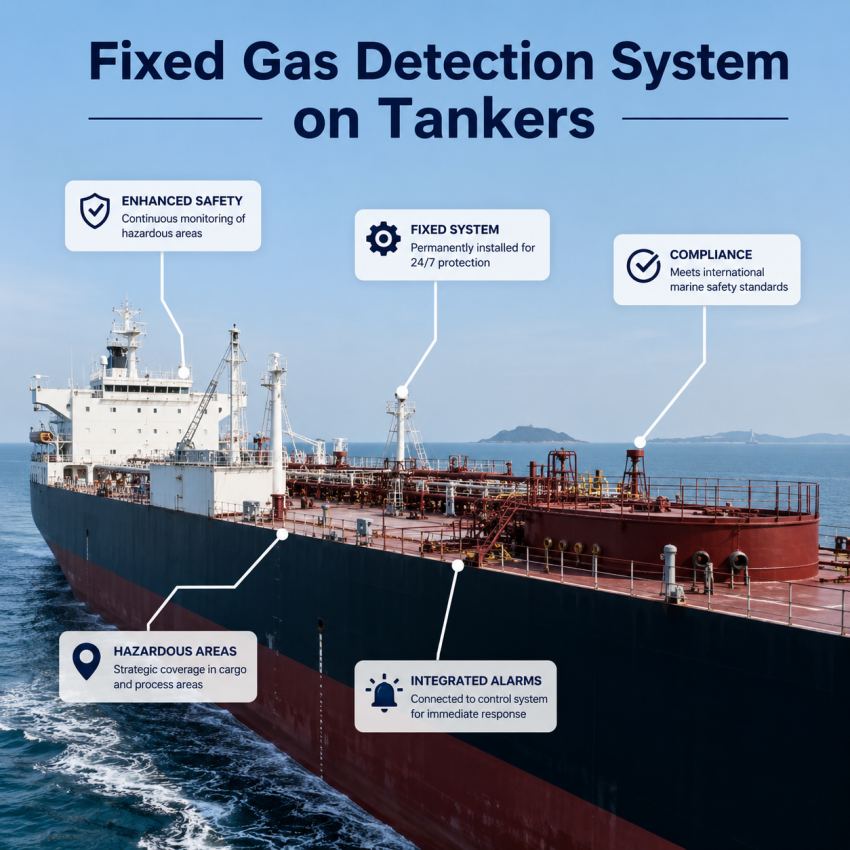
Fixed gas detection system is a set of gas monitoring equipment permanently installed on the ship, which consists of multiple gas sensors, control host, alarm device and data communication module.
The system collects environmental gas concentration data in real time through sensors installed in different dangerous areas, and transmits the detection results to the central control unit.
When the detected gas concentration reaches the preset alarm value, the system will automatically start the acousto-optic alarm to remind the crew to deal with the potential danger in time.
A typical fixed gas detection system for oil tankers includes:
- Gas detection sensor
- Central control host
- Acousto-optic alarm device
- Data acquisition module
- Communication interface
- Main power supply and standby power supply system
The system can run continuously during the navigation, loading and unloading and docking of the ship, providing real-time safety protection for the ship.
Why Do Tankers Need Fixed Gas Detection Systems?
1. Prevent Fire and Explosion Accidents
Oil tankers usually transport crude oil, gasoline, diesel oil and various chemical liquids, which may produce a lot of flammable vapor during transportation and loading and unloading.
When the concentration of combustible gas reaches the lower explosion limit (LEL), it may burn or even explode when it meets a fire source.
The fixed gas detection system can detect the abnormal change of gas concentration in advance and help the staff:
- Find the source of leakage in time
- Strengthen ventilation treatment
- Isolate the dangerous area
- Eliminate potential ignition risk
Early warning can effectively reduce the probability of major ship accidents.
2. Realize Continuous Monitoring of Dangerous Areas
There are a lot of enclosed or semi-enclosed spaces inside the tanker, and gas accumulation is easy to occur in these areas, such as:
- Oil hold
- Pump room
- Ballast
- Engine room
- Fuel storage area
- Chemical treatment area
All-weather monitoring cannot be achieved by manual inspection, while the fixed gas detection system can run continuously without the limitation of personnel time.
Especially in the following cases, continuous monitoring is more important:
- In the process of cargo loading and unloading
- During the night voyage
- During long-distance transportation
- During ship maintenance operation
What Gases Are Mainly Detected by the Fixed Gas Detection System for Oil Tankers?
According to the type of ship and the different goods transported, the types of detection gases are also different.
Combustible Gas Detection
Combustible gas is one of the most important safety risks of oil tankers.
Common detection gases include:
- Methane (CH₄)
- Propane (C₃H₈)
- Butane (C₄H₁₀)
- Petroleum vapor
These gases are usually monitored as a percentage of LEL (lower explosive limit) concentration.
Toxic Gas Detection
Some oils and chemicals may release toxic gases during transportation, which poses a serious threat to the health of crew members.
Common toxic gases include:
- Hydrogen sulfide (H₂S)
- Carbon monoxide (CO)
- Ammonia gas (NH₃)
Through continuous monitoring, the risk of personnel poisoning can be reduced.
Oxygen Concentration Detection
Oxygen detection is also an important part of ship safety.
The low oxygen environment in the tanker may be caused by the following reasons:
- Inert gas system operation
- Cargo vapor replaces air
- Insufficient ventilation
Insufficient oxygen usually does not produce obvious visual or olfactory warning, so professional equipment is needed for real-time detection.
Main Components of Fixed Gas Detection System for Oil Tanker
Gas Sensor
The sensor is installed at the position where gas leakage may occur, and is used to detect the target gas concentration in real time.
According to different gas types, different sensing technologies can be used:
- Catalytic combustion sensor: used to detect combustible gas.
- Infrared sensor: used to detect hydrocarbon gas.
- Electrochemical sensor: used to detect toxic gases.
Control Host
The control host is the data processing center of the whole system and is responsible for:
- Receiving sensor signals
- Display gas concentration
- Judging the alarm state
- Detect system failure
- Realize data communication
The modern system can also be connected with the ship automation system to realize centralized management.
Alarm System
When the gas concentration exceeds the safe set value, the system will automatically start:
- Audible alarm
- LED lighting alarm
- Remote alarm prompt
Help the crew to quickly understand the dangerous location and risk degree.
Matters Needing Attention in Installation of Oil Tanker Gas Detection System
Correct installation is the key to ensure the accuracy of detection.
Sensor Installation Position
The sensor position needs to be determined according to the following factors:
- Gas density
- Air flow direction
- Possible leakage location
- Structural characteristics of ships
For example:
Dense gas may gather in low-lying areas, while lighter gas may spread to the upper space.
Marine Environmental Adaptability
The marine environment usually has:
- Salt spray corrosion
- Judder
- Temperature change
- High humidity
Therefore, the gas detection equipment used by oil tankers needs to have good environmental adaptability and meet the relevant ship protection requirements.
Relevant Standards of Fixed Gas Detection System for Oil Tankers
The fixed gas detection system of oil tanker usually needs to meet the relevant requirements of international maritime safety, including:
- Fire safety requirements for ships
- Requirements for transport of dangerous goods
- Safety requirements for confined space operation
- Safety requirements for explosion protection
Relevant certification and requirements usually involve:
- Explosion proof certification
- Classification society approval
- Alarm reliability
- Regular calibration and maintenance capability
These standards ensure that the equipment can operate stably in a complex marine environment.
Difference Between Fixed Gas Detection System and Portable Gas Detector
Fixed and portable gas detection equipment assume different roles on oil tankers.
| Comparison Project | Fixed Gas Detection System | Portable Gas Detector |
|---|---|---|
| Monitoring mode | Automatic continuous monitoring | Manual detection |
| Installation method | Permanent installation | Hand-held mobile |
| Coverage | Multi-area monitoring | Single point detection |
| Response speed | Automatic alarm | Depends on the operator |
| Main uses | Long-term safety protection | Daily inspection and job detection |
For oil tankers, the fixed system provides basic safety guarantee, while the portable detector is used to assist inspection and maintenance operations.
Maintenance of Fixed Gas Detection System for Oil Tanker
Regular maintenance is an important measure to ensure the accurate and reliable operation of the system.
Sensor Calibration
The gas sensor needs to be calibrated according to the specified period to maintain the detection accuracy.
Alarm Function Test
Test the alarm function regularly to ensure that the acousto-optic alarm equipment works normally.
Systematic Inspection
Maintenance personnel should check:
- Sensor status
- Cable connection
- Control the running state of the host computer
- Standby power supply function
Maintenance Record
Complete maintenance records are not only helpful for equipment management, but also can meet the requirements of ship safety inspection.
Future Development Trend of Oil Tanker Gas Detection Technology
With the development of intelligent ships, the fixed gas detection system is developing towards intelligence.
Future technology trends include:
- Remote monitoring
- Digital communication
- Automatic fault diagnosis
- Higher precision sensing technology
- Data Analysis and Predictive Safety Management
Intelligent gas detection technology will help shipping enterprises to improve their safety level and optimize their operational efficiency.


 WhatsApp: 8619339980364
 E-mail: contact@hirepsafety.com