
How to use the portable four-in-one gas detector: a complete guide to daily safety monitoring
Portable four-in-one gas detector is an important safety detection equipment, which is suitable for industrial operation and limited space operation environment that may be exposed to dangerous gases. By continuously monitoring the concentration of various gases, the gas detector can give an alarm in time when the gas concentration reaches a dangerous level, providing early safety warning for the staff.
A typical portable four-in-one gas detector is usually used to detect LEL combustible gas, oxygen (O), carbon monoxide (CO) and hydrogen sulfide (HS). This kind of equipment is widely used in oil and gas, chemical plants, sewage treatment, mines, industrial production workshops, public facilities and limited spaces.
However, just carrying a gas detector cannot guarantee safety. Correct operation, inspection, calibration and maintenance are very important to ensure that the detector can work reliably.
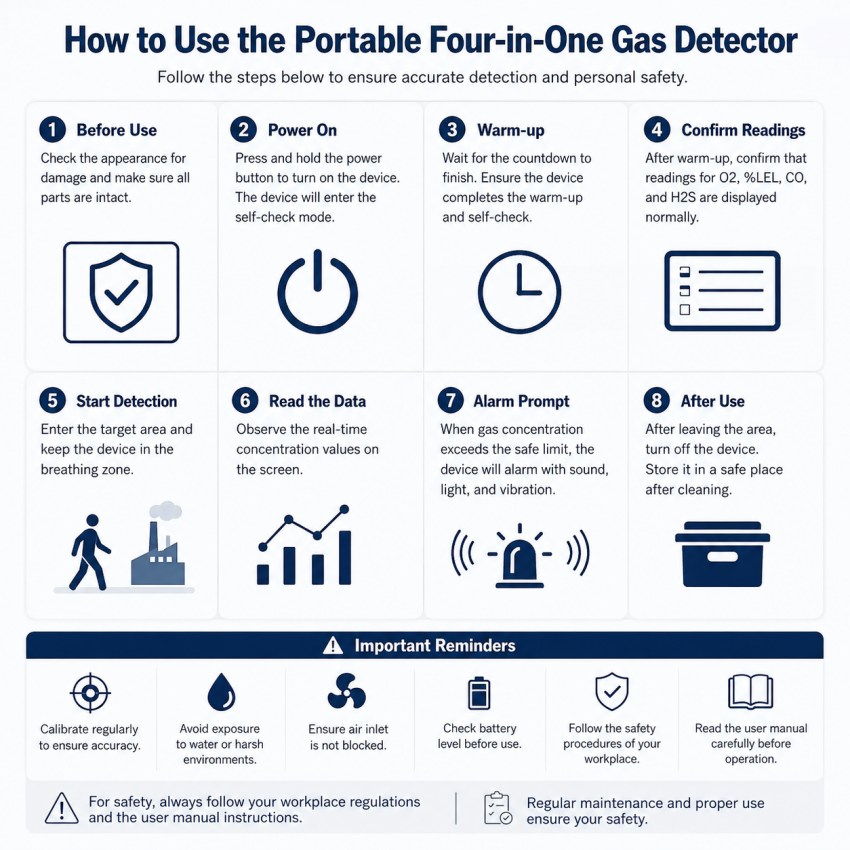
1. Check the gas detector before use.
Before entering the environment where dangerous gas may exist, the porta ble four-in-one gas detector should be inspected comprehensively.
Check whether there is obvious crack, damage or serious pollution in the instrument shell, and confirm that the display screen can display normally and the key operation is normal. At the same time, check the battery power to ensure that the remaining power can meet the use needs during the whole working period.
It is also necessary to check the gas inlet and sensor area. Dust, moisture, oil pollution or other pollutants may affect the gas diffusion, thus affecting the test results.
If you are using a pumping four-in-one gas detector with a built-in sampling pump, you should also check the sampling tube, filter and connection position. Blockage, damage or poor connection of sampling tube may cause inaccurate test results or delay alarm.
2. Start the detector in a safe environment.
The gas detector should usually be started in a clean and safe air environment according to the manufacturer’s operating instructions.
During startup, the instrument may automatically carry out sensor inspection, battery inspection, display screen test and alarm function test. Wait for the instrument to complete the startup procedure before entering the area where dangerous gas may exist.
The operator needs to confirm that the instrument can normally identify the installed sensors, and check whether the initial reading of each gas is within a reasonable range.
If the detector displays abnormal prompts such as sensor failure, insufficient power, and the need for calibration, it should not be used as a reliable safety detection device until the problem is solved.
3. Understand the detection parameters of four gases.
Correctly understanding the data detected by each sensor is very important for judging the field environment.
Lel-combustible gas
LEL is the abbreviation of Lower Explosive Limit. Combustible gas detection results are usually displayed in the form of LEL percentage.
When the concentration of combustible gas in the environment increases, the risk of fire or explosion may also increase. Therefore, continuous monitoring is needed in the environment with combustible gas risk.
The specific alarm value should be set according to the technical requirements of the gas detector manufacturer, relevant laws and regulations and the actual working environment.
O-oxygen
Oxygen detection is very important for confined space operations and other potentially dangerous environments.
When the oxygen concentration is too low, it may cause the danger of hypoxia; The abnormal increase of oxygen concentration may also increase the combustion risk.
Therefore, it is a very important safety step to detect the oxygen concentration before entering the limited space.
Co-carbon monoxide
Carbon monoxide is a toxic gas, which may be produced by incomplete combustion and may appear in industrial production, closed areas, garages and other places.
Because carbon monoxide can’t be reliably identified by ordinary people’s senses, continuous monitoring with gas detector can help workers find potential dangers in time.
Hs-hydrogen sulfide
Hydrogen sulfide is a toxic gas, which may exist in sewage treatment, oil and gas production, wastewater treatment and other industrial environments.
Because the concentration of hydrogen sulfide may increase rapidly in some environments, continuous monitoring of HS is very important for the safety of workers.
4. Conduct alarm test as required.
Alarm test, also known as Bump Test, is a practical method to check whether the gas detector and alarm function can respond normally.
When testing, the standard test gas with specified concentration is introduced into the detector sensor. The instrument should produce corresponding response within the expected time, and start acousto-optic alarm, vibration alarm or other alarm methods according to the equipment function.
It should be noted that alarm testing and gas calibration are not the same operation.
The alarm test is mainly used to confirm whether the detector can correctly respond to the target gas, while the calibration is to adjust the measurement results of the detector through the standard gas with known concentration.
The specific frequency of alarm test shall be determined according to the manufacturer’s suggestion, enterprise safety management system and applicable safety requirements.
5. Check the alarm value setting
Before using the portable four-in-one gas detector, it should be confirmed that the alarm parameters of the equipment have been set correctly.
Many portable four-in-one gas detectors support low alarm and high alarm functions. Depending on the specific model and sensor configuration, some devices may also support other alarm thresholds.
Wrong alarm setting may reduce the safety early warning effect of gas detector. Therefore, the alarm value should be set in combination with the type of detected gas, site risk assessment, local regulations and applicable safety standards.
It is not recommended to directly copy the alarm parameters of other workplaces, but to confirm the appropriate alarm settings according to the actual application environment.
6. Continuous monitoring of the environment
When entering a dangerous area or a limited space, a portable gas detector should be placed reasonably so that the sensor can effectively contact and detect the surrounding air.
Because the gas concentration in the environment may change with time, a single detection can not always represent the environmental conditions in the whole operation process.
Continuous monitoring can help workers find the change of gas concentration in time and get an early alarm when dangerous situations occur.
In a limited space, there may be differences in gas concentrations at different heights and locations. Therefore, according to the on-site risk assessment and the actual configuration of the detector, the staff may need to detect multiple locations.
For pumping gas detector, sampling probe and sampling tube can help operators to sample and detect the target area in a relatively safe position.
7. How to deal with the gas detector after alarm?
If the portable four-in-one gas detector gives an alarm, the staff should take the alarm signal seriously.
The specific emergency measures depend on the on-site emergency management system and the type of gas detected. Under normal circumstances, the alarm should not be ignored, and the alarm function should not be turned off or blocked without confirming that the danger is relieved.
Staff should take corresponding measures according to the emergency plan formulated by the enterprise.
For confined space operations, procedures for confined space entry and emergency rescue should be strictly implemented, and hazardous gas problems should not be handled without authorization and proper protective equipment.
It needs to be clear that the gas detector is mainly used for monitoring and alarming, and cannot replace the complete workplace safety management and gas protection system.
8. Regularly calibrate the detector.
Gas sensors may be affected by factors such as sensor aging, environmental exposure, pollution, etc. in the long-term use process, resulting in changes in detection performance.
Regular calibration is helpful to maintain the measurement accuracy of gas detector.
According to the requirements of specific equipment, zero calibration and range calibration may be needed. The calibration operation shall be carried out according to the instructions provided by the manufacturer, and a reasonable calibration period shall be formulated in combination with the actual application environment and relevant safety requirements.
In the calibration process, the standard gas with correct concentration and suitable calibration equipment should be used.
If the detector can’t pass the calibration, stop using it and check the cause of the failure, and then put it into use after confirming that the equipment is back to normal.
9. Maintain the detector after use.
Correct routine maintenance can help to prolong the service life of portable gas detector.
After use, the instrument housing should be cleaned according to the manufacturer’s requirements to avoid long-term exposure of the equipment to excessive moisture, corrosive chemicals, extreme temperature or strong mechanical impact.
When storing the gas detector, you should choose a suitable storage environment, and keep the sensor and gas inlet clean to prevent dust or other pollutants from entering.
For gas detectors powered by batteries, the batteries should also be maintained according to the manufacturer’s requirements for charging, use and storage.
10. How to choose a suitable portable four-in-one gas detector?
There are different gas risks in different working environments, so when choosing a portable four-in-one gas detector, it should be selected according to the actual application requirements.
Mainly need to consider the following factors:
- Detecting gas type
- examination area
- Sensor type
- Response time
- Alarm function
- Battery life
- the protection grades
- operating temperature range
- Relevant certification requirements
- Is it necessary to pump and sample?
For limited space detection, a pumping gas detector with a reliable sampling system may be more suitable.
For personal safety protection applications, equipment weight, volume, alarm visibility, alarm sound and battery life are also important factors.
When selecting a gas detector, it should be ensured that the equipment can match the gas risk and use requirements in the actual working environment.


 WhatsApp: 8619339980364
 E-mail: contact@hirepsafety.com