
How Does a Gas Detector Measure LEL? Complete Guide to %LEL Gas Detection
What Is LEL in Gas Detection?
LEL is the abbreviation of Lower Explosive Limit, which refers to the lowest concentration of combustible gas in air that can be ignited.
When spark, flame, high temperature and other ignition sources exist, the gas mixture reaching LEL concentration range may burn or explode.
Below LEL:
The concentration of combustible gas is not enough to form combustion conditions.
When the gas concentration reaches between LEL and UEL (Upper Explosive Limit):
- The gas mixture enters the flammable range.
- An explosion may occur when encountering an ignition source.
For example:
The LEL of methane (CH₄) in air is about 5% (volume concentration).
When the methane concentration is lower than 5%, it is generally lower than the explosion danger range.
When the methane concentration reaches 5% in the air, it reaches 100% LEL.
Industrial gas detectors usually use %LEL as the display unit, so that workers can more intuitively understand the current degree of danger.
What Does %LEL Mean on the Gas Detector?
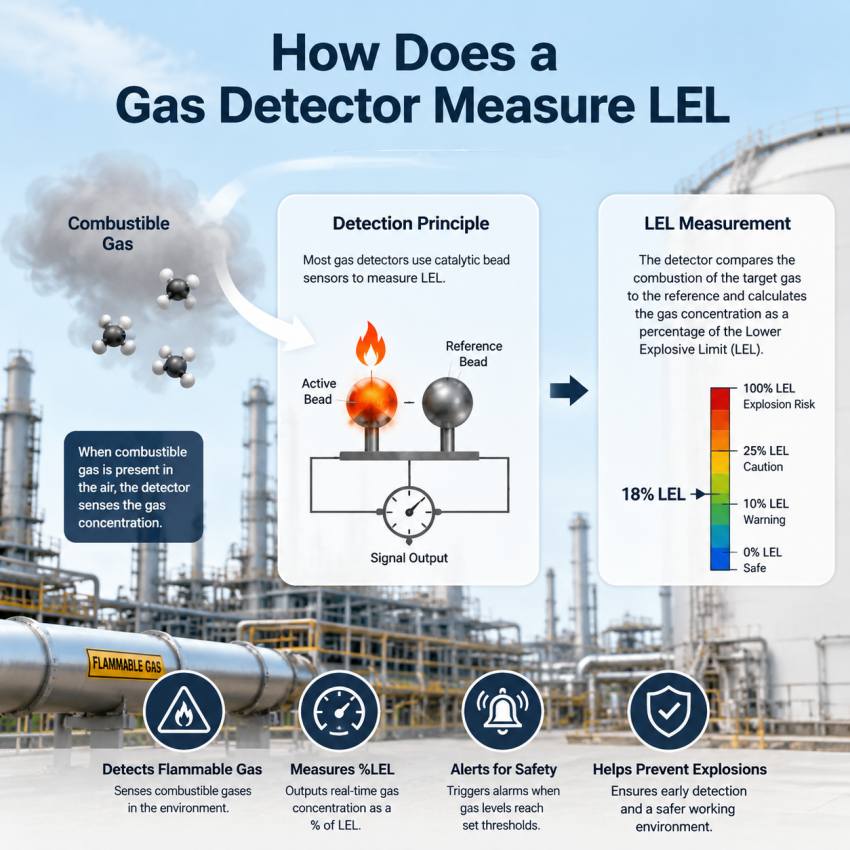
%LEL indicates the percentage of the current combustible gas concentration reaching the lower explosion limit.
For example:
- 0% LEL = no combustible gas detected.
- 10% LEL = combustible gas concentration reaches 10% of the lower explosion limit.
- 50% LEL = combustible gas concentration reaches half of the lower explosion limit.
- 100% LEL = combustible gas reaches the minimum explosion concentration.
Most industrial gas detectors will set different alarm values, such as:
- Low alarm: 10–20% LEL
- High alarm: 20–50% LEL
When the gas concentration is close to the dangerous range, the detector will pass:
- Audible alarm
- LED lighting alarm
- Vibration alarm
Remind staff to take safety measures in time.
How Does the Gas Detector Measure LEL?
The gas detector detects the concentration of combustible gas in the air through an internally installed combustible gas sensor, and converts the detection result into a %LEL numerical display.
The whole measurement process usually includes the following steps:
1. Gas Enters the Sensor
The detector continuously collects ambient air through the air inlet near the sensor.
When combustible gases such as methane, hydrogen and propane enter the sensor, the detection process begins.
2. The Sensor Detects Combustible Gas
At present, the commonly used LEL detection technologies for industrial gas detectors mainly include:
- Catalytic combustion sensor technology
- Infrared (IR) sensor technology
Catalytic Combustion Sensor
The catalytic combustion sensor contains a heating element with catalytic material.
When combustible gas contacts the sensor:
- The gas undergoes an oxidation reaction on the heated surface.
- Heat is generated during the reaction.
- The sensor resistance changes.
- The detector converts the resistance change into gas concentration.
The final display is a %LEL value.
The catalytic combustion sensor has:
- Fast response speed
- Lower cost
- Wide application range
And so on, are widely used in industrial portable and fixed gas detection equipment.
Infrared (IR) Sensor Technology
The infrared sensor measures the gas concentration by analyzing the absorption degree of infrared light by gas molecules.
Its advantages include:
- Sensor life
- Strong anti-poisoning ability
- Better stability in harsh environment.
Infrared technology is often used to:
- Oil and gas facilities
- Offshore platform
- High risk industrial environment
How Does the Gas Detector Convert the Gas Concentration into %LEL?
The signal detected by the sensor will not be directly displayed as %LEL.
The tester will be converted internally through calibration data.
The conversion process includes:
- The sensor detects the gas reaction signal.
- The electronic circuit processes the sensor output.
- The microprocessor reads and analyzes the signal.
- The system calculates the gas concentration according to the calibration data.
- The display shows the final %LEL value.
In this way, the staff can quickly judge whether the current environment is safe.
Why LEL Detection Is Very Important for Industrial Safety?
The biggest danger of combustible gas lies in:
- Can’t be seen by the naked eye.
- Many gases cannot be found by human senses.
- It may accumulate rapidly after leakage.
LEL monitoring can help enterprises:
Prevent Explosion Accidents
Continuous monitoring can find anomalies before the gas reaches the explosive dangerous concentration.
Protect the Safety of Staff
Early warning enables staff to:
- Evacuate the dangerous area
- Stop dangerous operation
- Take emergency measures
Improve the Ability to Respond to Accidents
Real-time gas concentration data can help safety managers judge the severity of leakage.
Meet the Requirements of Safety Management
Many industrial safety codes require flammable gas detection during dangerous operations.
Main Application Fields of LEL Gas Detector
Oil and Gas Industry
The oil and gas industry involves a large number of hydrocarbons, and there is a high risk of combustible gas.
LEL detection is widely used in:
- Refinery
- Tank area
- Oil and gas pipeline
- Drilling platform
- Pumping station
Chemical Industry
Chemical production may release flammable gases during production processes.
LEL monitoring can help:
- Find the leak in time
- Reduce fire risk
- Improve production safety
Confined Space Operation
Storage tanks, underground pipelines, sewage pools and other spaces may produce dangerous gases due to insufficient ventilation.
Before entering and during the operation, the staff usually need to check:
- Oxygen concentration
- Toxic gas concentration
- Combustible gas concentration
Mining Industry
There may be a risk of methane accumulation in underground mines.
LEL testing can help miners:
- Real-time understanding of environmental security status
- Discover the explosion risk in advance
- Reduce the probability of accidents
Calibration and Maintenance of LEL Detector
Accurate LEL measurement depends on correct maintenance.
Suggestion:
Carry out Bump Test regularly.
Confirm:
- Is the sensor normal?
- Is the alarm function effective?
- Is the display accurate?
Periodic Calibration
Calibration can ensure that the detector continuously provides accurate gas concentration data.
Check the Sensor Status
Dust, chemical pollutants and environmental factors may affect the performance of the sensor.
Keep the Battery in Good Condition
Stable power supply is an important guarantee for continuous monitoring.
If the maintenance is not in place, it may lead to:
- Detect data errors
- Alarm delay
- Unable to detect danger in time
Difference Between LEL Measurement and Gas Concentration Measurement
Need to note:
%LEL is not equal to the actual volume concentration of gas.
For example:
The LEL of methane in air is about 5%.
This means:
Methane concentration reaches 5% (volume ratio) ≈ 100% LEL.
If the tester shows:
20% LEL
It means that the methane concentration reaches about one-fifth of its lower explosive limit.
The gas detector uses %LEL display because it can reflect the explosion risk more intuitively, not just the gas proportion.
How to Choose a Gas Detector with LEL Detection Function?
When selecting LEL gas detector, you need to consider:
1. Detection of Gas Type
Different combustible gases have different characteristics, so detection equipment suitable for working environment should be selected.
2. Sensor Technology
According to the application environment:
- Catalytic combustion sensor
- Infrared sensor
3. Working Environment
Need to consider:
- Temperature condition
- Humidity
- Dust environment
- Explosion-proof requirements
4. Alarm Function
A reliable detector should have:
- Audible alarm
- Lighting alarm
- Vibration alarm
5. Certification Requirements
Industrial application environment may need to comply with relevant:
- Explosion-proof standard
- Industry safety certification
- Regional use requirements


 WhatsApp: 8619339980364
 E-mail: contact@hirepsafety.com