
Gas Monitoring in Manufacturing Industry: Industrial Application Scenarios and Equipment Selection Guide
Gas monitoring in manufacturing industry is an important part of industrial production safety management. In manufacturing plants, different production processes may involve flammable gases, toxic chemicals, solvents and other dangerous substances. Gas leakage may occur near pipelines, storage tanks, production equipment, chemical treatment areas and ventilation systems. Without proper monitoring measures, these hazards may lead to safety accidents such as fire, explosion, exposure of workers to toxic gases or insufficient oxygen.
Reliable gas monitoring system can help manufacturing enterprises identify potential gas hazards, monitor the air quality in the workplace, and give early warning when the gas concentration is abnormal.
Why Does the Manufacturing Industry Need Gas Monitoring?
There are usually different types of gas risks in the manufacturing environment, depending on the production process and raw materials used.
For example, metal working and welding operations may involve oxygen, acetylene and other industrial gases. Toxic gases and volatile organic compounds (VOC) may be released during chemical production. Food processing plants may use ammonia refrigeration system, while some production workshops use natural gas or liquefied petroleum gas (LPG) as fuel.
Gas leakage can not always be detected in time through human senses. Some gases are colorless and odorless, so they need to be monitored by professional gas detection equipment.
Installing appropriate gas detection equipment can help enterprises monitor the concentration of dangerous gases, reduce the safety risks in the workplace and improve the level of industrial safety management.
Common Gas Hazards in Manufacturing Plants
Flammable Gas
Natural gas, methane, liquefied petroleum gas and other combustible gases are widely used in industrial heating, drying and production processes. When these gases leak and meet an ignition source after reaching a dangerous concentration, it may cause a fire or explosion accident.
Fixed combustible gas detector can be installed near gas pipelines, valves, combustion equipment and storage areas to continuously monitor gas concentration.
Toxic Gas
In some manufacturing processes, there may be toxic gases such as hydrogen sulfide, carbon monoxide, ammonia and chlorine. These gases may affect the health of workers, and high concentration exposure may even cause serious safety accidents.
According to the different production environment, fixed toxic gas detector and portable gas detector can be used to monitor related hazards.
Lack of Oxygen
In closed production areas, storage tanks and poorly ventilated spaces, the oxygen concentration in the environment may decrease due to gas replacement or other industrial production processes.
The oxygen detector can identify abnormal oxygen concentration and give an alarm when the oxygen level exceeds the set safety range.
Volatile Organic Compounds (VOC)
Volatile organic compounds may be released in painting workshops, printing facilities, painting operation areas and chemical production areas during the manufacturing process. Long-term exposure to certain VOCs may affect the health of workers, and some compounds also have fire risks.
Using appropriate VOC detection equipment can help enterprises monitor the concentration of target compounds in the working environment.
Gas Monitoring Equipment Commonly Used in Manufacturing Industry
Fixed Gas Detector
Stationary gas detectors are usually installed at designated monitoring locations for continuous gas concentration measurement. It is suitable for areas prone to gas leakage, such as production lines, chemical storage rooms, gas supply pipelines and equipment rooms.
According to different target gases, different sensor technologies can be selected, including catalytic combustion, electrochemical, infrared and photoionization sensors.
For manufacturing enterprises that need to continuously monitor the gas concentration, we can consider using HRP-T2000-G Fixed Gas Detector, a fixed gas detector of HIREP, for industrial gas detection applications.
Portable Gas Detector
Portable gas detector is mainly used for staff to conduct equipment inspection, maintenance and other on-site operations. It can help workers identify gas hazards in areas not covered by fixed detectors.
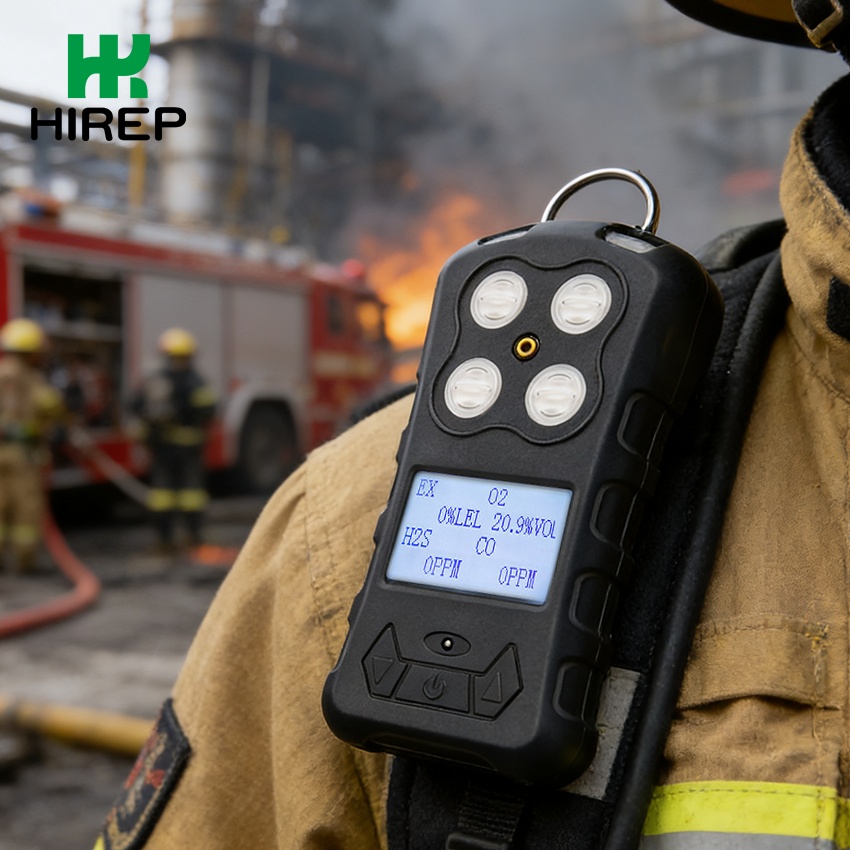
Common portable four-in-one gas detector can usually monitor combustible gas, oxygen, carbon monoxide and hydrogen sulfide at the same time, which is especially suitable for equipment maintenance and confined space entry.
HIREP’s Portable Four-in-One Gas Detector HRP-B1000-C is suitable for industrial inspection, equipment maintenance and confined space operations.
Where Should the Gas Detector in the Manufacturing Plant Be Installed?
The installation position of gas detector will directly affect the monitoring effect. Before determining the installation location of the equipment, the manufacturing enterprise should identify the potential gas leakage source and make a comprehensive evaluation according to the physical characteristics of the target gas.
The gas detector can be installed near gas supply pipelines, valves, compressors and production equipment that are prone to leakage.
In the chemical storage area and solvent treatment area, corresponding monitoring equipment can be added according to the chemical substances stored and used. In the production workshop with poor ventilation conditions, the location where gas accumulation may occur should also be considered.
For combustible gas, it is necessary to determine the installation position of the detector in combination with gas density and site ventilation conditions. The toxic gas detector should be arranged reasonably according to the potential release source and the risk area that the staff may contact.
For confined spaces such as storage tanks, tunnels and enclosed equipment, workers should use Portable Gas Detectors for gas detection before entering, and continuously monitor during the operation according to the on-site safety operation procedures.
How to Choose a Suitable Gas Monitoring Scheme?
Choosing suitable gas monitoring equipment requires a full understanding of the manufacturing process and actual working environment.
First of all, identify the types of gases that need to be detected. Different production processes require different monitoring configurations. For example, the paint shop may need VOC monitoring, while the natural gas supply area may need methane detection.
Secondly, consider the actual working environment of the equipment. Temperature, humidity, dust, corrosive substances and potential explosion hazards may all affect equipment selection. The protection level and explosion-proof certification of the detector shall meet the requirements of the actual installation environment.
Third, determine whether fixed or portable monitoring equipment is needed. Stationary detectors are suitable for continuous monitoring in designated areas, while portable devices can provide additional safety protection during staff inspection and maintenance.
Communication interface is also an important factor to be considered when selecting equipment. Industrial gas detector may support 4–20ma, RS485 or relay output, and can be connected to gas alarm controller, PLC or DCS system according to project requirements.
In addition, regular calibration, functional testing and equipment maintenance are also important measures to maintain monitoring reliability.
Choose HIREP Gas Detection Solution to Improve Production Safety in Manufacturing Industry
Gas monitoring is an important part of safety management in manufacturing industry. From combustible gas leakage to toxic gas exposure and insufficient oxygen, different production environments need to adopt appropriate gas detection methods.
HIREP Safety provides Fixed Gas Detectors and Portable Gas Detectors, which can be used in industrial manufacturing workshops, chemical production facilities, storage areas and confined spaces.
By selecting appropriate gas detection equipment and establishing an effective monitoring system, manufacturing enterprises can improve their ability to identify dangerous gases, strengthen workplace safety management and provide support for safer industrial production.


 WhatsApp: 8619339980364
 E-mail: contact@hirepsafety.com
