
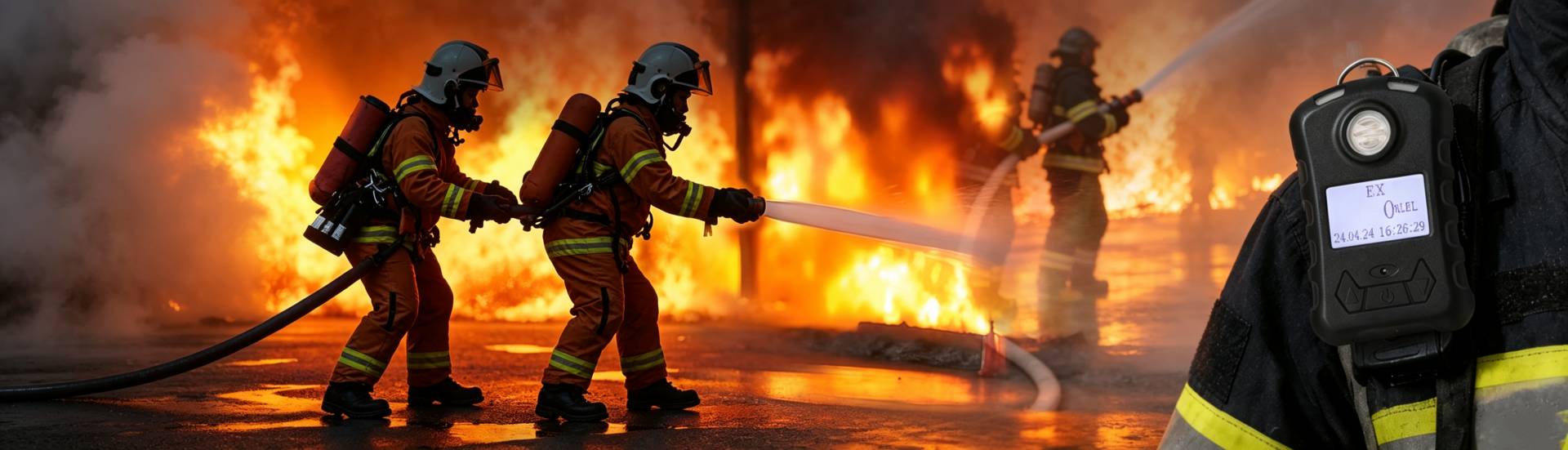
Common Industrial Gases Detected: What Worksites Need to Monitor for Safety
There are some invisible gas risks in industrial sites every day. Different from the obvious dangers such as running machinery and equipment and high-temperature surfaces, dangerous gases can not always be detected by sight, smell or taste. Without continuous gas monitoring, workers may face the risks of poisoning, suffocation, fire or explosion before the danger signal appears.
HIREP Safety’s portable multi-gas detector and fixed gas detection transmitter can be used to continuously monitor these potential hazards. The following will introduce the most common monitoring gases, typical application sites, health hazards and applicable detection technologies in industrial sites, so as to help factory managers, safety leaders and dealers choose appropriate gas detection solutions.
Oxygen (O₂)
Oxygen detection is the basis of confined space operation and factory environment inspection. The oxygen content in normal air is about 20.9% VOL (volume percentage).
-
Insufficient oxygen: the oxygen concentration is lower than 19.5% VOL Common causes include nitrogen purging, inert gas leakage, metal corrosion, fermentation process and tank inerting. Lack of oxygen can quickly lead to confusion, fainting and even death.
-
Excessive oxygen concentration: the oxygen concentration is higher than 23.5% VOL Oxygen cylinder leakage is common in welding, cutting and medical treatment. Oxygen-enriched environment will make ordinary materials burn more violently and increase the risk of fire and explosion.
-
Sensor type: electrochemical sensor.
-
Typical application places: sewers, storage tanks, silos, chemical containers and welding workshops.
Combustible Gases (LEL / Methane CH₄, Propane C₃H₈, Hydrogen H₂)
Combustible gases are usually measured in %LEL (percentage of lower explosive limit). When the gas concentration is between the lower explosion limit (LEL) and the upper explosion limit (UEL), sparks, static electricity or high temperature surfaces may cause explosion.
-
Methane (CH₄): It is commonly found in natural gas, biogas, landfills, coal mines and gas pipelines.
-
Propane (C₃H₈): It is commonly found in liquefied petroleum gas storage areas, forklift refueling areas and food freezing workshops.
-
Hydrogen (H₂): It is commonly found in battery factories, electrolytic hydrogen production facilities and fuel cell workshops. Hydrogen has low ignition energy and is easily ignited.
-
Sensor type: catalytic combustion sensor or NDIR sensor.
-
Main risk: Even a small amount of leakage may gradually accumulate in poorly ventilated corners. Whether a fixed gas alarm device must be installed in the storage area shall be determined according to applicable laws and regulations, risk assessment and site requirements.
Hydrogen Sulfide (H₂S)
Hydrogen sulfide has a smell similar to rotten eggs at low concentration, but it is a highly toxic asphyxiating gas. More dangerously, a higher concentration of hydrogen sulfide may quickly damage the sense of smell, making it impossible for people to continue to rely on the smell to identify the danger.
-
Common sources: oil and gas wellheads, refineries, sewage treatment plants, sewage inspection wells, sludge ponds and biogas facilities.
-
Health hazard: low concentration may irritate eyes and respiratory tract; High concentration exposure may quickly lead to respiratory arrest.
-
Sensor type: electrochemical sensor.
-
Common alarm reference values: time-weighted average concentration (TWA)5 ppm, short-term exposure limit (STEL)10 ppm. The actual alarm setting should be based on the applicable occupational health standards, local regulations and on-site risk assessment.
Carbon Monoxide (CO)
Carbon monoxide is often called “invisible killer” and widely exists in industrial scenes involving fuel combustion. It will combine with hemoglobin and affect the ability of blood to deliver oxygen to body tissues.
-
Common sources: boiler room, engine exhaust, incomplete combustion process, steel heat treatment process and exhaust gas from forklift trucks in closed warehouses.
-
Main symptoms: headache, fatigue, nausea and loss of consciousness.
-
Sensor type: electrochemical sensor.
Carbon monoxide is also one of the four gases usually monitored by the standard four-in-one gas detector in confined space.
For applications requiring simultaneous monitoring of multiple gases, explore the Portable 4-in-1 Gas Detector.
Ammonia Gas (NH₃)
Ammonia is a corrosive gas with strong pungent smell, which is widely used in refrigeration industry.
-
Common sources: cold storage, food processing plants, fertilizer production plants, livestock farms and chemical synthesis facilities.
-
Main hazards: irritation to eyes, throat and lungs. High concentration exposure may cause permanent lung injury. In addition, ammonia gas is flammable in a specific concentration range.
-
Sensor type: electrochemical sensor.
Carbon Dioxide (CO₂)
Carbon dioxide is a gas that may cause suffocation. It is colorless and tasteless, and usually does not cause obvious harm at normal concentration in ambient air, so it is easy to be ignored.
-
Common sources: breweries, fermenters, greenhouses, dry ice storage areas and underground silos.
-
Main risks: High concentration of carbon dioxide will affect the normal breathing of human body, and may cause dizziness, shortness of breath and even suffocation.
-
Sensor type: NDIR infrared sensor.
Nitrogen Dioxide (NO₂) and Sulfur Dioxide (SO₂)
These two toxic gases are usually related to combustion process, industrial waste gas and production discharge, which may cause serious damage to respiratory system.
-
Nitrogen dioxide (NO₂): It is commonly found in welding flue gas, diesel engine tail gas and industrial furnace discharge. It can damage lung tissue and may lead to delayed pulmonary edema.
-
Sulfur dioxide (SO₂): It is commonly found in coal-fired boilers, smelters and sulfur processing facilities. It is strongly irritating to the respiratory tract.
-
Sensor type: electrochemical sensor.
Chlorine Gas (Cl₂)
Chlorine is a yellow-green heavy gas with strong irritation, which is often used for disinfection.
-
Common sources: water treatment plants, swimming pool chemical storage rooms and pulp bleaching production lines.
-
Main risks: Chlorine gas may cause serious respiratory burns and lung injuries, and even low concentration exposure may cause health hazards.
How Does the HIREP Safety Gas Detector Deal with the Industrial Gas Risk?
HIREP Safety’s HRP series industrial gas detection equipment supports single gas and multi-gas detection configurations, which can be selected according to the above gas types and site requirements.
The main features include:
-
Highly selective electrochemical sensor: used to detect toxic gases such as CO, H₂S, NH₃, NO₂, SO₂ and Cl₂.
-
NDIR infrared sensor: used to detect combustible hydrocarbon gas supported by CO and applicable models.
-
Catalytic combustion sensor: used to detect combustible gas that meets the applicable conditions of the corresponding sensor.
-
Real-time concentration display and signal output: LCD screen can display concentration information such as PPM or %VOL, and the equipment can be equipped with acousto-optic alarm, and connected to the central control system through 4–20mA or RS485 interface.
-
Explosion-proof and functional safety options: ATEX or SIL options can be provided according to specific models, and the specific certification and application scope shall be subject to the product data.
Portable 4-in-1 gas detector is usually used for the inspection before the confined space enters, which can simultaneously monitor oxygen (O₂), combustible gas (LEL), carbon monoxide (CO) and hydrogen sulfide (H₂S).
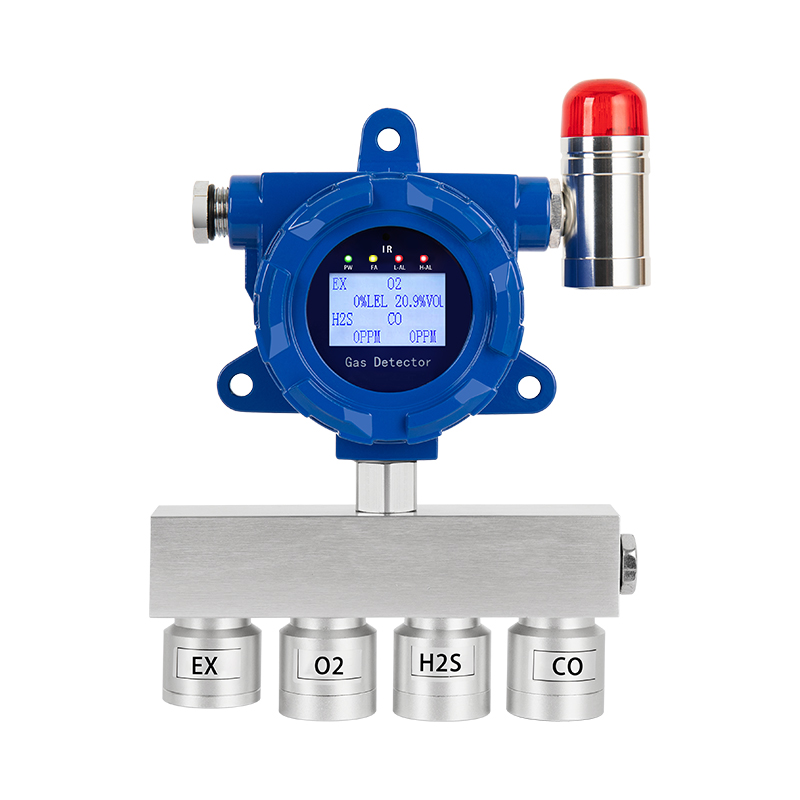
For continuous monitoring of toxic gases and other industrial hazards, explore the Fixed Multi-Gas Detector HRP-T2000-G.
The fixed wall-mounted gas detection transmitter is suitable for areas that need long-term continuous monitoring, such as boiler room, refrigeration room and chemical workshop, which can help enterprises keep abreast of the changes of gas concentration on site.
How to Choose a Suitable Gas Detector?
First, identify the gas to be detected on site. Monitoring targets should be determined according to process flow, raw materials, equipment types and potential leakage sources. Different gases need to match corresponding sensors, and carbon monoxide detectors cannot be used instead of hydrogen sulfide or ammonia detectors.
Secondly, confirm the site environment and equipment requirements. Factors such as working temperature, humidity, dust, corrosive environment and whether explosion-proof certification is needed should be considered.
Then, select the device type according to the usage scenario. Portable gas detector is suitable for inspection, maintenance and confined space entry; The fixed gas detector is more suitable for continuous monitoring of specific areas.
Finally, do a good job in equipment maintenance and calibration. Functional testing, calibration and sensor inspection should be carried out regularly according to the requirements of the manufacturer, and the sensor should be replaced in time when it reaches its service life or its performance does not meet the requirements.


 WhatsApp: 8619339980364
 E-mail: contact@hirepsafety.com
