
Accuracy of Gas Detector: The Key Factors Affecting Measurement Reliability
The measurement accuracy of gas detector is a key factor to be considered when selecting industrial safety monitoring equipment. In chemical plants, oil and gas facilities, sewage treatment plants, confined spaces and other places, inaccurate gas readings may lead to the danger not being discovered in time or causing unnecessary alarms. Knowing the factors that affect the accuracy of gas detector is helpful for users to choose suitable equipment and keep the reliability of monitoring results.
What Is the Accuracy of Gas Detector?
The accuracy of gas detector refers to the closeness between the gas concentration measured by the instrument and the actual concentration under the specified test conditions. Manufacturers usually use reading percentage, full-scale percentage, or a combination of different measurement parameters to express accuracy.
For example, when detecting carbon monoxide, the numerical value displayed by the instrument may be different from the actual concentration of standard gas. Whether this difference is within the acceptable range depends on the equipment specifications, calibration status, measuring range and applicable safety requirements.
Accuracy is not the same concept as resolution and response time. Resolution is the smallest measurement increment that the instrument can display, and response time indicates the time required for the instrument to respond to the change of gas concentration. Just because the display resolution is higher does not mean that the detection accuracy must be higher.
Factors Affecting the Accuracy of Gas Detector
Sensor Types and Service Life
Different sensor technologies are suitable for different gases and working environments. Electrochemical sensors are usually used to detect toxic gases such as carbon monoxide and hydrogen sulfide, while catalytic combustion and infrared sensors can be used to detect combustible gases in suitable scenarios.
With the increase of service time, the sensor performance may change. Long-term exposure to the target gas, pollution, or contact with substances that may interfere with the work of the sensor may affect the detection results. Therefore, the first step to ensure the reliability of measurement is to select a sensor that matches the target gas and the field environment.
Temperature and Humidity
Environmental conditions may affect the output of the sensor. Extreme temperature, condensation and high humidity may affect the response of some types of sensors. Outdoor equipment may also face rapid temperature changes, rainfall and direct sunlight.
Before installation, confirm the operating temperature and humidity range specified by the tester. For the fixed gas detection system, it is helpful to protect the equipment and maintain stable operation by choosing the installation location and protective casing suitable for the field environment.
Calibration and Maintenance
Even if the gas detector itself is in good performance, if it is not calibrated as required, or the sensor is aging, unreliable readings may occur.
Zero calibration is used to establish an appropriate measurement benchmark, while range calibration is used to check and adjust the response of the sensor through the standard gas with known concentration.
Bump Test is another independent check to confirm that the sensor can respond to gas and check whether the related alarm function is normal. It cannot replace formal calibration.
Maintaining according to the manufacturer’s requirements and recording the test results every time will help to find out the changes in equipment performance in time and avoid further expansion of the problem.
Regular calibration and maintenance are essential for maintaining reliable gas detection performance. Understanding different gas sensor calibration methods can help operators establish appropriate maintenance procedures and identify sensor drift before it affects measurement reliability.
Gas Types and Cross Sensitivity
Some sensors may respond to multiple gases. When there is interference gas in the field, the sensor reading may be affected, which is called cross sensitivity.
In addition, different types of combustible gas detectors may have different responses to different gases, depending on sensor technology and calibration gas.
Therefore, the user should confirm that the detector is suitable for the target gas, and understand the correction factor and cross-sensitivity description provided by the manufacturer. At the same time, the selected measuring range should meet the expected gas concentration and safety monitoring requirements on site.
For applications involving combustible gases in confined spaces, a Portable Combustible Gas Detector can help workers check gas conditions before and during relevant operations, subject to the instrument’s specifications and workplace safety procedures.
How to Choose a Gas Detector with Appropriate Measurement Accuracy?
Choose the right equipment, not just compare the precision values in the product specification table. The target gas, expected concentration range, sensor type, response time, environmental conditions and required alarm function should also be considered comprehensively.
For workers who need to make on-site inspection or enter confined space, portable multi-gas detector can monitor multi-gas risks in one device. According to the specific configuration, the equipment can be used to detect combustible gas, oxygen, carbon monoxide and hydrogen sulfide. HIREP Safety’s Portable 4-in-1 Gas Detector is suitable for application scenarios that require multi-gas monitoring and personnel safety protection.
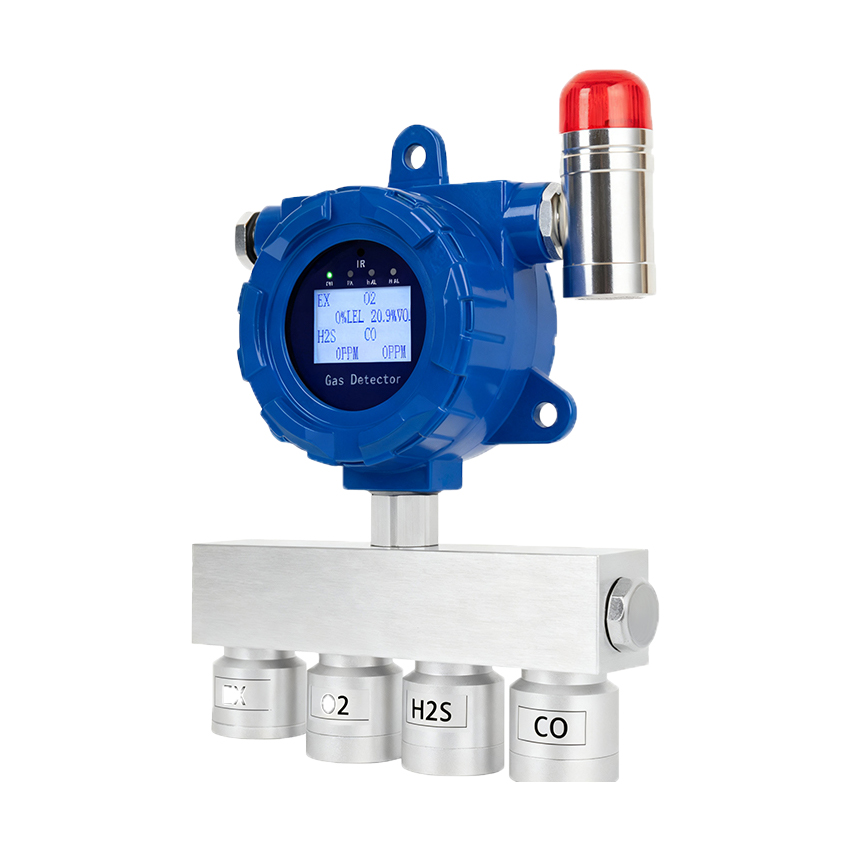
For places that need continuous monitoring, such as production areas, pipelines, storage facilities and process equipment rooms, fixed gas detection transmitters can continuously measure gas concentration and transmit signals to alarm controllers or factory control systems. When evaluating the industrial fixed gas detection scheme, the HRP-T2000-G Fixed Multi-Gas Detector can be considered.
When comparing different products, we should focus on their nominal accuracy, measuring range, sensor specifications, calibration requirements, signal output interfaces and applicable certification information. These parameters are helpful to judge whether the equipment meets the requirements of actual monitoring tasks.
How to Keep the Reliability of Gas Measurement Results?
Regular inspection, correct calibration, functional test and timely replacement of aging sensors are all helpful to maintain the reliability of gas detection results. If the reading of the equipment is unstable, fails the calibration check, or is obviously different from the expected value, the reasons should be investigated first, and then the equipment should be put into use in safety-critical scenarios again.
Reliable gas monitoring and management not only depends on appropriate equipment, but also needs correct installation and continuous maintenance. Understanding the key factors that affect the accuracy of gas detectors can help industrial users make more reasonable purchasing decisions and improve the stability of gas monitoring in the workplace.


 WhatsApp: 8619339980364
 E-mail: contact@hirepsafety.com
