
Industrial Gas Leakage Detection System: Composition, Application Scenarios and Selection Guide
Gas leakage may bring serious safety risks to the industrial environment. In oil and gas facilities, chemical plants, manufacturing workshops and sewage treatment plants, flammable or toxic gases may leak from pipelines, valves, storage tanks and production equipment. The industrial gas leakage detection system can help identify the concentration of dangerous gases and send out early warning signals, so that relevant personnel can take timely countermeasures.
To select a suitable system, it is necessary to understand the gas types involved in the site, monitoring requirements, installation environment, and the integration requirements of equipment and existing safety systems.
How Does the Industrial Gas Leak Detection System Work?
The industrial gas leakage detection system monitors the concentration of specific gases in the surrounding environment through sensors or gas detectors. When the measured concentration reaches the preset alarm threshold, the detector can trigger a local alarm or transmit a signal to the gas alarm controller or the factory control system.
According to the specific application requirements, the system may include fixed gas detector, portable gas detector, alarm controller, audible and visual alarm, communication interface and monitoring software.
Stationary detectors are usually installed near potential leakage sources or areas where gas accumulation may occur. Portable detector is used for staff inspection, equipment maintenance and confined space operation. When the two devices are used together, they can provide complementary gas monitoring capabilities for different scenarios.
Main Components of Industrial Gas Monitoring System
Fixed Gas Detector
The fixed gas detector can continuously monitor the designated position, which is suitable for production areas, pipelines, pump houses, storage facilities and other industrial places where gas risks need to be continuously monitored.
The sensor technology should match the target gas. Electrochemical sensors are usually used to detect toxic gases, while catalytic combustion and infrared sensors can be used to detect combustible gases according to specific applications.
For the scene that needs continuous industrial monitoring, the HRP-T2000-G Fixed Multi-Gas Detector can be evaluated according to the configuration of the gas to be detected and the field conditions.
Portable Gas Detector
Portable gas detector is convenient for workers to check the ambient gas condition when moving in different working areas, especially suitable for equipment inspection, leakage investigation, maintenance and gas detection before entering confined spaces.
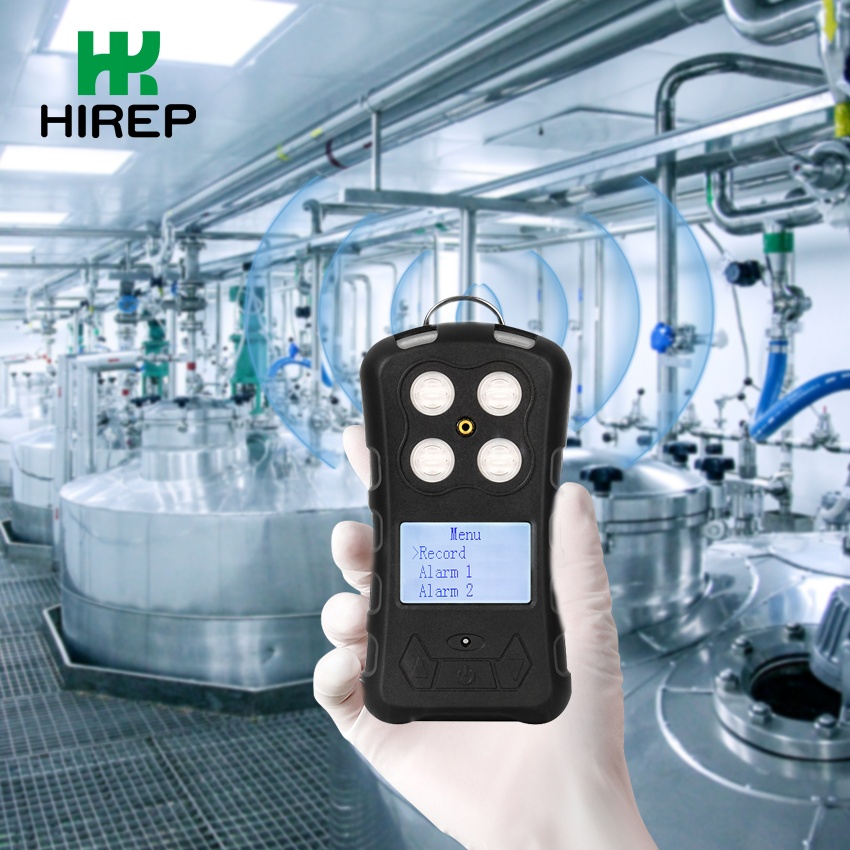
Portable four-in-one gas detector equipped with corresponding sensors can monitor combustible gas, oxygen, carbon monoxide and hydrogen sulfide. HIREP Safety’s HRP-B1000-C Portable 4-in-1 Gas Detector is suitable for application scenarios that require multi-gas monitoring and personnel safety protection.
The specific configuration of equipment should always be determined according to the risks identified in the workplace. If there are other toxic gases or vapors on site, additional sensors may be required.
Alarm Controller and Communication Interface
When the gas concentration exceeds the set threshold, the detection system can transmit the alarm signal to the controller or the factory monitoring platform. Audible and visual alarm can alert the field personnel, and the communication interface can connect the gas reading and alarm status to a wider industrial control system.
Depending on the equipment configuration, the system may adopt 4–20 Ma, RS485, relay output or other supported communication modes. Before purchasing, the compatibility of testing equipment with existing controllers, PLC, DCS and alarm equipment should be confirmed.
Common Application Scenarios of Gas Leakage Detection System
Oil and Gas Facilities
Methane, hydrogen sulfide and other dangerous gases may be involved in the production and treatment of oil and gas. Pipelines, compressors, valves, loading and unloading areas and the vicinity of storage equipment are usually the monitoring positions that need to be evaluated. The type and installation location of the detector should be determined according to the possible leakage and the ventilation conditions at the site.
Chemical Plants and Manufacturing Facilities
The chemical production process may involve flammable gases, toxic substances or solvent vapors. The gas detection schemes required by different processes are different, depending on the materials used and the possible consequences of leakage. Choosing the correct sensor and measuring range is an important link to ensure the monitoring reliability.
Sewage Treatment Plant
There may be risks such as insufficient hydrogen sulfide, methane and oxygen in sewage system, treatment tank and underground working space. Fixed monitoring equipment can continuously monitor the designated area, while portable detector can be used for inspection and maintenance.
Confined Space Operation
Storage tanks, inspection wells, containers and underground spaces may form a dangerous atmosphere due to insufficient ventilation or changes in operating conditions. The staff shall detect the ambient gas before entering, and continuously monitor it as required during the operation according to the on-site confined space operation procedures.
Portable gas detection is an important part of confined space safety management, but it should also be combined with appropriate work permit, ventilation, hazardous energy isolation, communication and emergency rescue arrangements.
How to Choose a Suitable Gas Leakage Detection System?
Firstly, the target gas and potential leakage source should be identified, and the expected gas concentration range, sensor response characteristics, environmental conditions and possible consequences of missed detection should be considered.
Installation planning should consider airflow, gas diffusion, ventilation, equipment layout and post-maintenance requirements. Gas density can be used as a reference factor to determine the installation position of the detector, but it should not be the only basis to determine the installation height or position.
The system should also meet the required alarm threshold and signal interface requirements. For the factory that adopts the central monitoring platform, the communication compatibility should be confirmed, and the alarm handling method in case of equipment failure or communication interruption should be defined.
Finally, a perfect maintenance plan should be established, including equipment inspection, calibration, function test, and sensor replacement when necessary. Improper installation or insufficient maintenance of the detector may not achieve the expected safety protection effect.
Establish a Reliable Industrial Gas Detection Strategy
An effective industrial gas leakage detection system needs to combine appropriate sensors, reasonable detector installation location, reliable alarm function and regular maintenance. The fixed detector can continuously monitor the designated location, while the portable equipment can help the staff to assess the gas risk during inspection and maintenance.
HIREP Safety provides fixed and portable gas detection solutions for a variety of industrial monitoring applications. By selecting the appropriate equipment according to the actual risk on site and following the standardized installation and maintenance procedures, enterprises can establish a more reliable gas monitoring system and provide better security for the industrial working environment.


 WhatsApp: 8619339980364
 E-mail: contact@hirepsafety.com
