
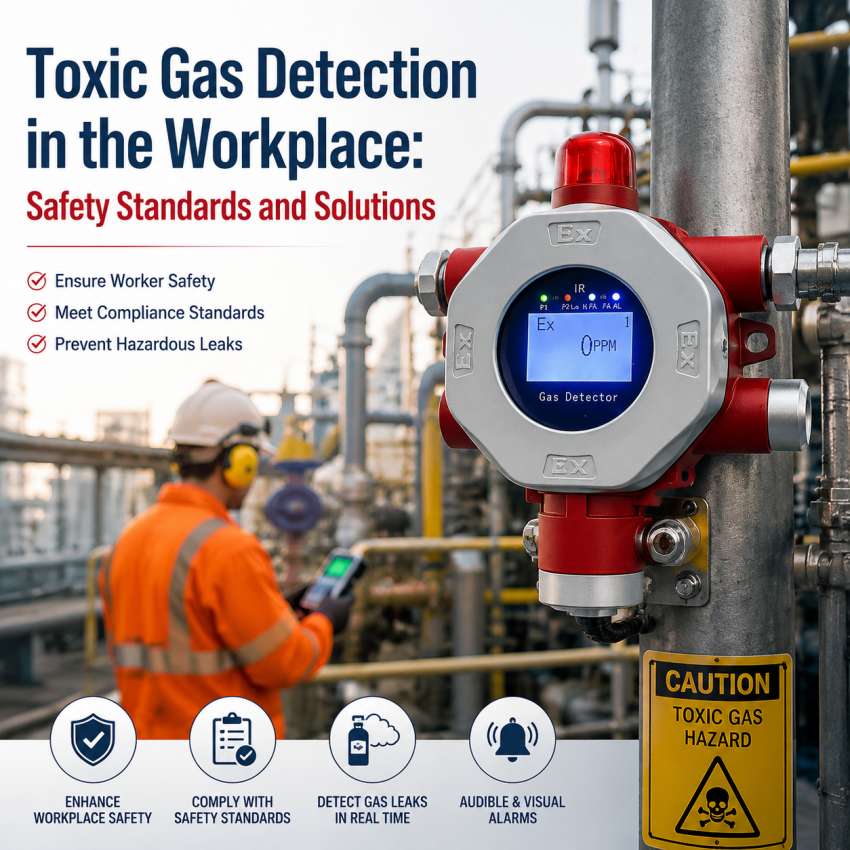
Toxic Gas Detection in the Workplace: Safety Standards and Solutions
introduction
In the industrial production environment, toxic gas leakage is always one of the security risks that cannot be ignored. No matter in petrochemical industry, sewage treatment, metal processing and energy industry, once gas leakage occurs, it may have a serious impact on people’s health and production system.
Hydrogen sulfide, carbon monoxide, ammonia, chlorine and other common industrial gases may cause poisoning or even fatal accidents even if they are exposed for a short time under certain concentration conditions. Therefore, the establishment of a stable and reliable gas detection system is the basic configuration in modern industrial safety management.
At present, international standard systems, including OSHA, IECEx and ATEX, all put forward clear requirements for gas monitoring in industrial sites, emphasizing the need for continuous monitoring and risk early warning.
What is toxic gas detection?
Toxic gas detection refers to the process of using professional sensors to monitor dangerous gases in industrial environment in real time and send out early warning signals before the concentration reaches the dangerous threshold.
Its core role is mainly reflected in several aspects:
- Identify potential gas leakage risks in advance
- Buy time for personnel evacuation and emergency treatment
- Linkage ventilation or emergency stop system
- Meet safety production and compliance requirements
Compared with ordinary air quality detection equipment, industrial gas detection system emphasizes stability, accuracy and long-term operation ability in complex environment.
Common types of industrial toxic gases
In practical industrial applications, the gas risks corresponding to different scenarios are also different:
Hydrogen sulfide (H₂S)
It mainly occurs in the process of oil and gas exploitation and sewage treatment, and it is extremely toxic, even at low concentration, there are serious risks.
Carbon monoxide (CO)
It comes from the process of incomplete combustion, colorless and tasteless, and is easy to cause poisoning under the condition of imperceptible.
Ammonia gas (NH₃)
Widely used in refrigeration and chemical production, it has obvious irritation to respiratory system.
Chlorine gas (Cl₂)
It is mostly used in disinfection and water treatment processes and has a strong corrosive effect on respiratory tract.
Nitrogen oxides (NOx)
Common in welding and combustion equipment emissions, which has a great impact on long-term health.
Main types of toxic gas detection system
Fixed gas detection system
Fixed systems are usually installed in high-risk areas for all-weather continuous monitoring. Generally, the system will be connected to the control platform to realize centralized management.
This kind of system is common in chemical plant area, storage tank area and closed production space.
Its advantages are wide coverage, high stability, and automatic linkage with exhaust or alarm system.
portable gas detector
Portable equipment is mainly used for personnel protection, especially for entering confined space or temporary maintenance.
This kind of equipment is usually small in size, fast in response, and can be carried around, giving an alarm at the first time when dangerous gases appear.
Multi-gas detection equipment
Multi-gas detector can monitor the concentration of multiple gases at the same time, which is suitable for industrial environments with complex components or high risks.
This kind of equipment is widely used in petrochemical, mining and other industries, which can effectively reduce the number of equipment deployment and improve management efficiency.
International safety standard requirements
In industrial applications, toxic gas detection systems usually need to meet a number of international standards to ensure the reliability and safety of equipment:
- OSHA puts forward the basic requirements for the gas exposure limit in the workplace;
- NIOSH provided reference data for occupational health;
- IECEx and ATEX put forward certification specifications for explosion-proof environment equipment;
- ISO 45001 requires safety in production from the management system level.
These standards together constitute the basic compliance framework of industrial gas detection system.
Principle of gas detection technology
At present, commonly used gas detection technologies in industry mainly include three categories:
electrochemical sensor
It is suitable for detecting low-concentration toxic gases, such as CO, HS and NO, with high sensitivity.
Infrared sensor
It is mainly used for the detection of CO and some combustible gases, with good stability and long service life.
semiconductor transducer
Low cost, suitable for basic alarm purposes, but its accuracy is relatively limited in complex environment.
Alarm and linkage mechanism
When the gas concentration exceeds the set threshold, the system will generally respond in stages:
- In the primary early warning stage, the operator is mainly reminded by indicator lights and prompt sounds;
- When the concentration continues to rise, the system will trigger an audible and visual alarm and prompt personnel to evacuate;
- In the case of higher risk, the system can automatically link the exhaust equipment or cut off the related process flow to reduce the accident risk.
Key practice in industrial application
In practical projects, the effect of gas detection system depends not only on the equipment itself, but also on the installation and management methods.
The detector usually needs to be installed near the leakage source or in a low-lying area where gas is easy to accumulate, while avoiding dead corners.
Equipment should be calibrated periodically to ensure long-term detection accuracy.
In addition, regular maintenance and data record analysis are helpful to find equipment anomalies in advance.
Personnel training is equally important to ensure that staff can correctly identify alarm signals and take corresponding measures.
In large industrial systems, gas detection equipment is usually integrated with DCS or PLC system to realize centralized control and automatic response.
Application industry
Toxic gas detection system is widely used in many industrial fields, including oil and gas, chemical production, mining operations, sewage treatment, electric energy and manufacturing.
These industries generally have the characteristics of many confined spaces, complex processes or high gas risks, so the stability and reliability of the detection system are required to be higher.
conclusion
Toxic gas detection has become an indispensable part of modern industrial safety system.
Through reasonable system design, standardized installation mode and strict maintenance management, the safety risk caused by gas leakage can be effectively reduced.
With the development of industrial automation, gas detection technology is also evolving in the direction of intelligence and networking, from a single alarm device to an important part of comprehensive safety monitoring system.


 WhatsApp: 8619339980364
 E-mail: contact@hirepsafety.com