
What is LEL in gas detection? Understand the lower explosion limit and combustible gas monitoring
In the working environment involving combustible gas, understanding LEL (lower explosive limit) is an important part of gas detection and industrial safety. Combustible gases may exist in oil and gas facilities, chemical plants, storage tanks, pipelines, mines, sewage treatment facilities and limited spaces. If the concentration of combustible gas reaches a certain level and there is an ignition source at the same time, there may be a fire or explosion hazard.
The combustible gas detector can help the staff to monitor the concentration of combustible gas in the air and give an alarm when the detected concentration reaches the preset condition. So, what exactly does LEL mean? Why is it so important in gas detection?
What is LEL?
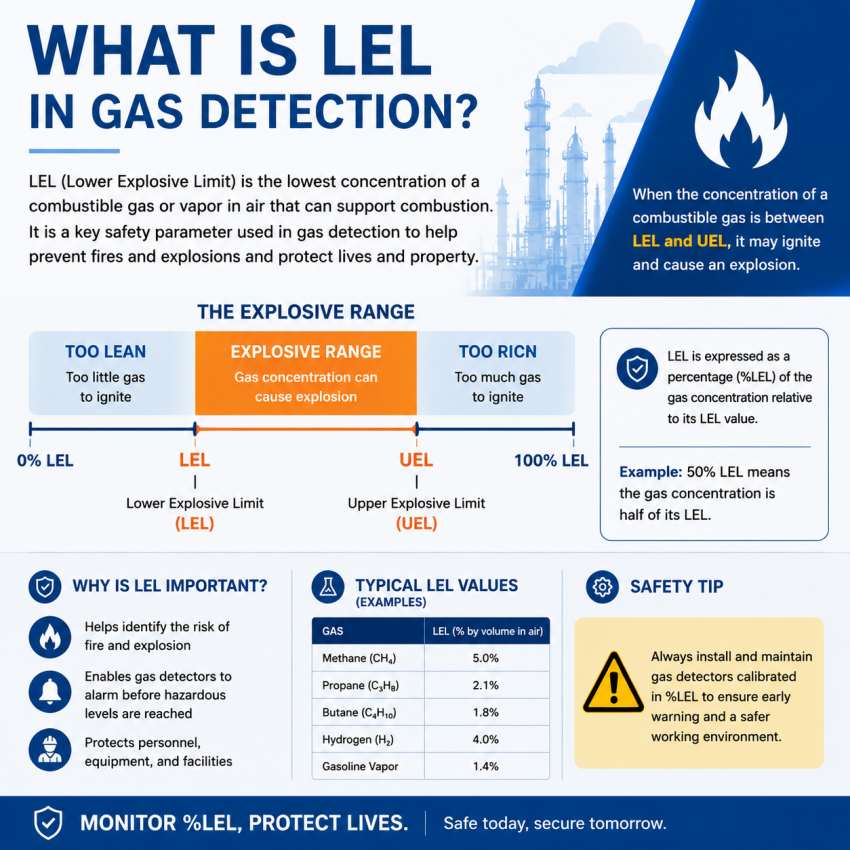
LEL is the abbreviation of Lower Explosive Limit, which refers to the lowest concentration when combustible gas or vapor can burn in air.
Different gases have different LEL values, which means that different flammable gases need different concentrations to form a potentially flammable environment.
For example, methane, propane and hydrogen have different flammable properties. Therefore, when choosing a portable gas detector, it is necessary to choose according to the specific combustible gas that may exist in the actual working environment.
In the actual gas detection process, the detector usually displays the combustible gas concentration in the form of %LEL, instead of simply using ppm and other units to express the gas concentration.
What is %LEL?
%LEL indicates the ratio of the detected combustible gas concentration to its lower explosion limit.
For example, if the gas detector shows 10% LEL, it usually means that the concentration of combustible gas currently detected is about 10% of the lower explosion limit of the gas.
The relationship can be conceptually expressed as:
%LEL = detected combustible gas concentration ÷ lower explosion limit × 100%
In this way, the staff can use a uniform percentage to understand the risk of combustible gas without remembering the specific LEL concentration of each gas.
However, the reading of the actual detector will be affected by sensor technology, calibration gas, target gas and instrument configuration. Always follow the manufacturer’s technical specifications and calibration requirements when using.
Why is LEL important for gas detection?
The leakage of combustible gas may not be detected by naked eyes, nor may it be detected by human senses in time. In some industrial environments, combustible gas may gradually accumulate in closed or poorly ventilated areas without obvious visual or sensory cues.
Monitoring LEL can help workers understand the change of combustible gas concentration and find the rising trend of concentration in time before the environment reaches the lower explosion limit.
Therefore, LEL monitoring is usually applied to industrial gas monitoring, especially in the working environment where combustible gas release may occur.
Typical applications include:
- Oil and gas facilities
- Petrochemical plant
- Chemical plant
- Gas pipeline
- Storage tank
- Mine
- Sewage treatment plant
- Finite space
- Equipment maintenance area
- Gas leakage investigation
- Emergency rescue
What’s the difference between LEL and gas concentration?
LEL is related to gas concentration, but they are not exactly the same concept.
The gas concentration can be expressed in units such as ppm or volume percentage, and LEL is a reference value, which is used to indicate the lowest concentration when a combustible gas forms a combustible mixture with air.
Therefore, the %LEL displayed by the detector is actually telling the staff how far the concentration of combustible gas currently detected is from its lower explosion limit.
For field workers, this display mode is more intuitive. Workers do not need to manually compare the actual gas concentration with the LEL value of the target gas, but can directly read the percentage of the current concentration in the LEL through the detector.
What’s the difference between LEL and UEL?
LEL and UEL are two important concepts when discussing combustible gases.
LEL is the Lower Explosive Limit, that is, the lower explosive limit; UEL is the Upper Explosive Limit, that is, the upper explosive limit.
The concentration range between LEL and UEL is usually called flammable range or explosive range. In this range, if there is a suitable ignition source, the mixture of combustible gas and air may burn.
Below LEL, the fuel in the mixture is usually not enough to support combustion; Above UEL, the oxygen in the environment may not be enough to support combustion. However, this does not mean that the environment above UEL can be considered safe.
As ventilation conditions and gas distribution change, gas concentration may change. Therefore, gas monitoring should be carried out according to the dangerous factors in the actual working environment, and it is not possible to judge whether the environment is safe only by a certain test result.
How to detect LEL with combustible gas detector?
The portable gas detector detects the target combustible gas through the gas sensor. According to the design and application requirements of the detector, different detection technologies can be adopted.
Catalytic combustion sensor is a common sensor in combustible gas detection. When the combustible gas reaches the sensor and undergoes oxidation reaction, it will produce corresponding changes, and the detector can calculate and convert it into gas concentration or %LEL reading according to this change.
In some applications, technologies such as infrared sensors can also be used to detect combustible gases.
Which sensor technology to adopt depends on the target gas, application environment, detection range and the specific configuration of the detector.
LEL detection in four-in-one gas detector
Many industrial workers need to monitor not only combustible gases, but also insufficient oxygen and toxic gases, which may also bring serious safety risks.
Therefore, the four-in-one gas detector usually integrates the detection functions of combustible gas (LEL), oxygen (O), carbon monoxide (CO) and hydrogen sulfide (HS) into a portable device.
For example, HRP-B1000-C four-in-one gas detector is a portable gas monitoring device used in industrial field, which can be configured to detect combustible gas (LEL), oxygen, carbon monoxide and hydrogen sulfide.
The equipment can display the gas concentration in real time, and support alarm modes such as sound, light and vibration. When multiple atmospheric environmental risks need to be monitored at the same time, the portable multi-gas detector can provide a comprehensive gas monitoring scheme.
For more information, please see HRP-B1000-C four-in-one gas detector.
LEL detection in limited space
Gas detection in confined space is one of the important applications of LEL monitoring.
Storage tanks, underground pipelines, inspection wells, sewage systems and other enclosed areas usually have limited ventilation conditions. If combustible gas enters these spaces, it may gradually accumulate over time.
Before personnel enter the confined space, the ambient gas shall be detected according to the applicable safety operation procedures. According to the site risk assessment, continuous gas monitoring may also be required during the operation.
Typical atmospheric environmental assessment usually needs to consider:
- Oxygen concentration
- Combustible gas concentration
- Toxic gas concentration
- Ventilation condition change
- Potential gas source
This is one of the reasons why multi-gas detectors are widely used in limited space operations.
What factors will cause the LEL reading to change?
The detection reading of combustible gas may be affected by many factors, and common factors include:
Gas leakage
Leakage of pipelines, valves, storage tanks or connecting parts may lead to the release of combustible gas into the surrounding environment.
Ventilation condition change
Poor ventilation may lead to the gradual accumulation of gas, while strengthening ventilation may reduce the concentration of gas in the environment.
Temperature and environmental conditions
Environmental conditions may affect the gas diffusion characteristics and the response of the sensor. When using the detector, ensure that the equipment is within the environmental conditions specified by the manufacturer.
Gas distribution
Gas is not necessarily evenly distributed in space. According to the difference of gas density, air flow and spatial structure, the gas concentration at different positions may be different.
Equipment and production process changes
Changes in industrial production process, equipment operation status or maintenance work may affect the possibility of gas release.
Because the field environment may change with time, the result of a single gas detection may not necessarily represent the actual situation of the whole working environment.
Why does LEL detection need to be calibrated?
Accurate calibration of gas detector is an important link to keep the gas detection performance reliable.
The gas detector shall be calibrated periodically according to the manufacturer’s recommendations and actual application requirements. The specific calibration period may depend on the sensor type, working environment, frequency of use and site safety management system.
Before using the detector, it should also be checked according to the corresponding operating procedures. Functional testing can help to confirm whether the sensor and alarm function can respond normally.
For combustible gas detection, appropriate calibration gas and calibration method should be selected according to the specific configuration of detector and sensor.
How to choose portable LEL gas detector?
When choosing a portable combustible gas detector, you can focus on the following factors:
- Target combustible gas
- LEL detection range
- Sensor technology
- Detection accuracy
- Alarm setting
- Response time
- Battery working time
- Environmental protection ability
- Explosion proof certification
- Calibration requirements
- Data recording function
- Practical application scenario
If there are multiple atmospheric safety risks in the application environment, then the portable multi-gas detector may provide a more comprehensive monitoring scheme than the single gas detector.
Conclusion
LEL is an important concept in combustible gas detection, which indicates the lowest concentration of combustible gas when it forms combustible mixture in air.
By monitoring the combustible gas concentration in the form of %LEL, the staff can understand the relationship between the currently detected combustible gas concentration and its lower explosion limit. Therefore, LEL monitoring is an important part of gas detection in oil and gas, petrochemical, chemical, mining, sewage treatment, equipment maintenance and limited space operations.
For the working environment where combustible gas, toxic gas and oxygen-related risks may exist at the same time, the four-in-one gas detector can integrate LEL, oxygen and toxic gas detection functions into a portable device.
HRP-B1000-C four-in-one gas detector is specially designed for portable multi-gas monitoring, which can be applied to a variety of industrial scenes that need to simultaneously monitor combustible gas and other atmospheric environmental risks.


 WhatsApp: 8619339980364
 E-mail: contact@hirepsafety.com