
What Gas Detection Systems Do Refineries Need to Configure?
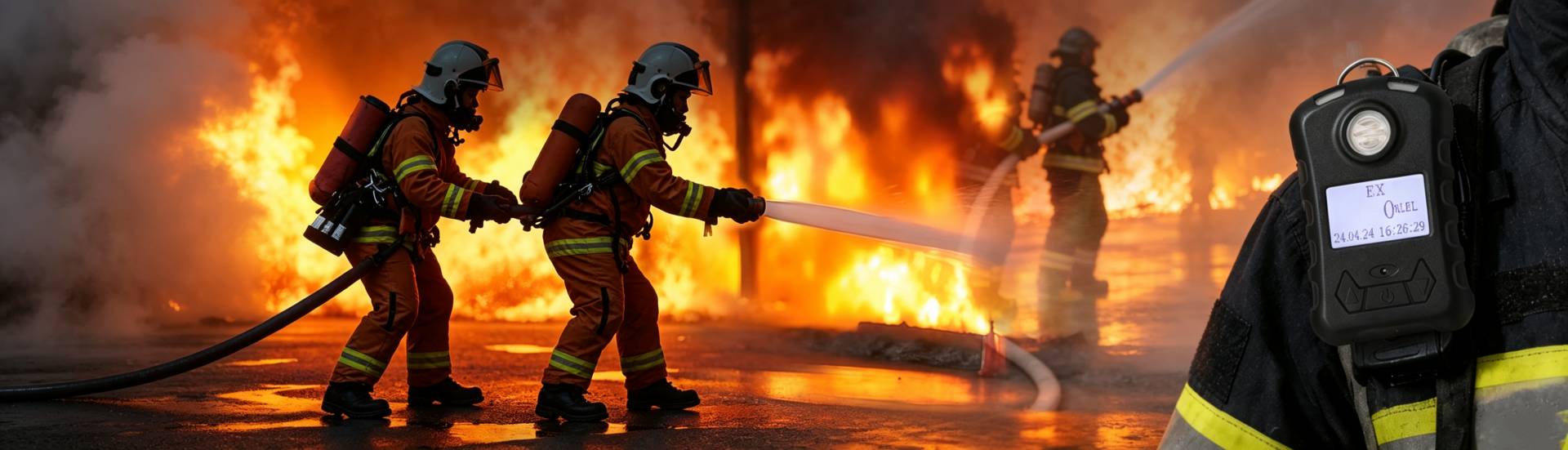
Oil refinery is a complex industrial production site. In the process of crude oil processing, refining, storage and transportation, flammable, toxic and abnormal oxygen concentration may be produced. Gas leakage may occur in pipelines, valves, compressors, reaction devices, storage tanks and loading and unloading areas. Without effective gas monitoring measures, these hidden dangers may lead to fire, explosion, poisoning or hypoxia accidents.
Reliable refinery gas detection system can detect abnormal gas concentration in time and help staff to take corresponding safety measures as soon as possible. According to different production processes and potential risks, refineries usually need to combine fixed gas detection systems, portable gas detectors and centralized alarm monitoring equipment.
Stationary Gas Detection System: Realize Continuous Monitoring
Fixed gas detector is an important equipment for continuous gas monitoring in refinery, which is usually installed near pipelines, pumps, compressors, storage tanks, process devices and other places where gas leakage may occur.
According to the types of gases existing in different areas, it is necessary to select the corresponding sensors.
-
Combustible gas detector: it is used to monitor flammable gases such as methane, propane and other hydrocarbons, and help workers find leaks before the gas concentration reaches dangerous levels.
-
Hydrogen sulfide (H2S) detector: it is mainly used to monitor the concentration of H2S in crude oil processing units, sewage treatment facilities and sulfur-containing gas treatment areas.
-
Carbon monoxide (CO) detector: used to monitor combustion-related processes and areas where incomplete combustion may occur, so as to find the risk of carbon monoxide in time.
-
Oxygen (O2) detector: used to identify the situation that the oxygen concentration is insufficient or too high, especially suitable for confined spaces and areas where inert gases are used.
-
Volatile Organic Compounds (VOC) detector: It is used to monitor the emission of organic vapor and related gas risks according to specific process requirements.
In industrial applications, the fixed gas detection transmitter can transmit real-time gas concentration data through communication interfaces such as 4-20mA and RS485, and connect with gas alarm controller, PLC or DCS system to realize centralized monitoring.
HIREP’s fixed gas detector series can be configured according to the monitoring requirements of combustible gas and toxic gas in different refineries.
Portable Gas Detector: Meet the Needs of Inspection and Maintenance
The fixed detector can continuously monitor the designated area, but the refinery staff also need to be equipped with personal gas detection equipment when moving between different operation areas.
Portable gas detectors are widely used in equipment maintenance, pipeline inspection, tank cleaning, confined space entry and emergency rescue.
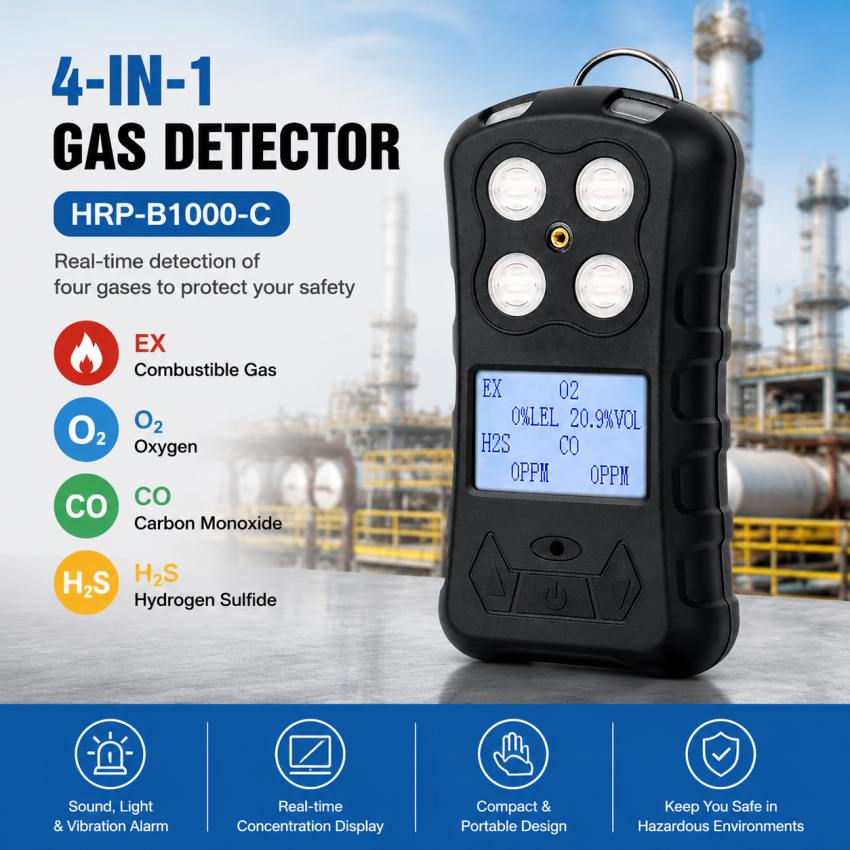
Portable four-in-one gas detector is a practical multi-gas monitoring equipment, which can simultaneously detect the following four common gas risks:
-
LEL: concentration of combustible gas.
-
O2: oxygen concentration.
-
CO: carbon monoxide concentration.
-
H2S: H2S concentration.
Before entering the confined space, the staff should use appropriate gas detection equipment to detect the internal environment. The detection content should consider the oxygen concentration, combustible gas and toxic gas, and strictly follow the management procedures of on-site confined space operation.
HIREP’s portable four-in-one gas detector HRP-B1000-C is specially designed for multi-gas monitoring and personnel safety protection in industrial environment.
Centralized Gas Alarm Controller and Monitoring System
A complete gas detection system in refinery needs not only an independent gas detector, but also a centralized gas alarm controller or monitoring platform to collect and process signals from multiple detection points.
When the detector finds that the gas concentration exceeds the preset alarm threshold, the system can start the acousto-optic alarm. According to the system design, the alarm signal can also be transmitted to the central control room or integrated with PLC and DCS control platforms.
A typical system usually includes fixed gas detector, signal transmission line, gas alarm controller, audible and visual alarm and centralized monitoring terminal.
For large refineries, the gas detection system should support multiple monitoring points, and can clearly display the location of the detector, gas type, real-time concentration and alarm status.
Gas Detection Requirements in Different Areas of Refinery
The gas risks faced by different production areas of refineries are different, so different monitoring schemes are needed.
Crude Oil Processing Area
Hydrocarbon leakage may occur near pumps, valves, pipelines and processing equipment, so it is usually necessary to install combustible gas detectors to continuously monitor the potential leakage locations.
Catalytic Cracking and Hydrogen Production Area
These production facilities may involve flammable hydrocarbons and hydrogen. The selection of gas detector should consider the specific gas type, equipment operating conditions and potential leakage location.
Sulfur Recovery and Sewage Treatment Area
Hydrogen sulfide is a toxic gas risk that needs to be paid attention to in these areas. The installation of fixed hydrogen sulfide detector and portable gas detection equipment is helpful to improve the coverage of on-site safety monitoring.
Storage Tanks and Loading and Unloading Areas
Hydrocarbon vapor may be released during the storage, transportation and loading and unloading of oil products. According to the specific process risks, it is usually necessary to configure fixed combustible gas detectors and applicable VOC monitoring equipment.
Confined Space
There may be risks such as insufficient oxygen, toxic gas accumulation and combustible gas exceeding the standard in storage tanks, containers and underground spaces. In the process of confined space operation, portable multi-gas detector should be used for detection according to the operation procedure.
How to Choose a Suitable Gas Detection System in Refinery?
When selecting gas detection equipment, it is necessary to know the production process of the refinery and the possible gas risks in different areas.
The first step is to identify the types of gases that may exist in each operation area. The sensor technology must match the target gas. For example, catalytic combustion or infrared sensors can be selected for combustible gas detection according to application requirements, while electrochemical sensors are usually used for toxic gases such as hydrogen sulfide and carbon monoxide.
The installation location is equally important. The detector should be arranged reasonably according to the potential leakage source, gas characteristics, ventilation conditions and site environmental factors. There is no uniform installation height or detector spacing suitable for all refineries.
In addition, factors such as explosion-proof grade, protection grade, working temperature, humidity, calibration requirements and communication compatibility need to be considered.
Regular inspection, calibration and maintenance can not be ignored, which help to ensure the reliable monitoring performance of gas detection equipment for a long time.
Gas Detection Solution in HIREP Refinery
An effective refinery gas detection system needs to combine fixed monitoring, portable detection and centralized alarm management. Different equipments undertake different monitoring tasks to help enterprises identify gas risks and ensure the safety of industrial production.
HIREP Safety is a manufacturer of industrial gas detection equipment, mainly producing fixed gas detectors and portable gas detection equipment. The products cover the monitoring of combustible gas, toxic gas and oxygen, and can meet the different gas detection requirements of oil and gas, refineries, chemical plants and other industrial places.
For refinery projects, it is an important basis for establishing a reliable gas monitoring system to select the appropriate detector configuration according to the actual site environment and process characteristics.


 WhatsApp: 8619339980364
 E-mail: contact@hirepsafety.com
