
How Is LEL Measured in Gas Detectors?
Introduction
Combustible gas leakage is one of the most serious safety hazards in industrial facilities. In oil and gas production, chemical plants, sewage treatment stations and limited space working environment, even if a small amount of combustible gas accumulates, it may cause explosion accidents. In order to prevent safety incidents, the gas detector will continuously monitor the concentration of combustible gas and display the detection results as a percentage of the lower explosive limit (LEL).
Understanding the measurement principle of LEL is helpful for safety managers and operators to correctly understand the detection data and improve the level of on-site safety management.
What is LEL?
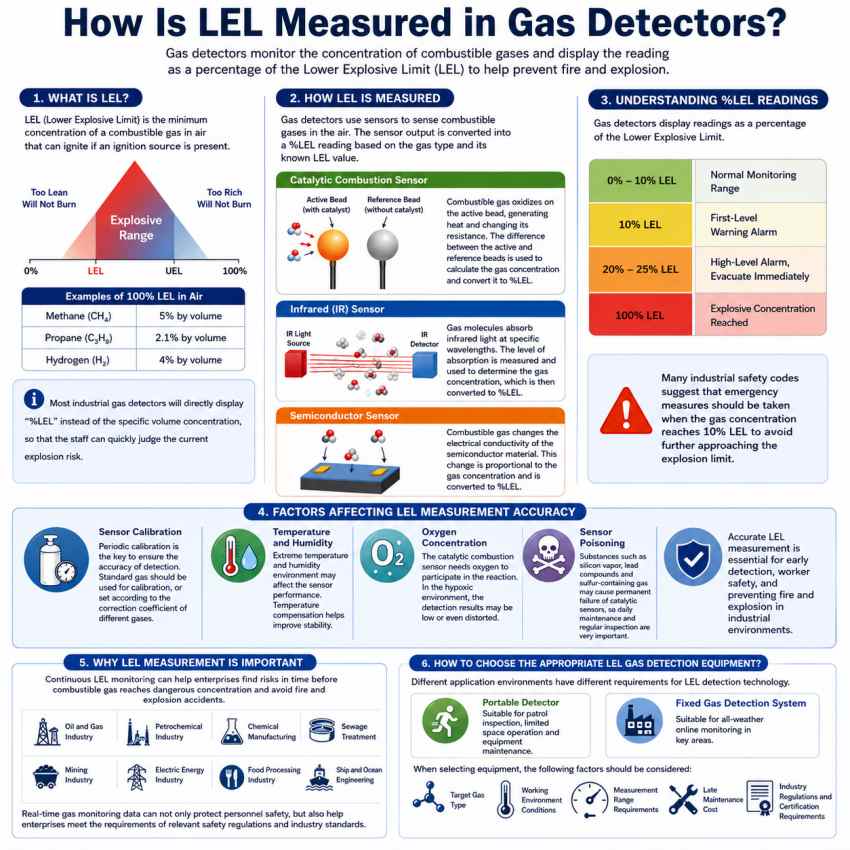
LEL (Lower Explosive Limit) refers to the lowest concentration of combustible gas that can be ignited and burned or exploded in air.
When the gas concentration is lower than LEL, the mixed gas is too thin and usually does not burn; once LEL is reached or exceeded, there is obvious risk of fire and explosion.
For example:
- Methane (CH): 100% LEL = 5% volume concentration in air.
- Propane (CH): 100% LEL = 2.1% volume concentration in air.
- Hydrogen (H): 100% LEL = 4% volume concentration in air.
Most industrial gas detectors will directly display “%LEL” instead of the specific volume concentration, so that the staff can quickly judge the current explosion risk.
How does a gas detector measure LEL?
The gas detector usually detects the concentration of combustible gas through special sensors, and converts the measurement results into LEL percentage for display.
At present, the most common detection technologies mainly include the following:
Catalytic combustion sensor
Catalytic Bead (also called Pellistor) is one of the most widely used combustible gas detection technologies in industrial field.
It usually contains two tiny detection beads inside:
- Working bead with catalytic layer
- Reference beads without catalytic layer
When combustible gas enters the surface of the working bead, it will undergo oxidation reaction and release heat under the action of catalyst, which will lead to the change of the resistance of the working bead. By comparing the resistance difference between the two beads, the instrument calculates the current gas concentration and converts it into LEL percentage.
Its main advantages include:
- Can detect a variety of combustible gases.
- Fast response speed.
- Lower cost.
- Industrial application is mature and stable.
However, the catalytic combustion sensor needs oxygen in the air to participate in the reaction, and may be polluted by chemical substances such as silicide and sulfide, which reduces the sensitivity.
Infrared sensor
The infrared sensor measures the concentration of combustible gas by detecting the absorption degree of gas molecules to infrared light with a specific wavelength.
Compared with catalytic combustion technology, infrared sensor has obvious advantages:
- Oxygen-independent environment.
- Longer service life.
- Higher stability.
- Sensor poisoning is not easy to occur.
Therefore, infrared technology is widely used in natural gas and methane monitoring, offshore platforms and fixed gas detection systems.
Semiconductor transducer
The semiconductor sensor uses the principle that combustible gas causes the change of material conductivity to detect.
This technology is more used in the field of home and business safety, while in the industrial environment, catalytic combustion and infrared technology are more popular because of their higher accuracy and reliability.
How to read %LEL?
The gas detector usually displays the data as a percentage of the lower explosive limit, instead of directly displaying the gas volume concentration.
Common alarm settings are as follows:
| LEL percentage | Safety status |
|---|---|
| 0%~10%LEL | Normal monitoring range |
| 10%LEL | First-class early warning alarm |
| 20%~25%LEL | Advanced alarm, advised to evacuate immediately |
| 100%LEL | Has reached the explosive dangerous concentration |
Many industrial safety codes suggest that emergency measures should be taken when the gas concentration reaches 10%LEL to avoid further approaching the explosion limit.
What factors will affect the accuracy of LEL measurement?
Many factors will affect the accuracy of combustible gas detector.
Sensor calibration
Periodic calibration is the key to ensure the accuracy of detection. Standard gas should be used for calibration, or set according to the correction coefficient of different gases.
Temperature and humidity
Extreme temperature and humidity environment may affect the sensor performance. Modern industrial testing equipment usually has the function of temperature compensation to improve the measurement stability.
Oxygen concentration
The catalytic combustion sensor needs oxygen to participate in the reaction. In the hypoxic environment, the detection results may be low or even distorted.
Sensor poisoning
Substances such as silicon vapor, lead compounds and sulfur-containing gas may cause permanent failure of catalytic sensors, so daily maintenance and regular inspection are very important.
Why LEL measurement is so important for industrial safety?
Continuous LEL monitoring can help enterprises find risks in time before combustible gas reaches dangerous concentration and avoid fire and explosion accidents.
At present, LEL detection technology is widely used in the following industries:
- Oil and gas industry
- Petrochemical industry
- Chemical manufacturing industry
- Sewage treatment industry
- Mining industry
- Electric energy industry
- Food processing industry
- Ship and ocean engineering industry
Real-time gas monitoring data can not only protect personnel safety, but also help enterprises meet the requirements of relevant safety regulations and industry standards.
How to choose the appropriate LEL gas detection equipment?
Different application environments have different requirements for LEL detection technology.
Portable detector is suitable for patrol inspection, limited space operation and equipment maintenance, while fixed gas detection system is suitable for all-weather online monitoring in key areas.
When selecting equipment, the following factors should be considered:
- Detecting the target gas type
- Working environment conditions
- Measurement range requirements
- Late maintenance cost
- Industry regulations and certification requirements
Reasonable selection of detection technology is helpful to improve the efficiency of safety management and the long-term stability of equipment.
Tag
LEL measurement is one of the core functions of modern gas detection system. Through different detection technologies such as catalytic combustion, infrared and semiconductor, the gas detector can monitor the concentration of combustible gas in real time and display it in the form of percentage of lower explosion limit.
Understanding the measurement principle of LEL not only helps to correctly interpret the test data, but also helps enterprises and staff to find potential risks in time, reduce the probability of explosion accidents and ensure the safe and stable operation of industrial production environment.


 WhatsApp: 8619339980364
 E-mail: contact@hirepsafety.com