
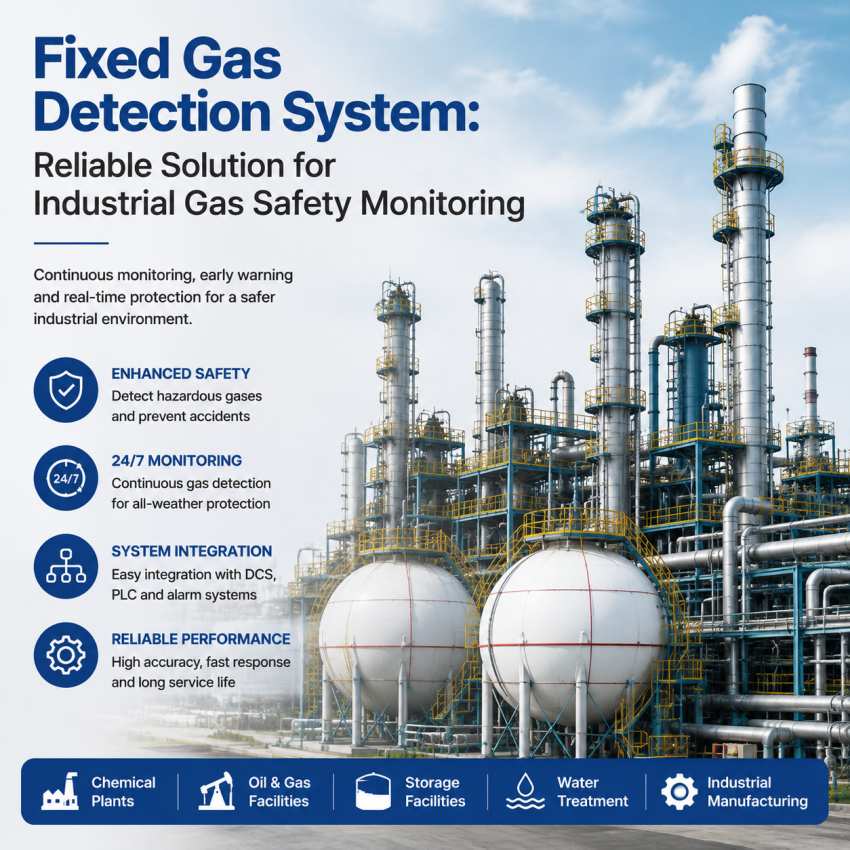
Fixed Gas Detection System: Reliable Solution for Industrial Gas Safety Monitoring
Introduction
In modern industrial environment, gas leakage is one of the important safety risks that lead to fire, explosion, poisoning and serious production accidents. Oil and gas, chemical manufacturing, mining, sewage treatment and various industrial facilities usually involve flammable, toxic or dangerous gases.
Fixed Gas Detection System provides continuous and reliable gas monitoring ability, which helps enterprises to find the change of dangerous gas concentration in time. By installing gas detectors in key areas, the system can monitor the gas concentration in the environment around the clock and give an alarm in time when it reaches the preset safety threshold.
With advanced sensing technology, real-time monitoring ability and integration ability with industrial control system, fixed gas detection system has become an indispensable safety protection scheme in dangerous industrial environment.
What is a Fixed Gas Detection System?
Stationary gas detection system is a gas monitoring solution permanently installed in industrial site, which is used to continuously detect specific gas concentration.
Different from portable gas detectors carried by staff for personal protection, fixed gas detection systems are usually installed in key locations where gas leakage may occur, such as:
- Machine shop
- Tank area
- Tubing
- Compressor room
- Chemical treatment area
- Boiler room
- Limited space operation area
The system can continuously measure the gas concentration in the environment, and realize timely warning through acousto-optic alarm, remote signal output or control system linkage.
A complete fixed gas detection system usually includes:
- Fixed gas detector
- Gas alarm controller
- Acousto-optic alarm equipment
- Signal transmission system
- Industrial monitoring platform
How Does the Fixed Gas Detection System Work?
The fixed gas detection system continuously monitors the gas concentration and carries out safety management according to the set alarm value.
1. Gas Detection
The gas detector installed on the site detects the target gas concentration in real time through high-precision sensors.
Common detection gases include:
Combustible Gas:
- Methane (CH)
- Natural gas
- Liquefied petroleum gas (LPG)
- Hydrogen (H)
Toxic Gas:
- Hydrogen sulfide (HS)
- Carbon monoxide (CO)
- Ammonia gas (NH)
- Chlorine gas (CL)
When the gas concentration changes, the detector will collect data in real time and transmit the signal to the control system.
2. Signal Processing
The gas detector will analyze the data collected by the sensor and compare it with the preset alarm value.
When the gas concentration reaches the warning or alarm level, the system will automatically start the safety response.
Common output modes include:
- Acousto-optic alarm
- Relay output
- 4-20mA analog signal
- RS485 communication
- Industrial control system connection
3. Alarm and Safety Response
When abnormal gas concentration is detected, the system will immediately remind the field personnel to take measures.
Possible safety measures include:
- Organize personnel evacuation
- Start the ventilation equipment
- Shut down related equipment
- Perform emergency handling procedures
Through rapid response, the accident risk caused by gas leakage can be effectively reduced.
Main Advantages of Fixed Gas Detection System
1. All-Weather Continuous Monitoring
The biggest advantage of fixed gas detection system is that it can run continuously.
Compared with manual inspection, the fixed inspection system can monitor the dangerous area 24 hours a day, and can provide continuous safety protection even if there is no staff on site.
2. Find Gas Leakage in Advance
Small-scale gas leakage in industrial environment may rapidly develop into a serious accident.
The fixed gas detection system can find anomalies before the gas concentration reaches the dangerous level, and provide timely treatment time for enterprises.
3. Improve the Level of Industrial Safety
The following dangerous gases exist in many industrial sites:
- Flammable gas
- Toxic gas
- Damp
- Gases harmful to human body
Continuous gas monitoring can effectively protect the safety of employees and reduce the risk of production accidents.
4. Easy to Integrate Industrial Control System
Modern fixed gas detection system can be connected with the existing automation and safety management system of enterprises.
Common communication methods include:
- 4-20mA output
- RS485 Modbus communication
- Relay alarm output
- Remote monitoring system
Help enterprises realize centralized management and automatic safety control.
Application Field of Fixed Gas Detection System
Oil and Gas Industry
The oil and gas industry involves a large number of flammable and toxic gases, so a reliable gas monitoring scheme is needed.
Stationary gas detection systems are widely used in:
- Refinery
- Gas filling station
- Gas storage area
- Pipeline facilities
Used to detect methane, hydrogen sulfide and other dangerous gases.
Chemical Manufacturing Industry
Chemical plants usually store and use a lot of dangerous chemical gases.
Stationary gas detection system can be used for:
- Chemical treatment area
- Storage warehouse
- Production line area
Help enterprises find the risk of leakage in advance to avoid personnel exposure and accidents.
Sewage Treatment Industry
Hazardous gases such as hydrogen sulfide and methane may be produced during sewage treatment.
Continuous gas monitoring can protect the safety of workers in the following areas:
- Pumping station
- Sewage treatment area
- Finite space
Industrial Manufacturing Field
Factories that use fuels, solvents or industrial chemicals also need gas monitoring.
Application scenarios include:
- Boiler room
- Equipment area
- Fuel storage area
Difference Between Fixed Gas Detector and Portable Gas Detector
Although both of them are used to detect dangerous gases, their application purposes are different.
| Comparison Project | Fixed Gas Detection System | Portable Gas Detector |
|---|---|---|
| Installation method | Fixed installation | Handheld device |
| Monitoring method | All-weather continuous monitoring | Temporary detection |
| Scope of protection | Regional safety protection | Personal safety protection |
| Application Scenario | Industrial Facilities | Inspection Personnel |
| System connection | Connectable control systems | Usually operate independently |
For large industrial facilities, the fixed gas detection system can provide more comprehensive regional security protection.
How to Choose a Suitable Fixed Gas Detection System?
When selecting a fixed gas detection system, the following factors need to be considered:
1. Detection of Gas Type
Select the appropriate model according to the possible dangerous gas on site.
For example:
- Natural gas environment selective methane detector
- Selection of hydrogen sulfide detector in petroleum industry
- Carbon monoxide detector for combustion zone selection
2. Installation Environment
Need to consider:
- Indoor or outdoor environment
- Temperature condition
- Humidity effect
- Explosion-proof requirements
3. Communication Requirements
Industrial users usually need to consider whether the system supports:
- 4-20mA output
- RS485 communication
- Relay control
- Remote monitoring
4. Maintenance and Calibration
Reliable fixed gas detection system shall support:
- Simple maintenance
- Sensor replacement
- Periodic calibration
So as to ensure long-term stable operation.
Why Choose HRP-T2000 Fixed Gas Detection System?
HRP-T2000 fixed gas detection system is specially designed for industrial safety monitoring applications, which can provide reliable and continuous gas detection capability.
The main features include:
- Real-time gas concentration monitoring
- Support combustible gas and toxic gas detection
- High definition display interface
- Multiple communication modes
- Industrial-grade structural design
- Fast alarm response
Applicable to:
- Chemical plant
- Oil and gas facilities
- Industrial manufacturing plant
- Dangerous environment area
Conclusion
Fixed Gas Detection System is an important part of modern industrial safety management.
Through continuous monitoring, early warning and reliable alarm functions, the system can help enterprises reduce the risk of gas leakage accidents, protect the safety of personnel, and improve the safety and efficiency of the production environment.
For industrial sites with dangerous gases, it is an important step to choose a reliable fixed gas detection solution to establish and improve the safety protection system.


 WhatsApp: 8619339980364
 E-mail: contact@hirepsafety.com