
How to choose the right “four-in-one gas detector” for confined space operation?
Confined spaces-whether storage tanks, underground pipelines or urban manholes-are full of unpredictable risks. Due to poor ventilation, harmful gases or combustible air masses can easily accumulate in the dark, and a routine maintenance operation can be turned into an irreparable disaster in just a few seconds. For this reason, a solid and reliable **4-in-1 gas detector** (four-in-one gas detector) is not only to cope with the decoration of safety inspection, but also the core personal protective equipment (PPE) for workers to maintain their lives in a dangerous environment.
However, configuring security equipment for the team is far from being as simple as “buying an alarm on the Internet”. In order to get real protection in dangerous meteorological environment, you must select the hardware according to the actual situation of the specific job site. The following are some hard indicators that really need to be paid attention to when evaluating and selecting models.
First, the core sensor configuration: find out your “air details”
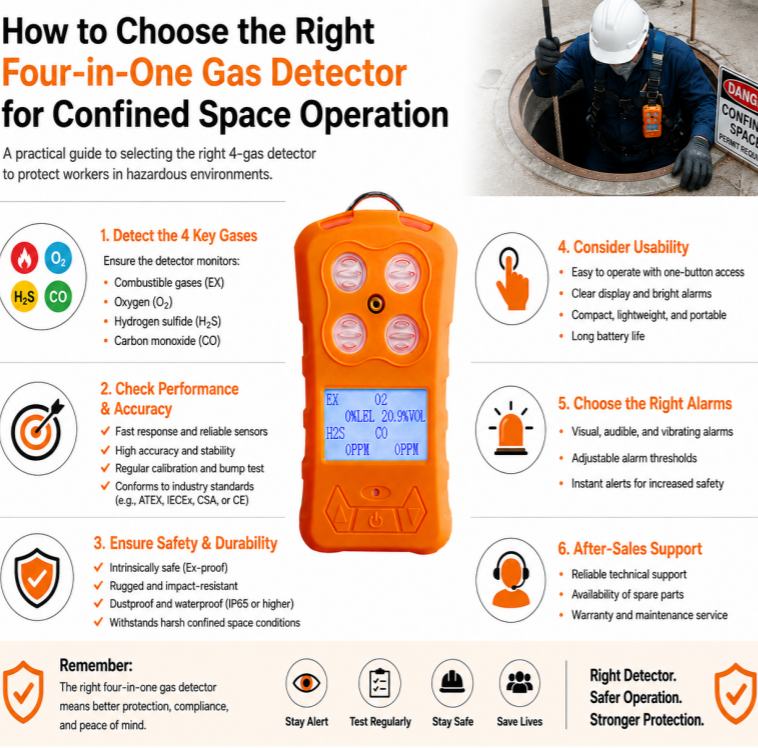
On the benchmark configuration, the standard 4-in-1 gas detector mainly monitors the four most common invisible killers in industrial sites: combustible gas (LEL), oxygen-deficient or oxygen-enriched ($O_2$), carbon monoxide (CO) and hydrogen sulfide ($H_2S$).
However, “standard” does not mean that it can cure all diseases. If your team needs to go deep into sewage pipelines or work in chemical plants, you may need to replace the standard toxic gas sensor with a more targeted model, such as sulfur dioxide ($SO_2$) or chlorine gas ($Cl_2$). When selecting the type, give priority to the instruments that support flexible adjustment of sensor configuration and have extremely short response time ($T_{90}$)-because when the gas concentration soars, every second is in a race with death.
Second, pre-entry detection vs. Real-time monitoring: the choice between pumping and diffusion
This is the easiest place for many purchasing teams to step on the pit. You must never let workers jump into a confined space and try their luck. All the major safety regulators in the world (such as OSHA, etc.) require gas detection before entering.
Pump-suction detector: with built-in or external electric sampling pump, the air at the tank bottom or deep well can be sampled and detected from the outside through sampling hose before personnel enter.
Diffusion detector: it relies on the natural flow of gas, and is suitable for workers to wear on their chests or breathing belts after entering the space for all-weather real-time monitoring.
For strict confined space compliance, the most sensible choice is to equip a 4-in-1 gas detector with built-in pump, or at least choose a modular system-connect the sampling pump for pre-inspection before entering, and remove the pump after entering to use as a portable diffusion monitor.
Iii. survivability in harsh environment: durability and IP protection level
The industrial site is extremely cruel to electronic equipment. A detector that strikes when it bumps into a steel beam or falls into a puddle is a huge safety hazard in itself.
Please pass off those consumer products with thin workmanship directly. Look for those models with thick rubber packages and protection level of at least IP67 or IP68 to ensure that they can still work normally in heavy rain, dust or accidentally falling into muddy water. In addition, the equipment must pass the intrinsic safety certification (such as ATEX, IECEx, etc.). Since you want to use it to detect combustible gas, the instrument itself must not be a detonating source.
Fourth, ensure that the alarm is “deafening”
The industrial operation site is usually full of noise and dim light. If there is a gas leak, the faint tick on the worker’s belt will not help at all.
A qualified 4-in-1 gas detector must be able to force attention instantly. What you need is a “triple alarm” system: high-decibel auditory siren (at least 95dB), extremely dazzling LED flashing light strip, and strong internal vibration of the fuselage.
For modern team management, we can also pay attention to intelligent functions such as “Man-down”. Once the worker falls unconscious due to poisoning or injury, the instrument will automatically send a distress signal to the external guardian after monitoring for a long time without action.


 WhatsApp: 8619339980364
 E-mail: contact@hirepsafety.com