
Fixed vs Portable Gas Detectors: Which One Do You Need?
In the grand narrative of industrial production, safety has always been the insurmountable red line, and gas leakage is the most hidden and fatal crack on this red line. Whether it is the magnificent phenomenon set up by the towers and tanks in the refinery, the quiet and narrow lanes under the mine or the seemingly quiet closed pools in the sewage treatment plant, the invisible gas threat has never stopped in an instant. In order to catch these unseen risks, the gas detector came into being, endowed with the lofty mission of caring for life, and became an indispensable “electronic nose” in the industrial field. However, in the practical safety production planning, decision-makers often fall into a kind of ideological misunderstanding, trying to make an either-or choice between fixed monitoring network and portable guards. This perspective of hating the two just ignores the disorder and multidimensional nature of industrial risk itself. A real, sophisticated and efficient security strategy has always been not a simple choice of topics, but a deep game about the spatial distribution of risks, the way people work and the emergency response mechanism. The ultimate answer lies in building a three-dimensional protection system that is dynamically combined and complementary.
Stationary gas detection systems constitute the static framework of modern factory safety. Like loyal soldiers, they are carefully placed at the key nodes where the risk sources meet most and the leakage probability is the highest. From the huge storage tank breathing valve to the dense pipeline flange joint, from the sealing point of the pump group to the pipe gallery groove with low terrain, these devices are closely connected with the central control room through the messy wiring system, forming a perceptual neural network covering the whole plant. The central value of fixed detector lies in its “all-weather” defense and “initiative” response ability. They don’t need to rest, and they monitor the change of gas concentration in the environment at a second speed day and night. More importantly, in the modern industrial initiative architecture, the fixed detector is not only an alarm, but also a trigger of control logic. When the risk signal appears, they can directly link with the actuator at the scene, instantly cut off the material delivery valve, start the high-power accident fan to exhaust air, or start the spray dilution system, so as to stop the disaster in the bud at the initial stage of the accident, even before the personnel are aware of it. This ability to actively interfere with process equipment is incomparable to any manual operation. They care about the integrity and stability of the whole production equipment. However, the limitations of fixed equipment are also significant. They are fixed “watchmen”, which are difficult to move once the device is finished, and their monitoring scale is limited to the limited space around the sensor. For those workers who are engaged in large-scale activities in the factory, or those temporary maintenance points and unplanned work areas, fixed equipment often has natural monitoring blind spots, which cannot provide personal safety assurance.
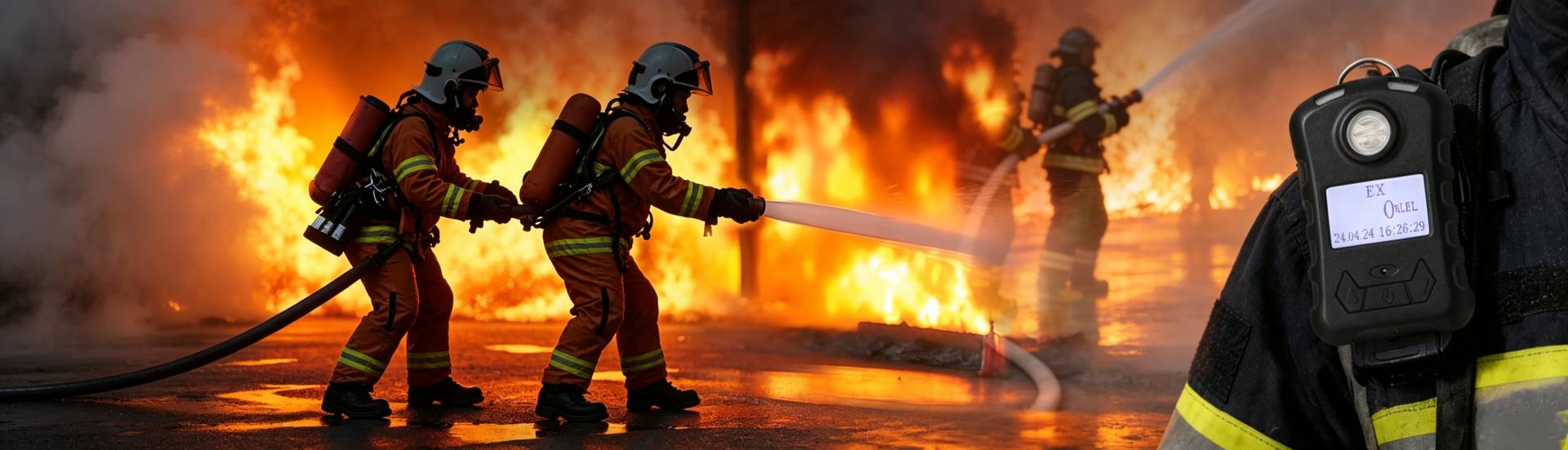
In contrast, the portable gas detector is an active safety shield, which is specially designed to deal with dynamic risks and uncertainties. They are exquisite and simple, and can be firmly clamped on the collar of workers or pinned to the waist to ensure that the sensors are always near the most critical breathing zone of people. This “man-machine walking” feature makes it the first choice to deal with non-fixed risks. When workers need to enter the confined space for compulsory inspection before operation, or make routine inspection in the equipment area, or even deepen the on-site investigation in the event of sudden leakage, portable instruments can accurately reflect the real environment of the personnel’s location in real time. It doesn’t rely on messy field wiring, but can work independently with built-in battery, which greatly improves the flexibility and response speed of operation. If fixed equipment is to maintain “equipment” and “area”, then portable equipment is to maintain “people” itself. It is the final line of defense for employees’ personal life safety, which endows operators with the ability to actively perceive and urgently avoid risks when faced with unknown risks. Of course, portable equipment also has its shortcomings. It can’t directly control large-scale process equipment to block the leakage source, and its efficiency is highly dependent on the user’s consciousness, which requires timely charging, regular calibration and standard wearing, otherwise it may become a display at critical moments due to battery exhaustion or sensor failure.
Therefore, the outstanding safety management system has never done subtraction between fixed and portable, but devoted itself to addition, seeking the fusion effect of “1+1>2”. The ideal protection system should be based on the fixed detection network, covering all known and high-risk fixed leakage points in an all-round way, and building the first unbreakable active defense line to ensure that the central risk source is closely monitored at any time and under any weather conditions; At the same time, the portable detector is the necessary complement and extension, which endows every operator who enters the site with the ability of mobile monitoring, fills the space gap between fixed points, and constructs the second flexible personal protection line. This “static-dynamic combination” method not only takes advantage of the linkage control of fixed equipment to prevent the expansion of disastrous incidents, but also gives full play to the flexibility and mobility of portable equipment to ensure the safety of individual lives, ending the seamless connection from “physical defense” to “civil air defense”.
In the final analysis, the selection logic of gas detector should not be limited by the tight budget or the skill of a single device, but should come from the accurate portrait and deep understanding of the operation risk. As long as we abandon the lazy thinking of “choose one from the other”, deeply understand the respective roles of fixed and portable, and organically weave them into a sound safety management system, we can weave a safety net with both rigid support and flexible protection in the changeable industrial environment. This net can not only keep the bottom line of equipment, but also protect the red line of life, so that every production work can be stable and far-reaching on a controllable and secure track, and truly end the harmonious coexistence of industrial development and life.


 WhatsApp: 8619339980364
 E-mail: contact@hirepsafety.com