
Solution of Gas Detection and Safety Protection in Gas Turbine Workshop
The gas turbine workshop belongs to a high-risk industrial environment, involving high temperature, high pressure and flammable and explosive gases. In order to ensure the safety of personnel and the stable operation of equipment, we need to establish a set of “all-weather, no dead angle” gas monitoring system. This scheme aims to realize early warning and rapid response to dangerous gases through scientific distribution and advanced detection technology.
1. Core Risk Source Analysis
Before deploying the detection system, the main hazard sources in the workshop must be made clear. During the operation of gas turbines, there are mainly three kinds of gas threats:
- Natural gas leakage (Methane CH₄): This is the core risk. As the main fuel, natural gas is easy to accumulate in a closed or semi-closed space once it leaks around pipelines, valves or combustion chambers. When the concentration reaches 5% of the lower explosive limit, it constitutes a serious threat.
- Toxic and harmful gas (Carbon Monoxide CO & Nitrogen Oxide NOx): High concentration of carbon monoxide may be produced when the gas turbine is not fully burned or the exhaust emission system fails. These gases are colorless and odorless, and have fatal hidden toxicity to on-site inspection personnel.
- Fire and smoke: Due to the high-speed operation of the turbine and the existence of the oil system, the high-temperature surface may lead to fuel fog or cables, resulting in a lot of smoke. Due to the high-speed operation of the turbine and the existence of the oil system, the high-temperature surface may lead to fuel fog or cables.
2. System Architecture Design
Our solution adopts the architecture of “distributed detection+centralized management” to ensure the real-time and stability of data transmission.
- Front-end sensing layer (Detector): All field detectors must have Ex d IIC T6 Gb explosion-proof certification to adapt to the harsh environment of the workshop. In view of complex environment, it is suggested to adopt composite sensor technology, and a single probe can simultaneously monitor combustible gas and toxic gas.
- Data transport layer: Adopt industrial-grade bus (such as RS485/Modbus) or industrial Ethernet to ensure that the signal is not lost in strong electromagnetic interference environment. Key nodes are equipped with wireless transmission module (LoRa/NB-IoT) as redundant backup of wired network.
- Central monitoring layer (Host and software): The large screen in the central control room displays the gas concentration curve in each area in real time. Once exceeding the standard is detected, the system will automatically trigger an audible and visual alarm, and start the exhaust fan, cut off the solenoid valve and even trigger an emergency stop program.
3. Deployment Strategy of Key Points
Reasonable distribution is the key to effective detection. We can’t “sprinkle pepper noodles” but “strike with precision”.
- Gas pressure regulating station and inlet pipeline area: Detection object is Methane (CH₄). Since natural gas is lighter than air, the detector should be installed 0.5-2m above the leakage source or below the roof truss.
- Around the gas turbine body and combustion chamber: Detection object is Methane (CH₄) + Carbon Monoxide (CO). The space in the enclosure is narrow and easy to accumulate gas, so it needs to be monitored emphatically.
- Lubricating oil station and hydraulic system: Detection object is Volatile Organic Compounds (VOCs) or smoke. Install close to the ground or above the oil tank, because oil vapor is usually heavier than air.
- Personnel patrol passage and rest area: Detection object is Oxygen (O₂) + Carbon Monoxide (CO). The objective is to prevent hypoxia, asphyxia and poisoning at the breathing zone height (about 1.5 meters).
4. Equipment Selection Technical Index Reference
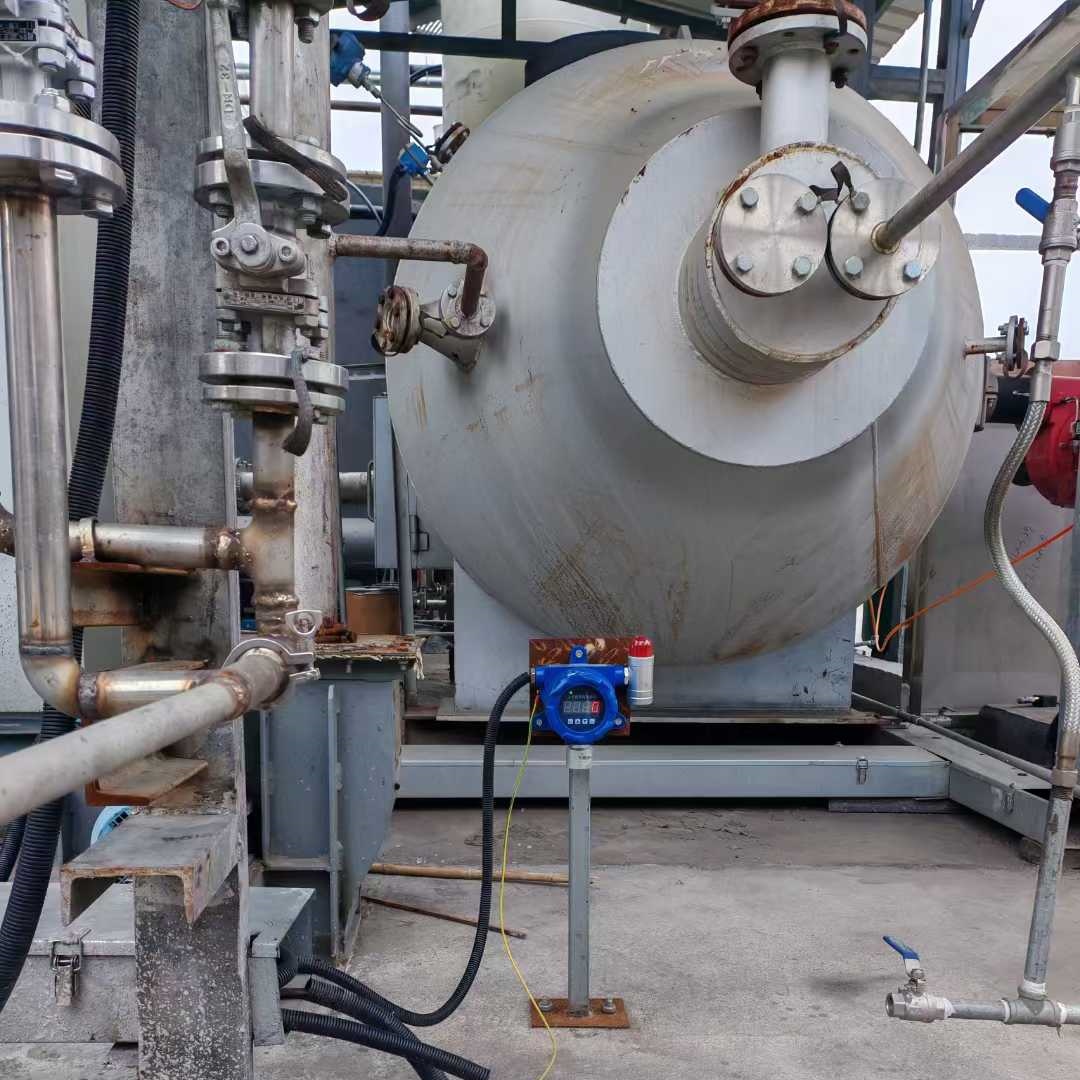
In order to ensure that the purchased equipment meets the standards, please refer to the following core technical indicators (taking natural gas detection as an example):
- Detection principle: Infrared principle (NDIR) is preferred, because it is not affected by sulfide poisoning, with long service life and high stability.
- Measuring range: 0-100% LEL (lower explosive limit).
- Response time: T90 < 15 seconds (the sooner the better, the more time to escape).
- Protection grade: IP65 or IP66 (dustproof and waterproof, suitable for workshop washing operation).
- Working temperature: -40℃ to +70℃ (suitable for high temperature environment in the workshop).
5. Maintenance and Emergency Response Mechanism
Hardware is only the foundation, and management is the soul.
- Periodic calibration: It is recommended to calibrate the detector with standard gas every 3-6 months to ensure the sensitivity of the sensor.
- Function test: Conduct a “bump test” once a week, that is, introduce a small amount of gas to confirm that the alarm function is normal.
- Emergency plan:
- First-class alarm (low limit): On-site sound and light alarm to remind personnel to pay attention and check the leakage point.
- Secondary alarm (high limit): The linkage exhaust system runs at full speed, the air inlet valve is cut off, and the control room automatically dials the emergency number.
Through this scheme, we not only solved the problem of “what to measure”, but also defined “how to measure” and “how to manage”, thus building a solid invisible safety wall for the gas turbine workshop.


 WhatsApp: 8619339980364
 E-mail: contact@hirepsafety.com