
Solution of gas detection and safety protection in desulfurization workshop
Desulfurization workshop (including natural gas purification, biogas upgrading, flue gas desulfurization and other scenes) has the characteristics of long process flow, dense pipelines and high concentration of toxic, harmful and corrosive gases. In order to ensure production safety and environmental compliance, this plan focuses on the comprehensive monitoring layout of hydrogen sulfide, sulfur dioxide and flammable and explosive gases.
I. Core Risk Sources and Monitoring Objectives
The core of desulfurization process is to remove acid gas, so the monitoring focus is very clear:
- Highly toxic gas (H₂S & SO₂): Hydrogen sulfide: feed gas or feed usually contains high concentration of H₂S (even up to thousands to tens of thousands of ppm), which is fatal once leaked. Sulfur dioxide: it may be produced in Claus sulfur recovery section or oxidation environment, and it is also a strong irritating toxic gas.
- Flammable and explosive gas (CH₄ & H₂): In desulfurization of natural gas or biogas, methane is the main component; Some wet desulfurization processes may produce hydrogen. In anaerobic environment (such as biogas system), oxygen leakage into the system will form explosive mixed gas, so the oxygen content must be strictly monitored.
II. The deployment strategy of key monitoring points
According to the technological process, we divide the monitoring points into three key defense lines: entrance, process and exit.
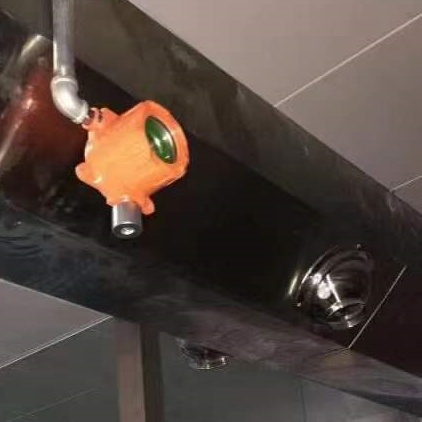
- The first line of defense: feed gas inlet and pretreatment area: Risk characteristics: high concentration of H₂S, high pressure and high leakage risk. Near the feed line/separator: install a high-range laser H₂S detector.
- The second line of defense: the core area of desulfurization reaction (tower body and regeneration area): Risk characteristics: involving chemical agents (such as amine solution and alkali solution), there is a risk of volatilization and leakage, and trace gases may escape. Middle and lower part of desulfurization tower/biological trickling filter tower: install H₂S/O₂ dual-channel detector.
- The third line of defense: purified gas outlet and discharge area: Risk characteristics: it is necessary to ensure that the desulfurization efficiency reaches the standard and prevent the gas exceeding the standard from being discharged. Desulfurization tower outlet pipeline: install low-range high-precision H₂S detector (0-50ppm or 0-100ppm).
- The fourth line of defense: crowded and patrol area: Entrance of central control room/duty room: install O₂ detector to prevent suffocation.
III. Equipment selection and technical index suggestions
The environment of desulfurization workshop is usually humid and corrosive, so the equipment selection must be “solid and durable”.
- Sensor technical route: High concentration H₂S (entrance): Laser principle (TDLAS) is preferred. Low concentration H₂S/SO₂ (environment/outlet): long-life electrochemical sensor is selected.
- Protection and installation requirements: Anti-corrosion coating: the equipment shell should be made of 316L stainless steel or sprayed with nanometer anti-corrosion coating to resist the corrosion of H₂S and acid-base mist.
- Installation height: H₂S/SO₂ (specific gravity > air): installed 30-60cm away from the ground. CH₄ (specific gravity < air): installed 30-60cm away from the ceiling.
IV. Intelligent linkage and data management
Simple data display is not enough, and a linkage mechanism must be established:
- Fan linkage: When the H₂S concentration reaches the first alarm value (such as 5ppm), the emergency exhaust fan will be automatically started. Emergency cut-off: When the concentration reaches the secondary alarm value (such as 15ppm), the feeding emergency cut-off valve will be shut down and the feeding will be stopped.
- Trend warning: based on the analysis of historical data, if it is found that the outlet H₂S concentration is slowly rising although it is not over the standard, the system should prompt “desulfurization agent may fail” or “packing layer penetration” to guide the replacement of chemicals in advance.
V. Maintenance and calibration specifications
- Poisoning prevention management: it is forbidden to use high-concentration gas to directly impact the low-range sensor. Periodic blowback: It is recommended to set up an automatic blowback system for compressed air (blowing for 15 seconds every 4 hours) to keep the sampling gas path unblocked.
- Calibration period: In the harsh environment of desulfurization workshop, it is recommended to calibrate the zero point and range every three months, and use standard gas to verify the accuracy.
Through this scheme, we will move the monitoring point from the “after-event discharge port” to the “before-event feed port” and “during-event reaction zone”, and truly realize the transformation from passive rescue to active defense.


 WhatsApp: 8619339980364
 E-mail: contact@hirepsafety.com