
What does the multi gas detector 4-gas detect? Full site safety guide
I. Preface
Most dangerous gases are colorless, odorless and invisible in industrial sites, underground tunnels, closed tanks and sewage underground. It is impossible to predict the leakage and concentration exceeding the standard in advance by relying on human senses. Often, when people have symptoms of dizziness, nausea and suffocation, the accident is irreparable.
In the current safety production specification, the four-in-one gas detector is the standard safety equipment for confined space access, hot work and confined space inspection, and it is also the most commonly used personal protective testing instrument for field personnel. Many front-line workers only know the startup detection, but they don’t know which gases it monitors, what risks it will cause when the concentration exceeds the standard, and what to do after the alarm.
In this paper, the test object, risk hazards, applicable scenarios and key points of safe use of the four-in-one gas detector are dismantled in detail, and a complete safety guide that can be directly used for team training and on-site disclosure is formed.
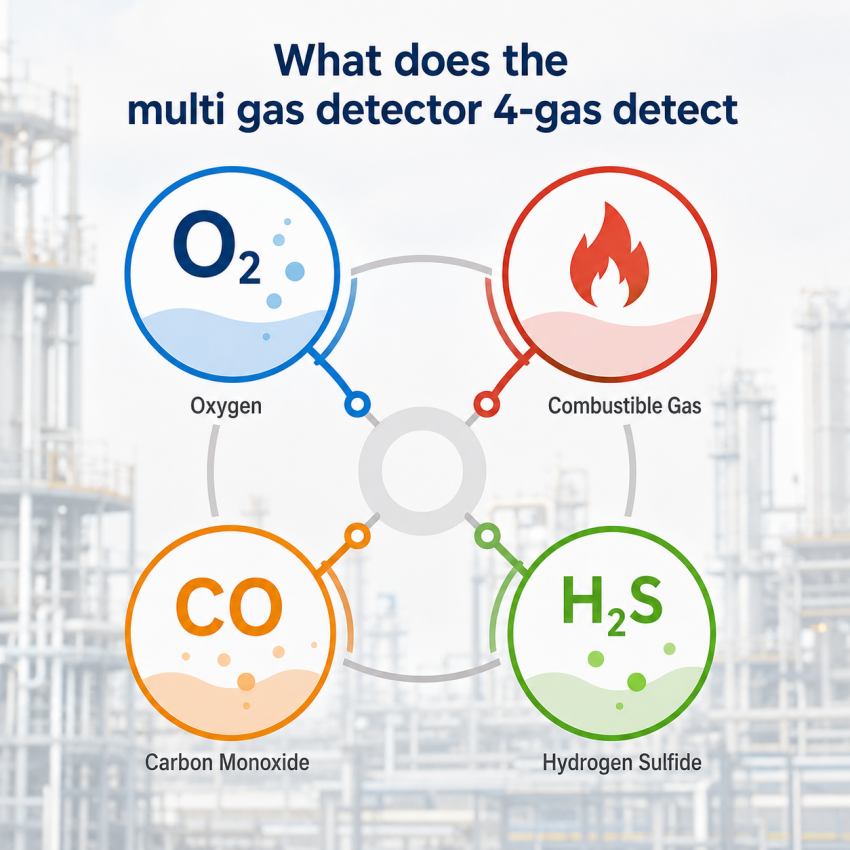
Second, the four-in-one gas detector core detection medium
The four-in-one gas detector, which is a general type of industry standard, can detect the highest and most harmful gas parameters in four types of industrial sites, and it is also a combination index required by safety supervision regulations, namely:
- oxygen (o)
- combustible gas (LEL, lower explosive limit)
- carbon monoxide (CO)
- hydrogen sulfide (hs)
These four parameters cover three core safety risks: suffocation, explosion and poisoning, which can meet the daily detection and access determination requirements of most general industrial scenarios.
III. Detailed explanation of four test parameters and site risks
(1) Oxygen (O): prevent suffocation and rich combustion.
In normal atmospheric environment, the standard concentration of oxygen is 20.9%VOL, which is the reference value for human respiration and equipment combustion. Too low or too high oxygen concentration will directly lead to safety accidents.
1. Risk of hypoxia (most common in confined spaces)
Organic matter decomposition, steel corrosion, gas replacement and inert gas plugging in confined space will consume oxygen in the space. After the concentration drops, the human body will have a gradual poisoning reaction:
Below-19.5%VOL: Early warning of hypoxia, causing fatigue, dizziness and shortness of breath.
Below-16%VOL: poor judgment, dyskinesia and rapid heartbeat.
Below-10%VOL: confusion, syncope and muscle spasm.
Below-6%VOL: suffocated within minutes.
The safety production specification clearly stipulates that when the oxygen concentration is lower than 19.5%VOL, personnel are prohibited from entering the confined space.
2. Oxygen-enriched risk (easily overlooked)
When the oxygen concentration is higher than 23.5%VOL, it belongs to an oxygen-enriched environment, which will not directly poison people, but will greatly reduce the ignition point of combustible materials, and clothes, rubber, oil stains, dust, etc. will be easily ignited, causing violent combustion or even secondary explosion.
(2) Flammable gas (LEL): explosion-proof core monitoring
LEL is the abbreviation of lower explosion limit, which refers to the lowest concentration of combustible gas in air that can be ignited by fire source and explode. The value displayed by the detector is the percentage of the current gas concentration to the lower explosion limit, not the real gas volume concentration.
1. Common detectable media on site
The universal calibration standard of the instrument is methane, which can cover the common flammable and explosive media on site: natural gas, methane, propane, hydrogen, gasoline vapor, alcohol vapor, etc.
2. Concentration classification and disposal requirements
- 0~10%LEL: safe range, which can be used for normal operation.
- 10~20%LEL: early warning interval, check leakage source and strengthen ventilation.
- ≥20%LEL: alarm interval, immediately stop hot work, evacuate personnel and force ventilation.
Important reminder: LEL exceeding the standard means that there is an explosion hazard. At this time, any static electricity, non-explosion-proof electrical appliances and mobile phone sparks may trigger an accident and must be treated with zero tolerance.
(3) Carbon monoxide (CO): silent, highly toxic and asphyxiating gas.
Carbon monoxide is colorless, odorless and non-irritating, which can not be detected by human senses. It is mainly produced by incomplete combustion, and it is the most likely toxic gas to cause mass deaths and injuries in winter heating, underground operation and internal combustion equipment operation.
1. The main sources on site
Internal combustion engine generator, boiler, welding operation, poor ventilation in roadway, tail gas accumulation of fuel equipment, smoldering of combustible materials in closed space.
2. The process of human poisoning
- Low concentration: headache, nausea, tinnitus, weakness of limbs, easily mistaken for fatigue.
- Moderate concentration: blurred vision, slow response, vomiting and coma.
- High concentration: the oxygen carrying capacity of blood is blocked, and the brain dies in a short time.
Misunderstanding is easy to occur at the scene: people stay and rest after feeling unwell, which aggravates the depth of poisoning. The correct way is to immediately move to a fresh air area and report it.
(4) Hydrogen sulfide (HS): a highly toxic gas with olfactory paralysis.
Hydrogen sulfide is the number one toxic gas in oil and gas, sewage and municipal underground operation. The well-known “rotten egg smell” is its most confusing feature.
1. High-risk operation scenarios
Oil and gas exploitation and gathering, sewage treatment tank, sewer and inspection well, chemical desulfurization device, papermaking and pulping, metal smelting workshop.
2. Fatal characteristics (key warning)
- Low concentration (within 10ppm): It has obvious rotten egg smell and can be detected.
- high concentration (> >50ppm): the olfactory nerve of nasal cavity is paralyzed instantly, and no smell does not mean that there is no toxic gas.
- Extremely high concentration: instant death by electric shock after inhalation, unable to save himself after falling to the ground.
All underground, sewage well and pipe trench operations must be pre-detected by lowering the detector, and it is strictly forbidden to judge whether it is safe by smell.
4. Why is fixation a combination of these four gases? (industry bottom logic)
Many field personnel will wonder: Why not increase the parameters such as ammonia, chlorine and VOC? The industry standard four-in-one combination is determined based on accident statistics, laws and regulations and site risks:
- Covering three core risks: oxygen corresponding to suffocation risk, LEL corresponding to explosion risk, and CO and HS corresponding to poisoning risk, including more than 90% common accident causes in industrial confined space;
- Strong compliance and universality: national safety production, confined space operation and hot work specifications all take these four items as mandatory indicators for access inspection;
- High field practicability: the all-in-one machine is portable, portable, suitable for team rotation and low maintenance cost. Compared with multiple single gas detectors, it is more suitable for carrying around and multi-point inspection;
- The risk priority is the highest: CO and HS are extremely deadly gases, and hypoxia and combustible leakage are the causes of high-frequency mass accidents, which are much higher than the toxic and harmful gases of small groups.
If there are special media such as ammonia, chlorine and volatile organic compounds in the operation scene, it is necessary to install a dedicated sensor or use a customized multi-gas detector on the basis of four in one.
Five, the mainstream application industry and testing focus
1. Oil and gas industry
Key monitoring: hydrogen sulfide (associated with formation) and combustible gas (oil and gas leakage); Auxiliary monitoring of oxygen and CO, which is used for access detection of hot work of drilling platform, gathering and transportation station, tank cleaning and pipeline.
2. Mine underground operation
Key monitoring: combustible gas (gas/methane), CO (coal spontaneous combustion, residue after blasting) and oxygen; Prevent underground suffocation, gas explosion and coal seam spontaneous combustion poisoning accidents.
3. Maritime operations of ships
Used for inspection of cargo hold, ballast tank, double bottom tank and enclosed area of engine room, focusing on the investigation of hypoxia, combustible risk of fuel vapor and hydrogen sulfide produced by organic matter in the cabin.
4. Municipal and Sewage Treatment Industry
Inspection wells, sewage ponds, sludge pump houses and septic tanks are the necessary equipment for municipal underground operations, with the core of preventing and controlling methane explosion caused by hydrogen sulfide poisoning and anaerobic decomposition.
5. General chemical industry and manufacturing industry
Maintenance of storage tanks, tank cleaning of reaction kettle and inspection of underground pipe gallery are used for pre-detection of restricted space access and hot work approval, which meets the requirements of on-site verification of safety supervision.
Six, the site use of key safety guidelines (practice must see)
- Test first, then enter: all confined space operations must be pre-tested before personnel enter, and all the values are qualified before entering.
- Real-time continuous monitoring: the detector needs to be turned on all the time during operation, and the gas concentration may suddenly change with working conditions, temperature and airflow.
- Regular calibration and calibration: the sensor will decay with time, and the uncalibrated instrument value has deviation. It is strictly forbidden to take up the post for the equipment that has not been inspected for a long time.
- Unconditional evacuation by alarm: If any parameter exceeds the standard, it is not necessary to investigate the cause, and immediately organize all personnel to evacuate, and then analyze the problem after the ventilation retest is qualified.
- Differentiate the use of models: the common four-in-one is not aimed at special gases such as ammonia and chlorine, and it is forbidden to mix general models in special media scenes.
VII. Conclusion
The core value of the four-in-one gas detector is to prevent and control the four fatal risks of hypoxia and asphyxia, flammable explosion, CO and HS poisoning with one device at the same time. It is not a formal security tool, but a life-saving device for front-line personnel.
Only by understanding the hazard logic of the four detection gases, mastering the determination standard of concentration, and strictly implementing the operation process of first inspection and then entry can we avoid the poisoning, suffocation and explosion accidents in the confined space from the source, so that the equipment can really play a safety protection role and meet the requirements of enterprise safety management and legal compliance.


 WhatsApp: 8619339980364
 E-mail: contact@hirepsafety.com