
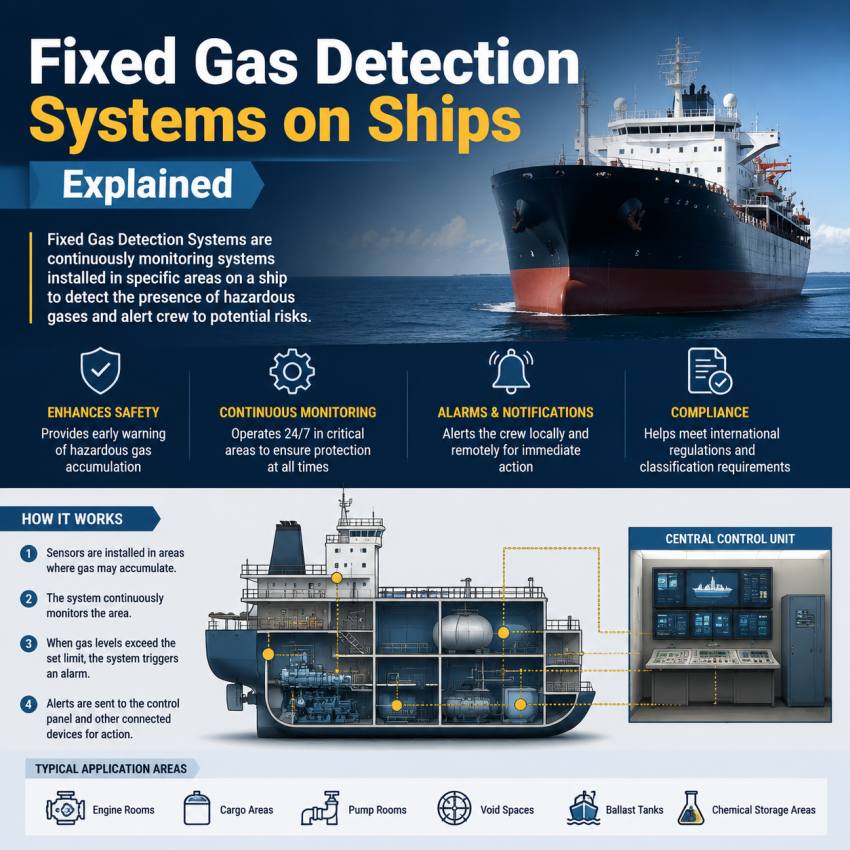
Fixed Gas Detection Systems on Ships Explained
Ship fixed gas detection system is a necessary compliance safety equipment for ships, which is widely used in high-risk and closed cabins of all kinds of ships. Different from the portable detector with manual hand-held sampling inspection, this system is permanently installed and runs online for 24 hours, which can monitor the concentration of combustible gas, toxic gas and oxygen in real time and warn the safety risks such as leakage, hypoxia, explosion and personnel poisoning in advance. It is the basic guarantee equipment for the safe operation of ships.
Based on the official maritime specifications such as IMO, SOLAS, IGC Code and the on-site ship operation and maintenance experience, this paper explains the structure, monitoring risk, installation area, compliance standards, application value, selection points and technical development direction of the system in a popular and systematic way, and the content meets the requirements of industry practice and compliance.
I. System Core Composition (Industry Standard Configuration)
The marine fixed gas detection system is an integrated closed-loop monitoring equipment, and all components are adapted to the high salt fog, high vibration and alternating high and low temperature environment at sea, meeting the explosion-proof and anti-corrosion operation standards of mainstream classification societies. The whole system consists of five core modules:
- Gas sensor: the core of on-site acquisition, which matches the corresponding monitoring model according to the ship type, can stably detect the combustible, toxic gas and oxygen content, has its own temperature compensation and anti-interference functions, and supports long-term continuous sampling.
- Central control display unit: responsible for summarizing all sensor data, displaying the gas concentration and equipment operation status in each area in real time, and supporting zone monitoring and abnormal prompt.
- Acousto-optic alarm device: it adopts hierarchical alarm mode, and triggers two-level acousto-optic warning and danger warning according to gas concentration, covering the ship operation and duty area.
- Automatic linkage interface: it can connect the ship’s ventilation, fire fighting and equipment emergency stop system, and automatically start emergency treatment when the gas exceeds the standard, without manual operation.
- Data recording and communication module: automatically retain monitoring data and abnormal event records, support data backtracking and remote transmission, and meet the traceability requirements of maritime supervision.
The operation logic of the system is simple and reliable: the sensor collects environmental data in real time and uploads it to the central control unit, and the equipment compares the preset safety threshold and continuously monitors it under normal conditions; Once the gas concentration exceeds the standard, the alarm will be triggered immediately and emergency equipment will be linked to realize risk control in advance.
II. Risk Classification of Ship Core Gas (Authoritative Compliance Monitoring List)
Combined with SOLAS Convention and the operation specification of liquid carriers, the gas safety risks of ships are mainly divided into three categories, which are also the core monitoring scope of fixed detection systems, all of which belong to maritime compulsory monitoring scenarios.
1. Combustible gas risk (explosion core hidden danger)
Combustible gas mainly comes from fuel leakage, volatilization of goods and equipment tail gas residue, which is easy to form explosive mixture after accumulating in closed cabin, and is the main inducement of ship fire and explosion. Common monitoring gases include methane, propane, butane and hydrogen, which are suitable for ordinary cargo ships, LNG ships and new energy ships.
2. Toxic gas risk (personnel health hazard)
Toxic gases are produced by fuel combustion, chemical volatilization and equipment corrosion reaction, most of which are colorless and odorless, which are difficult to find by manual inspection and are easy to cause acute poisoning or chronic physical injury to crew members. Conventional monitoring categories include hydrogen sulfide, carbon monoxide, sulfur dioxide, ammonia gas and chlorine gas, which are mainly used in engine room and chemical tanker operation area.
3. Risk of abnormal oxygen concentration (high-risk hidden danger of closed operation)
The ventilation condition of the ship’s closed cabin is poor, and it is easy to cause suffocation due to low oxygen or aggravate combustion due to high oxygen for a long time. The maritime code clearly requires that oxygen concentration must be monitored regularly in all closed working spaces to ensure the crew’s entry, maintenance and operation safety.
III. Compliance installation location (special monitoring in high-risk areas)
The system adopts fixed-point centralized control mode, and according to maritime regulations and on-site safety experience, it mainly covers high-risk, closed and high-frequency operation areas for personnel, and completely eliminates the monitoring blind area. The core installation areas are as follows:
- Engine room: the core area of the ship’s power, with many equipments and concentrated heat sources. The fuel oil and lubrication system are easy to leak and produce combustible gas and carbon monoxide, so it is necessary to deploy sensors at multiple points for 24-hour monitoring.
- Cargo hold and cargo hold: in the high-risk areas of oil tankers, chemical tankers and LNG carriers, the continuous volatilization of goods is easy to cause gas accumulation, so it is necessary to lay out points in layers and zones, which is the key project of maritime inspection.
- Pump room: the space is closed, the ventilation is weak, the gas diffuses quickly after the pump leaks, and the risk is concentrated, so independent detection loop and exclusive alarm mechanism are needed.
- Battery compartment: the key protection area of new energy ships. The thermal runaway of lithium batteries will release flammable and toxic gases, which has been included in the monitoring scope of mainstream classification societies.
- Closed empty cabin: long-term closed space such as ballast cabin, overhaul cabin and isolation cabin, which is easy to lack oxygen and retain harmful gases, is a necessary inspection area for crew before operation.
IV. Authoritative compliance standards (basis for compulsory industry access)
The fixed gas detection system for ships is mandatory safety equipment for ships. The whole process of design, installation, operation and maintenance must conform to the international maritime code and classification society standards. It is forbidden to use the equipment without compliance certification. The core basis includes:
- IMO safety regulations.
- International Convention for the Safety of Life at Sea (SOLAS)
- liquefied gas carrier code (IGC Code)
- ABS, DNV, LR, CCS and other domestic and foreign mainstream classification society inspection standards.
In addition to compliance requirements, the equipment should be adapted to the harsh environment at sea, with salt spray corrosion resistance, vibration resistance and high and low temperature resistance, so as to ensure long-term stable and trouble-free operation of ocean navigation.
V. The system core security value (practical effect)
In the daily operation of ships, the core function of fixed gas detection system is to prevent and control risks in advance, make up for the shortcomings of manual inspection and realize automatic emergency protection. The specific value is embodied in the following aspects:
- Full-time monitoring: 24-hour uninterrupted operation, to make up for the gap of manual regular inspection, and to eliminate the safety blind spot at night and unattended time.
- Early warning of risks: support grading threshold warning, prompt rectification in advance when the gas concentration is close to the dangerous value, so as to prevent and control in advance.
- Automatic emergency response: ventilation, emergency stop and alarm equipment are automatically linked when the gas exceeds the standard, so as to quickly deal with dangerous situations and improve emergency efficiency.
- Reduce the accident rate: effectively prevent major accidents such as ship explosion, fire, personnel poisoning and suffocation, and reduce the safety risks of ship operation.
- Simplify safety operation and maintenance: reduce the workload of manual inspection, and the monitoring data can be traced back and counted, which will help standardize ship safety management.
VI. The key factors of project selection (industry practice standard)
Combined with the procurement, installation and operation and maintenance of ship equipment, the core principles of system selection are compliance, adaptation and stability, and the key considerations are as follows:
- Complete classification society certification: the equipment must hold a valid classification society certification certificate to meet the requirements of ship inspection and maritime compliance, and it cannot be used on board without certification.
- Adaptability to marine environment: the components and housings of the equipment shall be corrosion-resistant, vibration-resistant and anti-jamming, and be suitable for the harsh environment with high humidity and high salt fog at sea.
- Multi-gas adaptive monitoring: the monitoring scheme can be customized according to the ship category, covering the monitoring requirements of combustible gas, toxic gas and oxygen concentration simultaneously.
- Good data set formation: compatible with marine general communication protocols, accessible to shipboard automation systems and shore-based platforms, and supporting remote monitoring and data synchronization.
- Easy operation and maintenance, high stability: the structural design is convenient for on-site calibration, overhaul and maintenance, with low failure rate, which is suitable for long-term continuous operation of ships.
VII. The industry frontier technology development trend
With the development of intelligent and low-carbon shipping and the continuous popularization of green new fuel ships, the ship gas detection system is no longer a single alarm device, but gradually transformed into an intelligent safety monitoring node. The main development trends of the industry are as follows:
- Wireless distributed monitoring gradually replaces the traditional wired system, featuring flexible installation, convenient operation and maintenance, and adapting to the new ship structure design.
- Cloud data management and remote fault diagnosis have become industry standards, enabling shore-based remote supervision and data traceability analysis.
- The application of AI algorithm can intelligently identify the abnormal trend of gas concentration, predict the hidden danger of leakage and realize active prevention and control.
- The special detection schemes for green fuels such as ammonia, methanol and hydrogen energy are continuously iterated to meet the development needs of low-carbon shipping.
- The sensor is upgraded to the direction of high precision, long service life and self-diagnosis, which greatly improves the overall stability and practicability of the system.
Summary
Ship fixed gas detection system is the core safety equipment necessary for maritime mandatory compliance and ship operation. Through all-weather monitoring, grading early warning, automatic emergency linkage, data traceability and other functions, the ship gas safety risks are comprehensively prevented and controlled. In the process of intelligent upgrading of shipping, the system is continuously iteratively optimized, which is an important component of the intelligent safety system of ships and provides reliable compliance technical support for ship navigation, cargo operation and personnel safety.


 WhatsApp: 8619339980364
 E-mail: contact@hirepsafety.com