
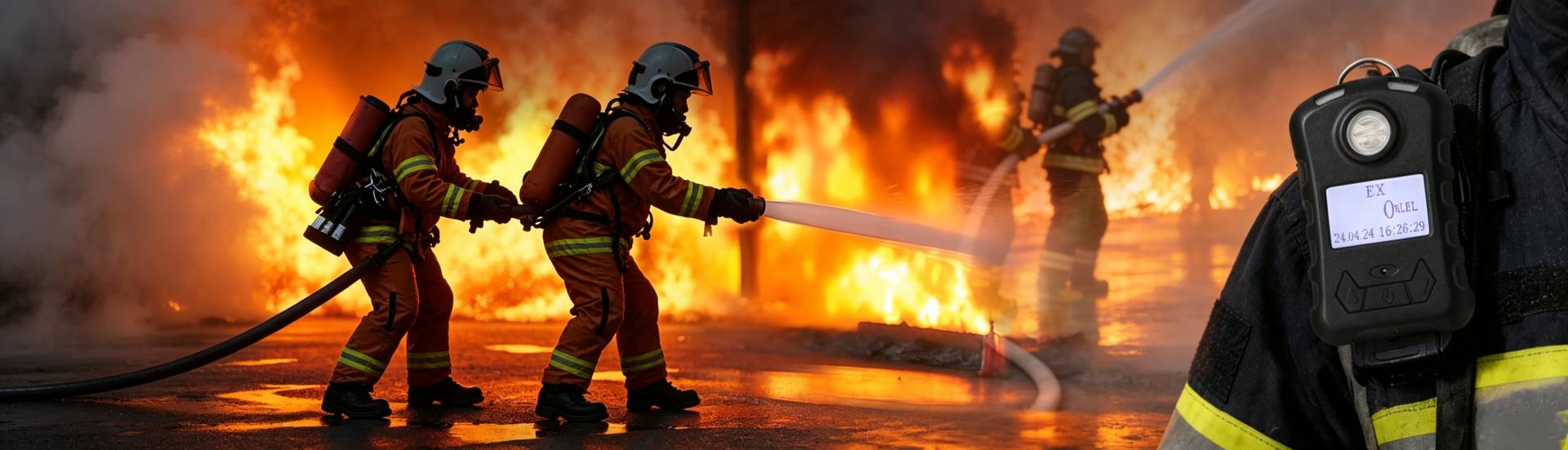
Infrared Sensor vs Electrochemical Gas Sensor
In industrial environment, gas leakage and air quality problems are directly related to personnel safety and equipment operation stability. Therefore, the selection of suitable gas detection sensors is an important part of enterprise safety management. At present, Infrared Sensor and Electrochemical Gas Sensor are the two most widely used technologies in the field of gas detection, each of which has different advantages and applicable scenarios.
1. Infrared sensor: working principle and characteristics
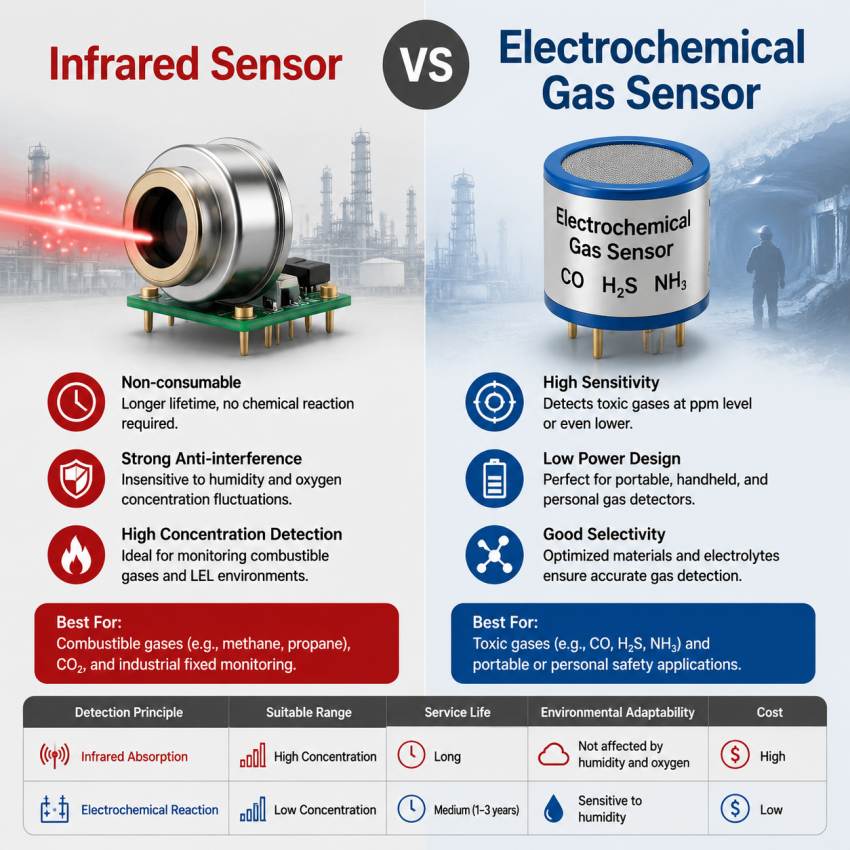
The infrared sensor detects the gas concentration by measuring the absorption of infrared light with a specific wavelength. Gases such as carbon dioxide (CO₂) and methane (CH₄) will absorb infrared light with a specific wavelength, and the sensor will calculate the gas concentration according to the absorption intensity.
Main advantages
Non-consumable detection
Infrared sensors do not need to complete detection through chemical reaction, so the life of sensors is usually long.
Strong anti-interference ability
It is insensitive to humidity change and oxygen concentration fluctuation, and is suitable for complex industrial environment.
Suitable for high concentration gas detection
It can stably monitor the high concentration combustible gas and the gas environment close to the lower explosion limit (LEL).
Limitations
- The initial purchase cost is relatively high, which is more suitable for long-term fixed monitoring applications.
- It is only suitable for specific gases with infrared absorption characteristics, and it is impossible to realize broad-spectrum gas detection.
2. Electrochemical gas sensor: working principle and characteristics
Electrochemical gas sensor uses the oxidation or reduction reaction of the target gas on the electrode surface to generate a current signal, and measures the gas concentration according to the current. This technology is widely used in the detection of toxic gases such as carbon monoxide (CO), ammonia (NH₃) and hydrogen sulfide (H₂S).
Main advantages
High sensitivity detection
It can detect toxic gases of ppm level or even lower concentration.
Low power design
It is very suitable for portable, handheld and personal protective gas detectors.
Good gas selectivity
By optimizing the electrode material and electrolyte formula, accurate detection of specific gases can be realized.
Limitations
- Environmental factors such as high temperature and high humidity may affect the detection performance and lead to signal drift.
- Sensors are consumable components, which usually have a service life of 1 to 3 years and need to be replaced regularly.
3. Practical application and selection suggestions
Petrochemical and natural gas industries
Infrared sensors are very suitable for monitoring combustible gases such as methane and propane. Because of its long-term stability and low maintenance requirements, it is widely used in refineries, natural gas treatment stations and gas pipelines.
Mining and sewage treatment industry
Electrochemical gas sensors can accurately detect low-concentration toxic gases, such as hydrogen sulfide and carbon monoxide, and provide timely safety warning for workers.
Portable gas detection equipment
Because of its low power consumption, small size and fast response, electrochemical gas sensors have become the mainstream choice for portable single gas detectors and multi-gas detectors.
Stationary gas monitoring system
For scenes that need to continuously monitor the concentration of combustible gas or carbon dioxide for a long time, infrared sensors are usually a more ideal solution because of their longer service life and excellent stability.


 WhatsApp: 8619339980364
 E-mail: contact@hirepsafety.com