
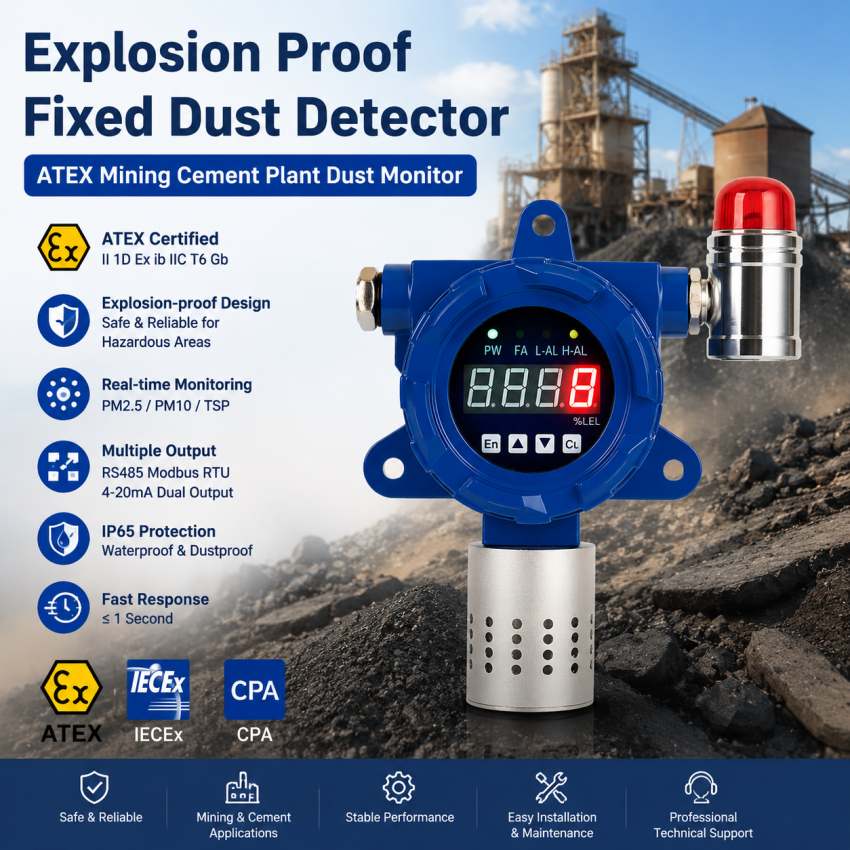
Explosion Proof Fixed Dust Detector ATEX Mining Cement Plant Dust Monitor
ATEX explosion-proof fixed dust detector: a complete guide to dust monitoring in mines and cement plants
Author:Hu Leo, an industrial dust sensor engineer with 12 years of on-site installation experience. Our factory has passed ISO9001, ATEX and CPA certification, and supplies fixed dust monitoring equipment to industrial customers all over the world.
I. What is ATEX explosion-proof fixed dust detector?
Explosion-proof fixed dust detector is a wall-mounted fixed monitoring equipment, which can continuously detect combustible suspended dust in dangerous operation areas for 24 hours, fully meeting the European Union ATEX safety standards.
Different from portable dust detector, fixed equipment can run unattended all year round. Once the dust concentration reaches the critical value of explosion risk, the equipment will immediately start an audible and visual alarm. The instrument can detect coal dust, cement powder, flour and metal dust, covering PM2.5, PM10 and TSP.
Ordinary dust detector is only applicable to conventional non-hazardous workshops. Plastic shell and common circuit can’t prevent electric spark from leaking out, which can easily ignite combustible dust clouds. ATEX explosion-proof model adopts cast aluminum explosion-proof shell and intrinsically safe circuit, which is suitable for mines and cement production workshops in areas 20, 21 and 22 with dust explosion risk.
Second, why must mines and cement plants be equipped with explosion-proof fixed dust detectors?
There are two major requirements for the factory to install compliant fixed dust monitoring equipment: preventing safety accidents and meeting the compliance requirements of environmental protection and safety supervision.
Combustible dust accumulated in crushing, grinding and packaging workshops is a major explosion hazard, and tiny electrostatic sparks will cause serious safety accidents, resulting in equipment damage and personal injury. When safety supervision and environmental protection departments conduct regular inspections, enterprises must provide long-term continuous monitoring records of fixed detectors. Using monitoring equipment without formal certification, enterprises will face fines and be ordered to stop production and rectify.
Combined with our field service cases, many manufacturers purchase non-explosion-proof dust detectors to reduce costs. This kind of equipment can’t pass the official verification, and the data issued by it does not have compliance effect. Replacing the equipment in batches will generate additional procurement and construction costs. The fixed dust detector with ATEX certification can avoid safety hazards and compliance penalties at the same time.
Third, the core technical parameters
Detection range: 0–2000mg/m3, resolution 0.1mg/m3, and the error of the whole machine does not exceed 5% of full scale.
Signal output: RS485 Modbus RTU, 4-20mA dual output, which can be connected with PLC and industrial monitoring platform.
Power supply specification: industrial standard DC 24V power supply.
Protection grade: IP65 is waterproof and dustproof, and the working environment temperature is-30℃ to 70℃.
Qualification certification: ATEX II 1D, IECEx and CPA metrological certification.
Response speed: ≤1 second, quick alarm when exceeding the limit.
Maintenance cycle: the filter screen is cleaned every 90 days to reduce the daily operation and maintenance workload.
Fourth, mainstream application scenarios
Mining industry: coal mine transfer station, ore crushing workshop, metal powder separation production line
Cement manufacturing: raw material grinding workshop, clinker packaging workshop and outdoor aggregate storage yard.
Food processing: flour mill, starch and feed processing workshop.
Metal processing: aluminum polishing, sandblasting, alloy powder production workshop.
Wood processing: a workshop that produces combustible wood dust by cutting and grinding.
V. Key points of standard installation and calibration
Standardized installation is the premise to ensure the stability and accuracy of monitoring data. The fixed dust detector shall be installed at a height of 1.2–1.8m from the ground, away from the strong ventilation outlet to prevent data distortion caused by dilution of dust concentration. Use explosion-proof cable connectors and shielded cables when wiring to avoid signal interference.
The equipment has been calibrated before leaving the factory, and it needs to be recalibrated with standard dust test gas every six months. Operation and maintenance personnel can purge the external filter screen with compressed air every month to prevent the sensor from being blocked. For customers who purchase in bulk, we can issue site layout drawings free of charge to avoid installation mistakes.
Six, how to choose and buy compliance ATEX fixed dust detector?
Many low-priced dust detectors on the market only falsely label explosion-proof words, and there is no official certification. The purchaser can identify qualified products through three points:
Check the unique ATEX certificate number and verify the authenticity in the EU official certification database.
Confirm that the fuselage is printed with Ex ib IIC T6 intrinsically safe logo.
Ask for the third-party CPA test report for environmental protection safety supervision review and submission.
Mining and cement plants give priority to the purchase of dual-signal output and all-metal IP65 shell model, which is suitable for harsh production conditions. Regular manufacturers provide 3-year warranty and global after-sales technical support for the whole machine.
VII. Frequently asked questions
Question 1: Can this stationary dust detector detect dust with multiple particle sizes at the same time?
Sure. The equipment can synchronously monitor PM2.5, PM10 and TSP in real time, and set alarm thresholds independently for different dust types.
Question 2: Can it be used in the open-air raw material storage yard of cement plant?
The equipment IP65 is waterproof and designed in a wide temperature range, which can run stably in outdoor working conditions and is suitable for open-pit mines and cement raw material stacking sites.
Question 3: How long is the service life of the built-in laser sensor?
Equipped with imported laser detection module, it can run continuously and stably for 5-8 years under normal maintenance conditions, and the long-term detection data fluctuates little.


 WhatsApp: 8619339980364
 E-mail: contact@hirepsafety.com