
Wiring specification and operation points of fixed gas detector industrial plant
Fixed gas detector is the core equipment for industrial explosion-proof and security detection, and the wiring quality directly determines the detection accuracy and operation safety of the equipment. Standardized wiring can avoid short circuit, signal failure and other problems, and ensure the monitoring stability of flammable and toxic gases. Its wiring operation should follow standardized procedures and strictly control the details.
Pre-preparation for wiring is essential. Before construction, the main power supply of the equipment must be cut off to prevent electric sparks caused by live working and safety accidents. Professional tools such as wire stripper and multimeter are selected as tools, and flame-retardant shielded cables are preferred as cables. The common specification is RVVP 3×1.5mm², which is suitable for industrial explosion-proof environment. At the same time, check the appearance of the detector and the terminal in good condition, clean up the dust and impurities at the terminal, and take construction protection measures.
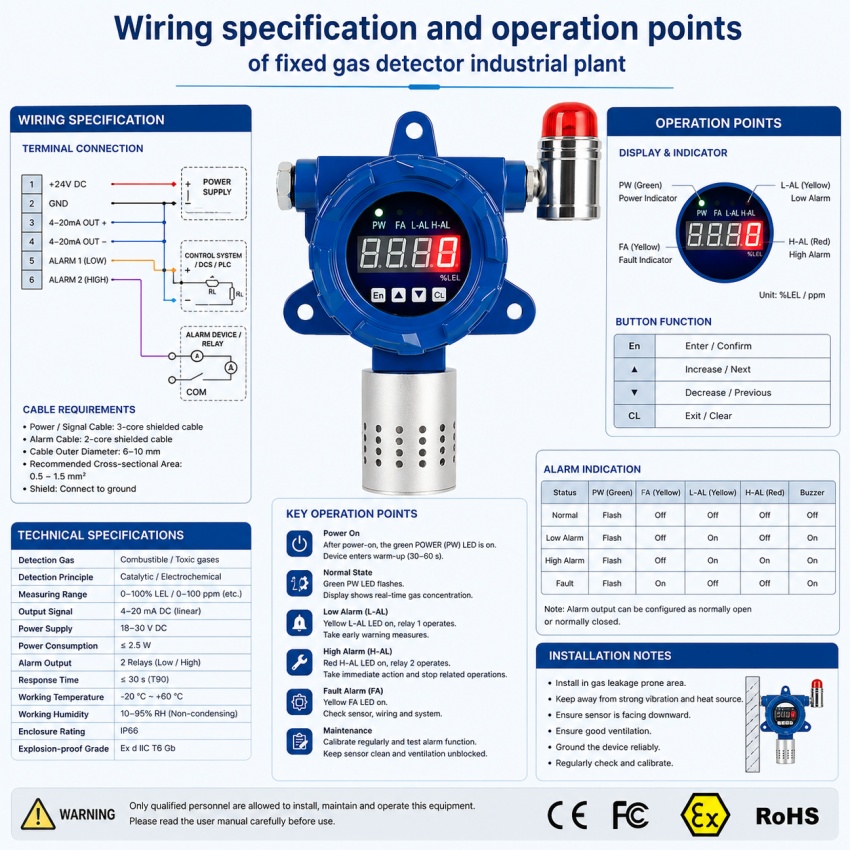
The mainstream of market detectors is divided into three-wire system and four-wire system. Three-wire system is mostly used for 4-20MA analog signal transmission, which is the positive pole of power supply, the signal terminal and the public negative pole respectively, and needs to be connected to the 24V, MA and GND terminals of alarm controller correspondingly. Four-wire system includes power line, signal line and grounding terminal, which is suitable for RS485 bus communication. Shielded cables are connected in series, and the shielding net is grounded separately to reduce signal interference. Strictly distinguish the terminal identification when wiring, and it is forbidden to connect the positive and negative electrodes reversely.
Wiring construction should abide by safety regulations. The cable passes through the explosion-proof glen head and is connected to the shell. The wound raw material belt is sealed and moisture-proof, and the terminal is pressed tightly to prevent virtual connection and looseness. The equipment shell must be reliably grounded, and the grounding resistance should not exceed 4Ω to avoid the risk of electrostatic accumulation. When wiring, avoid high temperature and strong corrosion areas, and wear explosion-proof pipes to protect cables from damage and aging.
After the wiring is completed, it needs to be debugged and finished. First, check that the wiring is correct and the casing is sealed and fastened, then turn on the power supply and preheat the equipment for 3 to 5 minutes. Use multimeter to check whether the voltage and signal are normal, and troubleshoot the line fault. It is necessary to check the terminal regularly every day to prevent oxidation looseness, ensure the long-term stable operation of the detector and build a safe defense line for industrial gas.


 WhatsApp: 8619339980364
 E-mail: contact@hirepsafety.com