
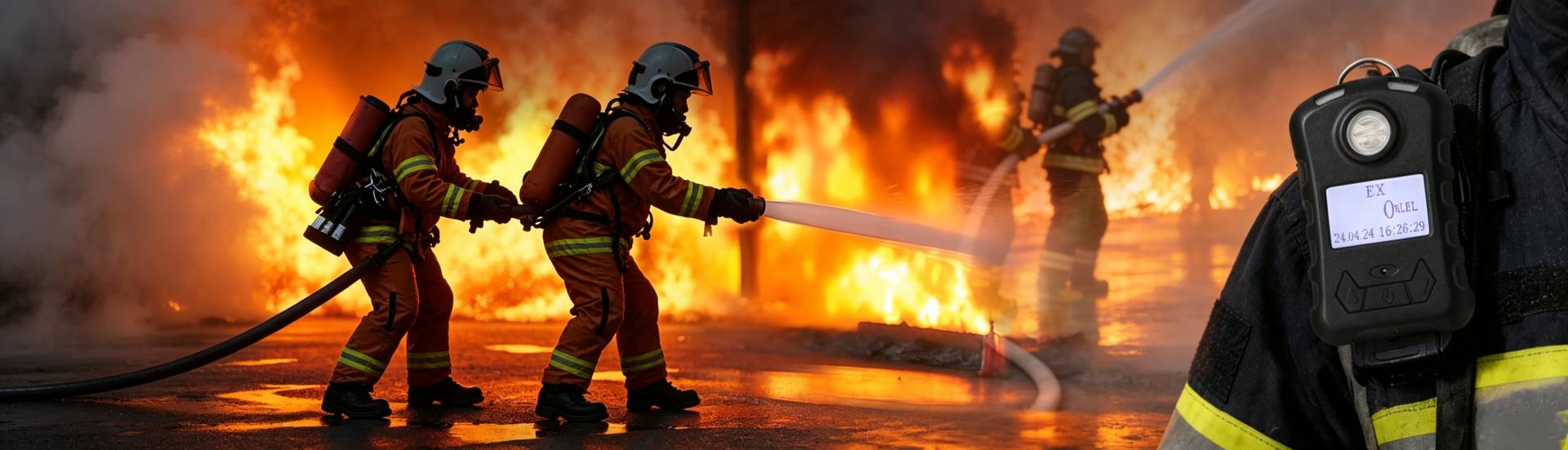
what is a safe lel level?
What LEL value is safe? Understanding the Lifeline of Combustible Gas Detection
In petrochemical industry, gas transmission and distribution, shipbuilding and even home kitchens, the word “safety” is as heavy as Mount Tai. And a key yardstick to measure this kind of safety is LEL. So, how many LEL values are safe? This is not a simple number, but a scientific early warning system.
To understand LEL, we must first understand the “limit” of combustible gas explosion. When combustible gas is mixed with air, it will not explode when it meets a fire source at any concentration. It needs a specific concentration range, which is called “explosion limit”. Among them, the lowest concentration that can cause explosion is the lower explosion limit, that is, LEL;; The highest concentration that can cause explosion is called the upper limit of explosion (UEL).
When the concentration of combustible gas is lower than LEL, it means that the gas is too “thin” to support combustion and explosion; When the concentration is higher than UEL, it means that there is insufficient oxygen and it cannot be detonated. Therefore, our safety goal is to ensure that the concentration of combustible gas in the environment is always far below LEL and avoid entering that dangerous “explosion zone”.
Since LEL is the critical point of explosion, the safety value must keep a sufficient safety distance from it. International and Chinese national standards (such as GB/T 50493 “Design Standard for Detection and Alarm of Combustible and Toxic Gases in Petrochemical Industry”) generally adopt the strategy of grading alarm, and set up two levels of alarm to build a security line.
Level 1 alarm (early warning value): ≤25% LEL
This is the first security cordon. When the detector reading reaches 25% LEL, the alarm will send out an early warning signal. This does not mean that the danger is imminent, but a clear reminder: combustible gas leakage has been detected in the environment. At this point, the operator should immediately start the investigation procedure, check whether there is any leakage point in the equipment and pipeline, and strengthen ventilation to prevent the concentration from rising further. The setting of this value reserves valuable time for manual intervention and risk elimination.
Secondary alarm (alarm value): ≤50% LEL
This is the second and last automatic security line. When the concentration climbs to 50% LEL, the situation has entered a highly dangerous state. The alarm will give a more urgent alarm, and usually start emergency measures together, such as automatically cutting off the air supply, starting the high-power exhaust system, and even triggering the emergency shutdown procedure of the whole plant. At this point, the field personnel must be evacuated immediately according to the emergency plan. 50% LEL is set as the red line, because beyond this value, the gas concentration may rapidly approach the explosion point of 100% LEL in a short time, and the time left for personnel to react will be extremely limited.
So, back to the original question: how much LEL is safe?
A generally accepted standard for safe operation is: less than 10% LEL.
Before carrying out high-risk operations such as hot work (such as welding and cutting), gas detection must be carried out in the working environment to ensure that the combustible gas concentration is lower than 10% LEL, and then a work ticket can be issued for operation. This value provides the maximum safety redundancy, ensuring that even if a small amount of gas accidentally leaks during the operation, it will not easily touch the warning line of 25% LEL.
To understand LEL, you should not only know the numerical value, but also read the units on the detector. Common units are %LEL, %VOL and ppm.
%LEL: This is the core unit, which directly reflects the explosion risk. It represents the current gas concentration as a percentage of its lower explosive limit. For example, if the lower explosive limit of methane is 5% VOL, then 100% LEL is equal to 5% vol. When the detector shows 25% LEL, it means that the actual concentration of methane is 5% × 25% = 1.25% vol.
%VOL: volume percentage, indicating the actual volume proportion of gas in air. This unit is usually used for high concentration gas detection or oxygen content detection.
Ppm: parts per million, which is used to detect extremely low concentrations of gases, especially toxic gases. 1% VOL = 10,000 ppm。
In practical work, we must correctly interpret these units according to the types and scenarios of gases detected to avoid misjudgment.
Combustible gas detection and alarm system is an “electronic sentry” to protect life and property. Understanding the meaning of LEL and keeping in mind the principle of “10% LEL below operation, 25% LEL starting early warning and 50% LEL emergency evacuation” are the basic safety literacy that every relevant employee must have. Safety is never luck, but comes from strict compliance with scientific standards and awe of potential risks.


 WhatsApp: 8619339980364
 E-mail: contact@hirepsafety.com